Pronto Xi: Features, Benefits, Cost and ERP Evaluation Guide
A comprehensive guide to Pronto Xi ERP, covering its features, deployment options, pricing, implementation considerations, and suitability for Australian businesses.
Pronto Xi is a modular enterprise resource planning and analytics platform developed by Australian software company Pronto Software. It connects financial management with operational functions such as distribution, inventory, warehousing, manufacturing, payroll, assets, service, retail and reporting. It is primarily evaluated by mid-market and larger organisations that have outgrown entry-level accounting software and need better control across several business functions.
Whether Pronto Xi is suitable depends on the modules proposed, operational complexity, implementation partner, integrations, internal skills and five-year commercial model.
Pronto Xi at a glance
| Attribute | Summary |
|---|---|
| Product | Pronto Xi |
| Vendor | Pronto Software |
| Category | Enterprise resource planning and analytics |
| Typical market | Mid-market and larger operational organisations |
| Deployment | SaaS, hosted or on-premises |
| Core areas | Finance, distribution, supply chain, payroll, manufacturing, assets, service, retail and CRM |
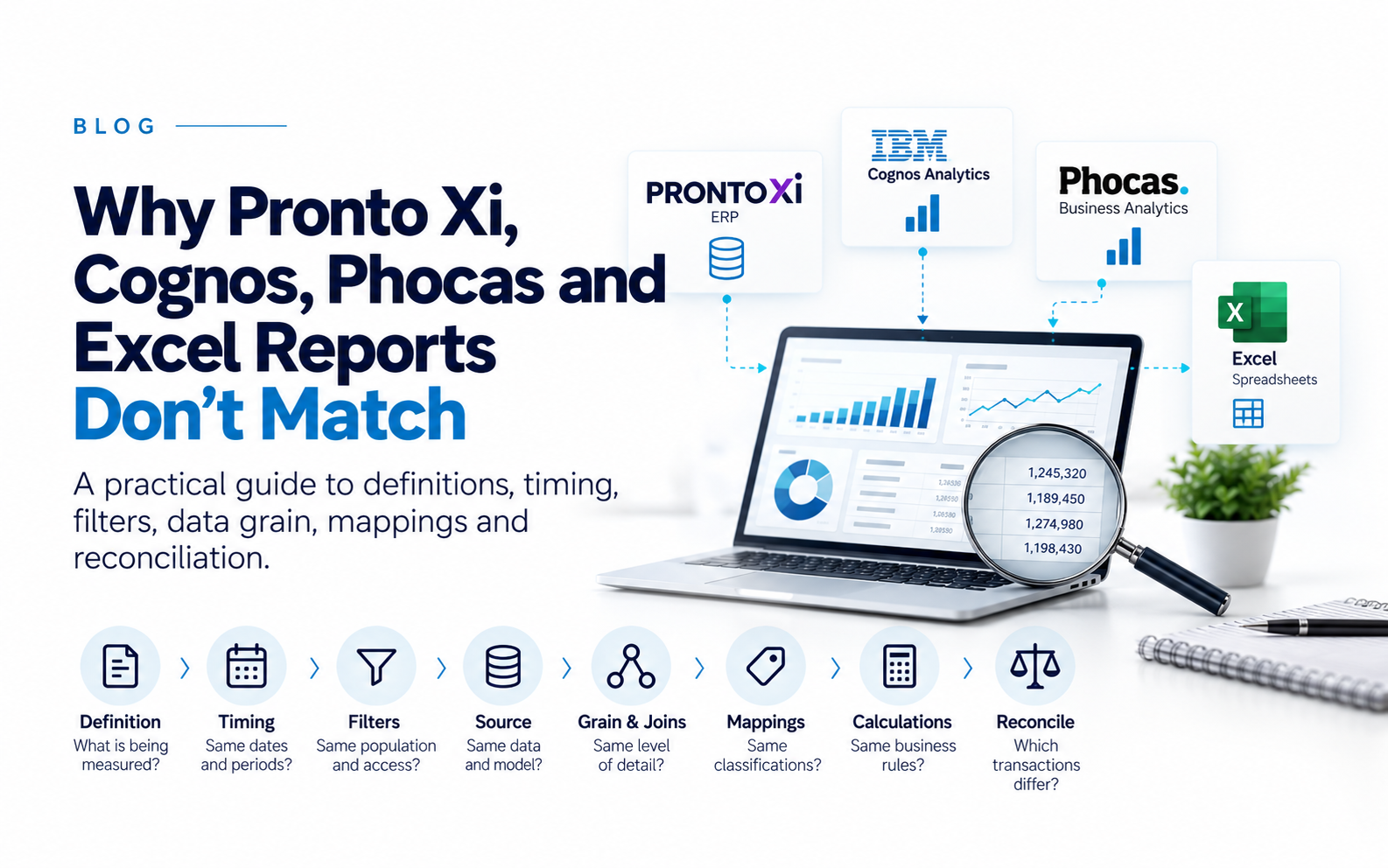
| Reporting | Embedded integration with IBM Cognos Analytics |
| Integration | Pronto Connect APIs, web services and development tools |
| Pricing | Custom quote based on modules, users, deployment and implementation |
| Potential fit | Australian organisations with complex operational, inventory, manufacturing, payroll or asset requirements |
What is Pronto Xi used for?
Pronto Xi ERP is used to manage financial and operational processes through a connected set of applications.
Its purpose is not merely to replace accounting software. A Pronto Xi implementation may bring together information from finance, sales, purchasing, warehouses, production, payroll, assets and service operations so that transactions and reporting are managed within a common environment.
Pronto publishes applications covering:
- financial management;
- sales, purchasing and inventory;
- supply-chain planning and warehousing;
- payroll and resource management;
- manufacturing;
- asset and facility management;
- projects and service;
- retail and CRM; and
- business intelligence.
The product is modular, so the final solution depends on what the organisation licenses and implements. Buyers should not assume that every published Pronto Xi feature is included in a standard proposal.
Who is Pronto Xi designed for?
Pronto Xi is most relevant to organisations whose requirements extend beyond general ledger, invoicing and basic stock control.
It may warrant evaluation where a business must coordinate several of the following:
- multiple warehouses, stores or operating locations;
- complex inventory and purchasing;
- wholesale or distribution processes;
- production planning and manufacturing;
- Australian payroll;
- asset maintenance or rental;
- field-service operations;
- projects and resource scheduling;
- retail or point-of-sale activity; and
- operational and financial reporting.
Pronto and IBM position the platform for mid-market and growing organisations across industries including distribution, manufacturing, mining, retail and services. IBM also states that information in its Partner Plus directory is supplied by the solution provider and is not independently validated, so the listing should be treated as published positioning rather than independent proof of performance.
Technographic databases also indicate use across industries such as distribution, manufacturing, mining, retail and government. However, individual customer records should be independently verified before they are used as evidence in an ERP selection.
What are the main Pronto Xi features and modules?
The most important Pronto Xi features are best considered by business outcome rather than module count.
| Business area | Published capability | What a buyer should test |
|---|---|---|
| Financials | General ledger, receivables, payables, fixed assets, multiple companies, currencies, budgets and cost centres | Can finance complete the real month-end process and management pack? |
| Distribution | Inventory, purchasing, sales orders, pricing, replenishment and landed-cost processes | Can it manage actual order volumes, pricing rules and fulfilment exceptions? |
| Supply chain and WMS | Forecasting, bins, put-away, wave picking, replenishment, scanning, packing and dispatch | Which applications are included, and can they handle warehouse complexity? |
| Manufacturing | MPS, MRP, capacity planning, scheduling, work orders, shopfloor, costing and quality | Can it demonstrate shortages, rework and rescheduling using representative data? |
| Payroll and resources | Australian payroll, employee data, leave, timesheets, rostering and resource scheduling | Can it support real awards, agreements, STP and payroll-to-ledger processing? |
| Assets and service | Assets, maintenance, service calls, projects, rental and equipment history | Does it support the full service or asset lifecycle? |
| Analytics | IBM Cognos Analytics, dashboards, reporting and scheduled distribution | Can internal users create and maintain the required reports? |
| Integration | APIs, web services, webhooks and development tools | How are failures detected, retried and supported? |
Pronto publishes multiple-company and multi-currency financial functionality, extensive supply-chain applications, Australian payroll and resource management, manufacturing, asset management and integrated Cognos reporting. The exact release and commercial scope should still be confirmed in writing.
Why is Pronto Xi considered for wholesale distribution?
Organisations searching for the best ERP for wholesale distribution should compare the systems against their actual order, inventory and warehouse model.
Pronto Xi’s published distribution and supply-chain coverage includes inventory visibility, purchasing, sales orders, replenishment, forecasting, warehouse management, picking, packing, dispatch and EDI-related processes.
For a suitable distributor, potential Pronto Xi benefits may include:
- clearer stock visibility across locations;
- tighter purchasing and replenishment controls;
- less rekeying between orders, inventory and finance;
- improved tracking of landed costs and margins;
- more consistent pricing and fulfilment;
- better exception reporting; and
- closer alignment between warehouse activity and financial outcomes.
These results are not automatic. Buyers should test difficult scenarios such as partial deliveries, backorders, substitutions, customer-specific pricing, overseas shipments, returns, stock discrepancies and integration failures.
How does Pronto Xi support manufacturing and asset-intensive businesses?
Pronto Xi Manufacturing publishes functionality across production planning, MPS, MRP, distribution and capacity planning, work orders, scheduling, shopfloor activity, costing and quality management.
This may suit manufacturers that need production to connect with:
- inventory and purchasing;
- warehousing;
- customer demand;
- labour and resources;
- product costing;
- quality control; and
- financial reporting.
Pronto Xi also publishes asset, maintenance, project, rental and service applications. These may be relevant to mining, equipment, facilities, field-service and other asset-intensive organisations that need to connect maintenance work, labour, parts, contracts and financial outcomes.
Manufacturers and asset-intensive buyers should require demonstrations of material shortages, production changes, scrap, rework, quality holds, preventive maintenance, breakdown work, warranty claims and equipment history.
Is Pronto Xi cloud-based?
Pronto Xi is available through SaaS, hosted and on-premises deployment models.
Pronto Software publishes all three options, allowing organisations to choose a model based on infrastructure strategy, internal capability and control requirements.
The deployment label alone is not enough. Buyers should confirm:
- where data will be located;
- who manages infrastructure and security;
- backup and disaster-recovery commitments;
- availability and recovery targets;
- upgrade responsibilities;
- test environments;
- support boundaries;
- data-extraction rights; and
- termination assistance.
Cloud delivery may reduce internal infrastructure responsibilities. On-premises or hosted deployment may offer different levels of control. Neither model is automatically safer, cheaper or more suitable.
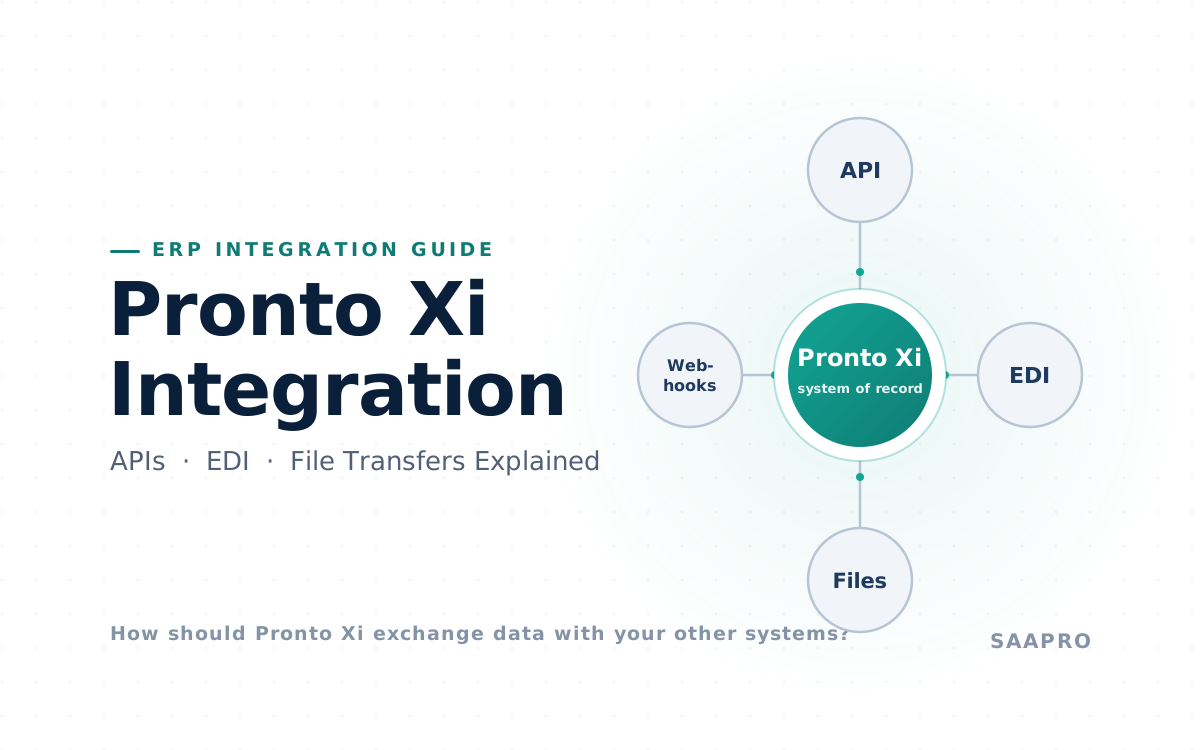
How does Pronto Xi integrate with other systems?
Pronto Connect is Pronto Xi’s published API and integration platform. It uses web-services architecture to connect Pronto Xi with external applications and platforms. Pronto also publishes developer tools, an SDK and customisation capabilities.
Potential integrations may include ecommerce, logistics, banking, CRM, data platforms, mobile applications and specialist operational systems.
However, API availability does not make an integration automatically reliable. The design should define:
- the system of record for each data object;
- real-time versus scheduled transactions;
- authentication and access;
- error monitoring and alerts;
- safe transaction retries;
- version control;
- regression testing;
- ownership of custom code; and
- full data extraction.
Custom integration should be treated as a continuing operational responsibility, not merely an implementation task.
How is Pronto Xi implemented?
Pronto Software’s published implementation approach covers project management, activation and customisation, data conversion, training, testing, business simulations and preparation for go-live.
Implementation duration cannot be estimated reliably from the product name alone. It depends on factors such as:
- number of modules and entities;
- data quality and migration volume;
- integrations;
- customisation;
- payroll complexity;
- reporting requirements;
- testing;
- user availability; and
- organisational readiness.
Before starting, buyers should clarify which processes will use standard functionality, which require configuration, where custom development is proposed and who will support the solution after go-live.
A phased implementation can reduce organisational pressure, but poor sequencing can also create temporary interfaces, duplicate work and prolonged dependence on spreadsheets.
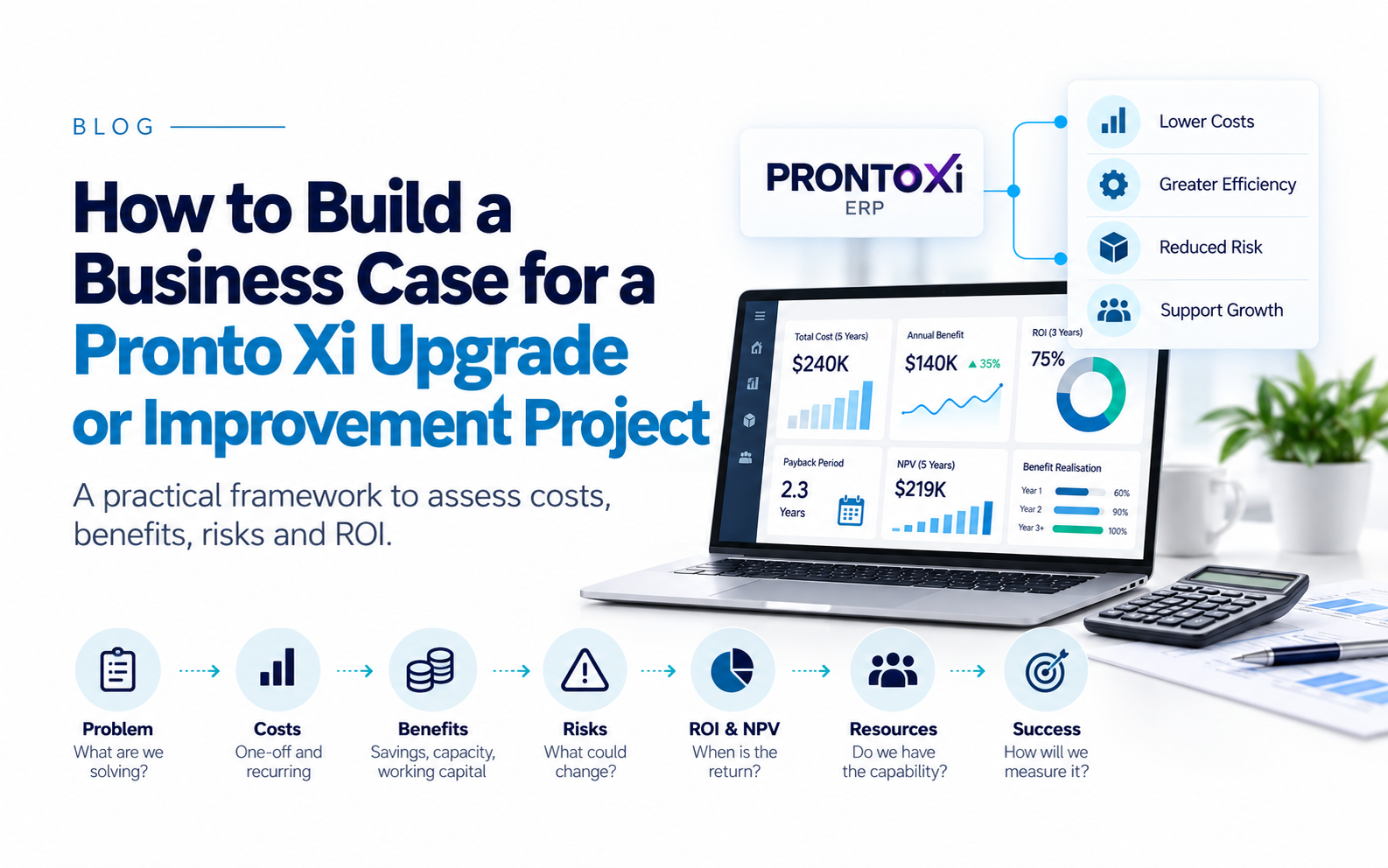
How much does Pronto Xi cost?
Pronto Xi does not have a meaningful public list price for a complete implementation. Public product profiles describe a modular, custom-quote model influenced by selected applications, users and implementation requirements.
A five-year cost comparison should include:
- software licences or subscriptions;
- required Pronto Xi modules;
- SaaS, hosting or infrastructure;
- implementation services;
- data migration;
- integrations;
- customisation;
- Cognos reporting and analytics;
- payroll;
- training;
- test environments;
- support;
- upgrades;
- internal project resources; and
- specialist recruitment or contracting.
A lower initial proposal may become the more expensive option if the business needs several additional modules, custom development or continuing specialist support.
What do public Pronto Xi reviews indicate?
Public Pronto Xi review evidence is too sparse and inconsistent to support a reliable product-quality benchmark.
Capterra, Gartner Peer Insights and Software Connect contain only small numbers of reviews, with materially different ratings and experiences. Gartner also states that Peer Insights reviews represent individual users’ opinions rather than Gartner endorsements or statements of fact.
Reported positive themes include:
- broad operational functionality;
- modularity;
- inventory and distribution capability;
- helpful support in some experiences; and
- specialist functions such as rental and maintenance.
Reported concerns include:
- user experience;
- navigation;
- payroll workflows;
- additional module costs;
- consultant dependency;
- localisation outside Australia; and
- particular functional gaps.
Some reviews relate to older implementations or versions and may not represent the currently proposed solution.
Use public reviews to develop questions, not to select or reject the product. More reliable evidence will come from:
- configured demonstrations;
- references from comparable organisations;
- implementation-partner capability;
- contractual scope; and
- proof-of-concept testing.
How does Pronto Xi compare with competitors?
The right Pronto Xi vs competitors comparison depends on the buyer’s operating priorities.
| Buyer priority | Alternative category to evaluate |
|---|---|
| Global multi-entity cloud standardisation | Global cloud ERP |
| Microsoft ecosystem alignment | Microsoft-centred ERP |
| Construction and project operations | Project-led cloud ERP |
| Complex manufacturing | Manufacturing-focused ERP |
| Simpler finance and inventory | Lower-complexity mid-market ERP |
| Global SAP architecture | SAP-aligned ERP |
| Broad Australian operational requirements | Pronto Xi and comparable localised ERP platforms |
Pronto Xi may deserve closer consideration where Australian payroll, wholesale distribution, manufacturing, assets or service are material and suitable Pronto expertise is available.
Alternatives may deserve greater consideration where international localisation, global cloud standardisation or alignment with an existing Microsoft, Oracle or SAP architecture dominates the requirement.
When might Pronto Xi be a poor fit?
Pronto Xi may warrant additional caution where:
- the business only needs simple finance and inventory;
- international localisation dominates the requirement;
- the organisation mandates another technology ecosystem;
- sufficient Pronto functional or technical expertise is unavailable;
- the proposed solution depends on extensive proprietary customisation;
- several optional modules make five-year costs unattractive; or
- users reject the demonstrated workflows or interface.
These are investigation triggers, not universal product weaknesses.
Is Pronto Xi the right ERP for your business?
Pronto Xi is a credible ERP and analytics option for operationally complex Australian organisations, particularly those managing distribution, warehousing, manufacturing, payroll, assets or service.
Its potential value comes from connecting operational processes with finance and reporting. Its suitability depends on the exact modules, deployment, integrations, implementation team and internal capability—not on the product name alone.
Before selecting Pronto Xi, require:
- a contractual list of included and optional applications;
- demonstrations of difficult end-to-end processes;
- a documented integration and data architecture;
- comparable customer references;
- a five-year commercial model;
- clear upgrade and support responsibilities; and
- an assessment of the Pronto skills required after go-live.
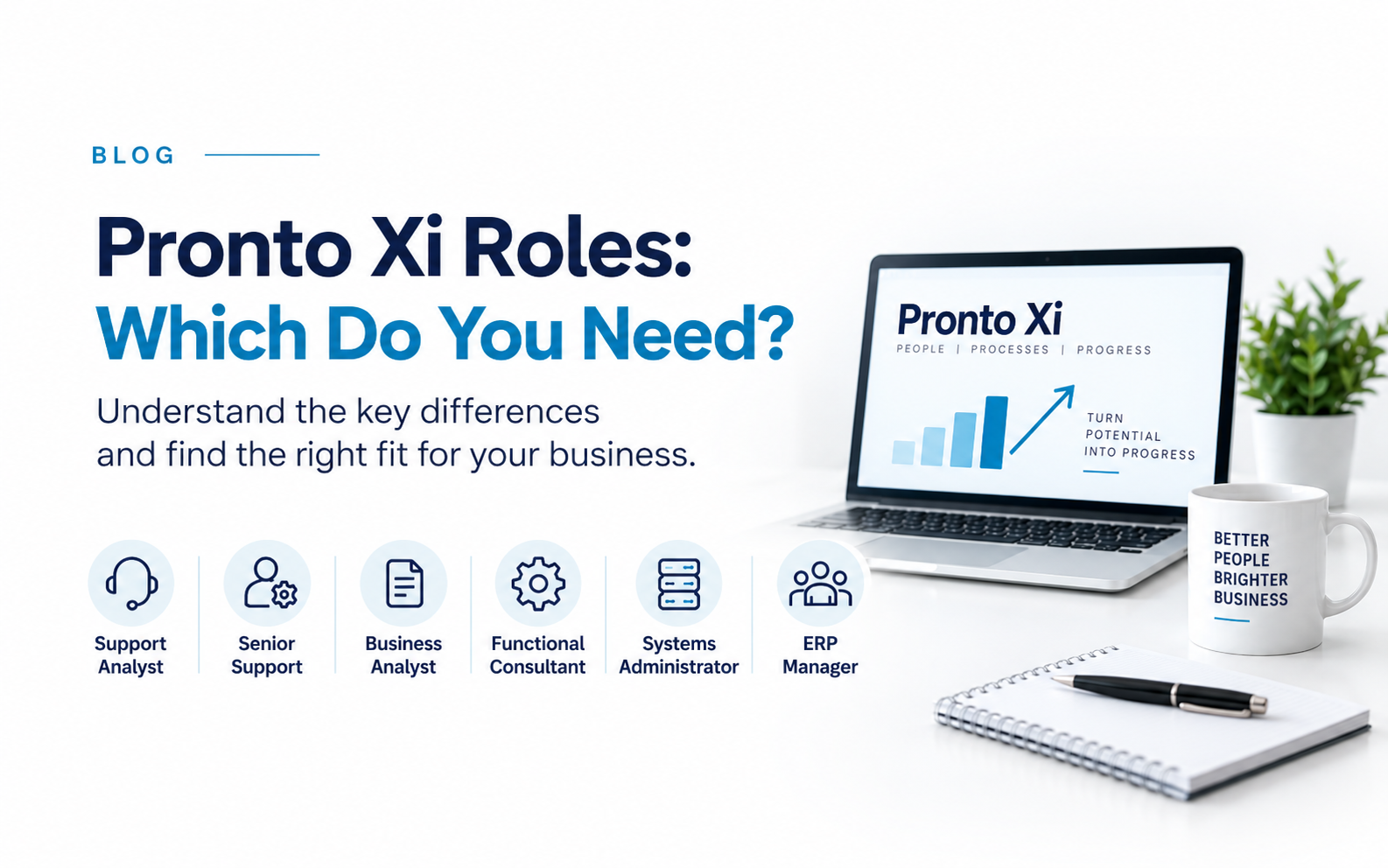
If Pronto Xi is on your shortlist, SAAPRO can help assess whether the functional, technical, payroll, reporting and systems-leadership capability required to support the platform is available in the Australian market.
Disclosure: SAAPRO is an independent Pronto Xi recruitment specialist. This article does not constitute a product endorsement.