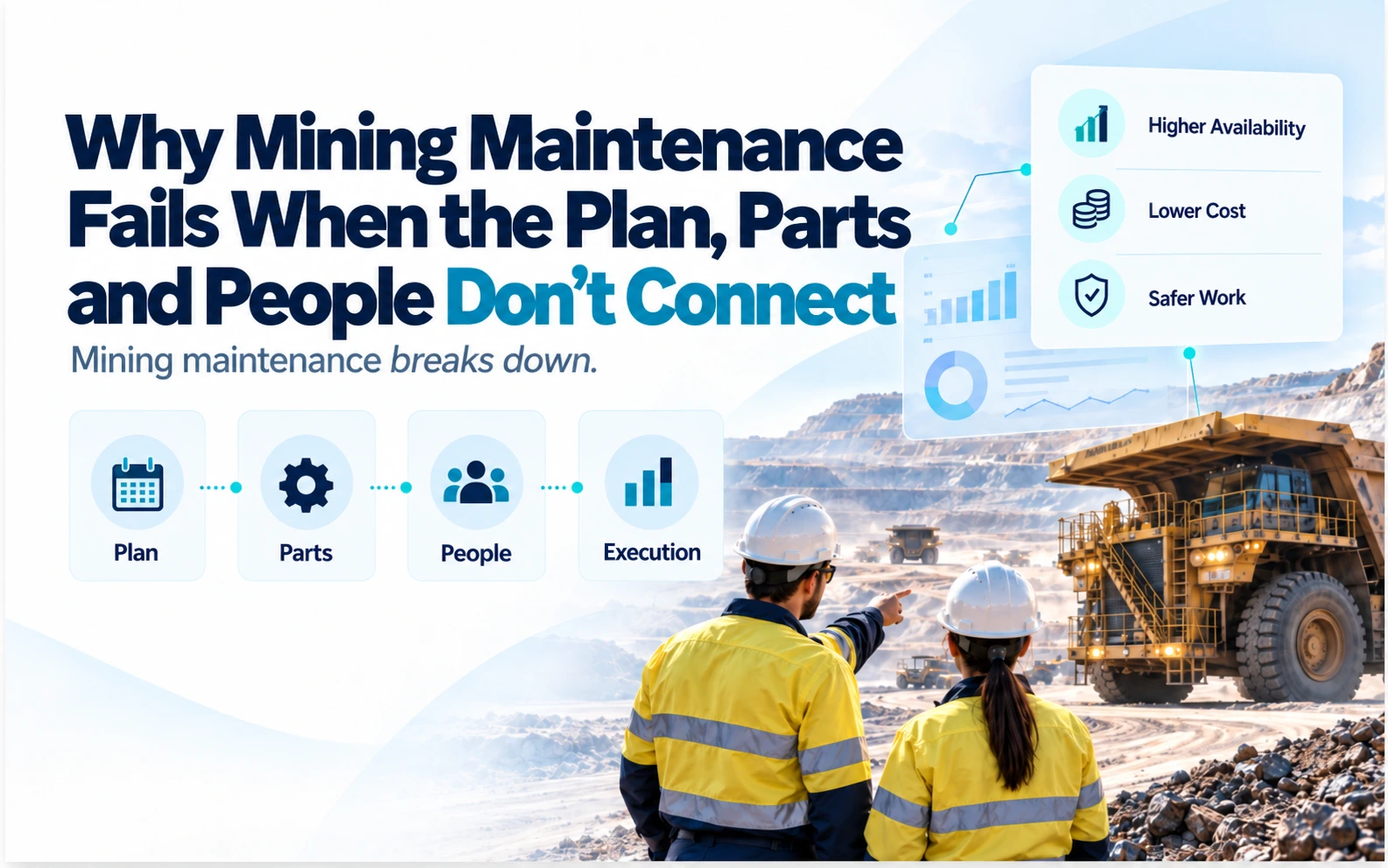
Why Mining Maintenance Fails When the Plan, Parts and People Don't Connect
An examination of why mining maintenance plans break down when planning, parts, people, and budget aren't connected, and how integrated ERP systems like Pronto Xi can close that gap.
A CMMS can tell maintenance what work is due.
The harder question is:
Are the parts, people and budget available to actually do it?
That's where many mining operations get exposed.
A shutdown plan can look fine on paper, but if:
- a critical component has an eight-week lead time;
- the fitter is already committed elsewhere;
- procurement hasn't been given enough notice; or
- the maintenance budget is already under pressure,
then the plan is not really executable.
The issue is rarely lack of data.
It's that mine planning, maintenance, inventory, procurement and finance are working from different versions of the truth.
Where Pronto Xi Becomes Interesting
Pronto Xi's Maintenance Management and Asset & Facility Management capabilities can perform many of the functions mining companies associate with a CMMS or EAM.
The more important point is that maintenance can operate against the same inventory, purchasing, resource and financial information used elsewhere in the ERP.
That creates a tighter operating loop:
Mine plan → maintenance demand → parts requirement → procurement → labour → cost → reporting
When one changes, the others can be affected.
That matters because a maintenance plan is only useful if the organisation is actually ready to execute it.
What Integrated Maintenance Can Improve
1. Parts Readiness
Planners can assess whether critical components are:
- in stock;
- already allocated;
- repairable or rotatable;
- on purchase order; or
- exposed to a long supplier lead time.
That gives procurement more time to act before a planned job becomes an emergency order.
2. Resource Readiness
Maintenance is constrained by more than parts.
It is also constrained by:
- trades;
- contractors;
- workshops;
- shutdown windows; and
- competing priorities.
Connecting work requirements with resource planning helps identify those constraints earlier.
3. Cost Visibility
For CFOs and COOs, the bigger question is often:
What is this asset actually costing us to keep running?
Connecting work orders, labour, parts, purchasing and finance creates a better basis for decisions about:
- repair versus replacement;
- maintenance strategy;
- asset lifecycle cost;
- contractor use; and
- budget forecasts.
A Simple Test for Any Mining ERP or CMMS
Don't ask for a standard demo.
Give the vendor this scenario:
A critical asset has a planned shutdown in four weeks. A required component now has an eight-week lead time.
Then ask:
- What work is due?
- What parts are required?
- What is available now?
- What is already committed elsewhere?
- What needs to be purchased?
- Which resources are available?
- What is the expected cost?
- What other work is competing for the same labour or parts?
- How does the delay affect the maintenance plan?
- What happens to the cost forecast?
If the system can't help answer those questions quickly, the integration may not be delivering much operational value.
The Bigger Point
The real advantage is not simply having maintenance functionality inside an ERP.
It is reducing the gap between:
what the mine plans to do
and
what the organisation is actually equipped to execute.
For mining companies evaluating Pronto Xi, that is the more important question:
Can maintenance, inventory, procurement, resources and finance work from the same operational picture before equipment stops?
Match the support to the work
If maintenance plans keep failing on parts or labour, look for Pronto Xi functional capability across maintenance, inventory and purchasing. If the gap is cost visibility, look for finance and reporting capability that connects work orders to asset costs. See SAAPRO's guide to Pronto Xi roles.
Talk to SAAPRO about the Pronto skills needed to connect maintenance planning with execution. Bring a recent shutdown plan, where it broke down, and the decisions your team needs to make.
#ProntoXi #MiningMaintenance #CMMS #EAM #MiningERP #AssetManagement #MaintenancePlanning #MiningTechnology
Frequently Asked Questions
A CMMS can identify scheduled work, but it often doesn't confirm whether the parts, labour, and budget needed to execute that work are actually available, which is where plans break down.
The disconnect usually happens because mine planning, maintenance, inventory, procurement, and finance teams operate from separate systems or data sets rather than a shared operational picture.
Pronto Xi connects maintenance management with inventory, purchasing, resource, and financial data within the same ERP, allowing planners to assess parts and resource readiness before a shutdown occurs.
Parts readiness means knowing whether critical components are in stock, allocated, repairable, on order, or exposed to long supplier lead times, so procurement can act early.
Companies can present a real scenario, such as a shutdown in four weeks with a component that has an eight-week lead time, and ask the vendor how the system identifies constraints, costs, and competing priorities.
Connecting work orders, labour, parts, and finance data helps leadership make informed decisions on repair versus replacement, contractor use, and budget forecasting.
Key Takeaways
- ✓A maintenance plan can look complete on paper but still fail without available parts, labour, or budget.
- ✓The real problem is disconnected data across planning, maintenance, procurement, and finance teams.
- ✓Pronto Xi connects maintenance to shared inventory, purchasing, and financial data across the ERP.
- ✓Assessing parts readiness early helps prevent emergency orders and delays.
- ✓Connected cost data supports better repair-vs-replace and budget decisions.
- ✓A simple shutdown scenario test reveals whether a system delivers real operational value.
- ✓The goal is closing the gap between what's planned and what can actually be executed.