
Pronto Xi CMMS
An overview of Pronto Xi's CMMS-style Maintenance Management capabilities, how they integrate with the wider ERP, and what buyers should evaluate before choosing it over a standalone CMMS or EAM.
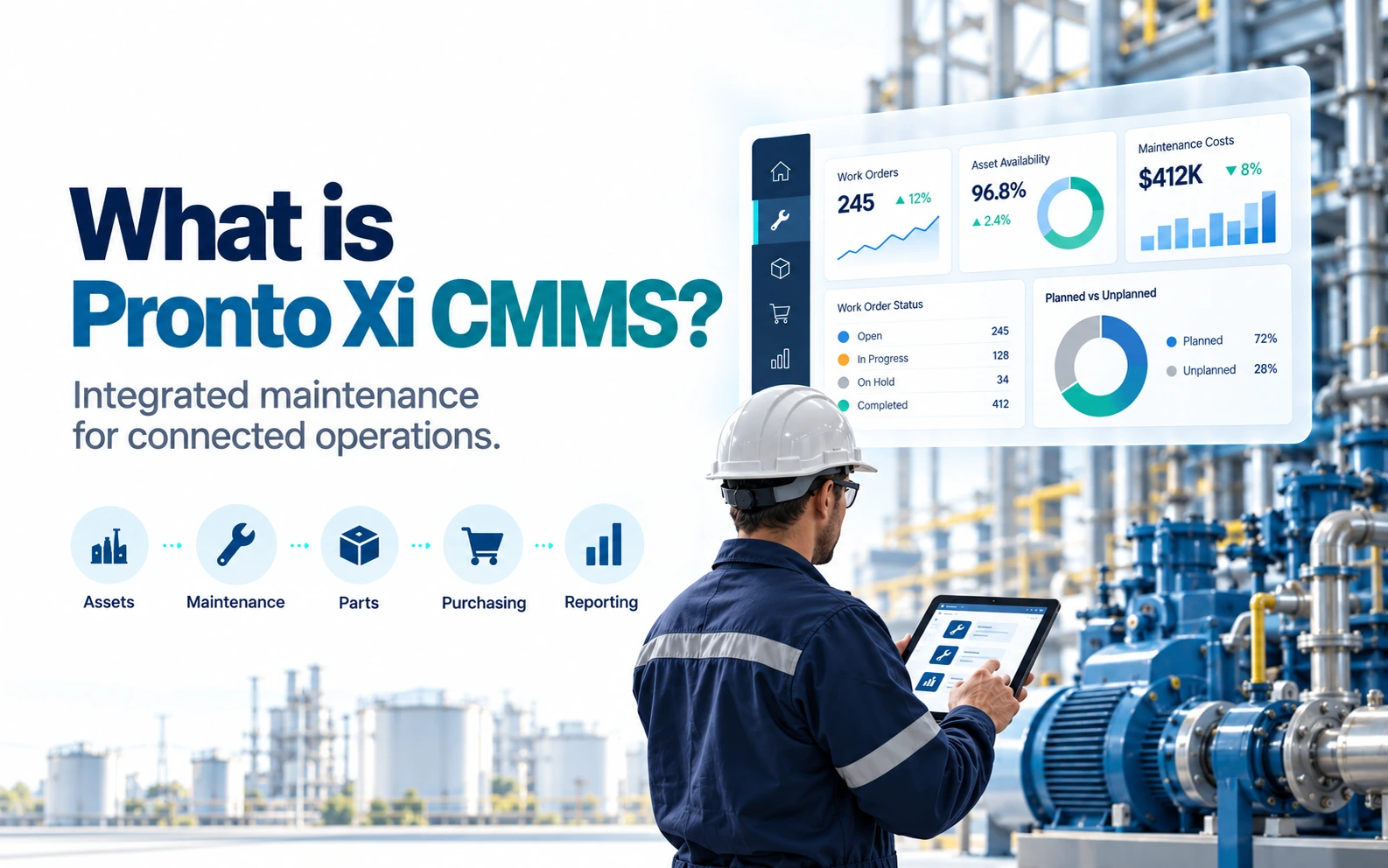
Pronto Xi CMMS refers to the maintenance-management capabilities within Pronto Xi's Asset & Facility Management suite. Pronto Software calls the application Maintenance Management, but it performs many functions commonly associated with a Computerised Maintenance Management System (CMMS) or Enterprise Asset Management (EAM) system.
Its practical value is not just maintenance scheduling. It is the ability to connect maintenance activity with inventory, purchasing, resources, assets and financial information inside the wider Pronto Xi ERP environment.
What Does Pronto Xi Maintenance Management Do?
Pronto Xi Maintenance Management is designed to support planned, preventive and reactive maintenance across the maintenance work-order lifecycle.
Published capabilities include:
- Work planning and scheduling: Create, prioritise, schedule and complete maintenance work orders.
- Parts and procurement: Identify spare-parts requirements, check availability and connect maintenance demand with purchasing.
- Resources and labour: Allocate employees, contractors, equipment and other resources to maintenance work.
- Asset history and analysis: Record work performed, downtime, meter readings, costs and maintenance history.
Pronto also publishes functionality for repairable and rotatable components, maintenance forecasting and work-order analytics within its broader Asset & Facility Management environment.
How Does Pronto Xi CMMS Integrate With Pronto Xi ERP?
The key distinction is that maintenance does not have to operate as a separate application.
When Maintenance Management is used with relevant Pronto Xi modules, maintenance can connect with:
Asset → Work order → Labour → Spare parts → Purchasing → Cost → Reporting
For example, a maintenance planner can potentially see whether:
- required parts are available;
- items are already committed elsewhere;
- components need repair or replacement;
- purchase orders are outstanding;
- labour or other resources are available; and
- the expected maintenance cost is within budget.
This integration can reduce the need to maintain a separate CMMS plus multiple interfaces between maintenance, inventory, procurement and finance.
The actual benefit depends on the modules licensed, configuration quality and operating processes.
Is Pronto Xi Maintenance Management Included in Standard Pronto Xi?
It should not be assumed to be included in every Pronto Xi implementation.
Pronto Xi is modular, so buyers should confirm whether the proposed solution includes:
- Maintenance Management;
- Resource Scheduler;
- mobile maintenance functionality;
- Inventory and Purchasing integration;
- asset-related modules; and
- reporting or analytics components.
The commercial proposal should clearly identify what is included, optional, customised or delivered through another product.
Who Is Pronto Xi CMMS Suited To?
Pronto Xi Maintenance Management may be particularly relevant to organisations with high-value or business-critical assets, including:
- mining and resources;
- manufacturing;
- transport and logistics;
- equipment and machinery;
- facilities management;
- field service;
- rental operations; and
- other asset-intensive industries.
These organisations often need to coordinate maintenance schedules with spare-parts availability, procurement lead times, technicians, contractors, equipment availability and budgets.
How Is Pronto Xi Different From a Standalone CMMS or EAM?
A standalone CMMS or specialist EAM can provide deeper asset-management capability in some environments.
Pronto Xi Maintenance Management's potential advantage is its connection with the wider ERP.
That can make it easier to align maintenance activity with:
- inventory;
- purchasing;
- labour;
- finance;
- asset costs; and
- operational reporting.
However, Pronto Xi Maintenance Management should not automatically be assumed to provide the same depth as a specialist enterprise EAM platform.
Organisations with advanced requirements should validate areas such as:
- reliability engineering;
- condition monitoring;
- IoT or sensor integration;
- linear assets;
- complex shutdown or turnaround planning;
- advanced mobile inspections;
- asset-performance analytics; and
- enterprise-wide asset governance across multiple systems.
When Might a Standalone CMMS or EAM Be a Better Fit?
A specialist CMMS or EAM may warrant greater consideration where:
- advanced reliability engineering is central;
- condition-based or predictive maintenance is a major requirement;
- shutdown and turnaround planning is highly complex;
- the organisation manages sophisticated linear or network assets;
- maintenance spans several ERP platforms;
- specialised mobile inspection capability is required; or
- the proposed Pronto Xi modules would require significant customisation.
These are evaluation triggers, not universal weaknesses of Pronto Xi.
What Should Buyers Validate?
A good demonstration should test a realistic maintenance problem.
For example:
A critical asset has planned maintenance in four weeks, but an essential component now has an eight-week supplier lead time.
The system should help users determine:
- what work is due;
- which parts and labour are required;
- what inventory is available;
- what is already committed elsewhere;
- what needs to be purchased;
- which resources are available;
- the expected maintenance cost; and
- how the shortage affects the work schedule.
That is more useful than simply asking whether the system has work orders or preventive maintenance.
The Key Takeaway
The important question is not simply:
"Does Pronto Xi have a CMMS?"
It is:
"Can Pronto Xi connect maintenance demand with the parts, procurement, labour, asset and financial information required to execute the work effectively?"
For asset-intensive organisations, that integration can be more valuable than maintenance functionality in isolation.
Match the support to the work
If you need to test Maintenance Management against your own scenarios, look for Pronto Xi functional capability across maintenance, inventory and purchasing. If assets, parts and costs must connect across modules or other systems, look for Pronto integration capability. See SAAPRO's guide to Pronto Xi roles.
Talk to SAAPRO about the Pronto skills needed to evaluate or run maintenance in Pronto Xi. Bring your critical assets, your current maintenance system and the decisions you need to make.
Frequently Asked Questions
Pronto Xi CMMS refers to the maintenance-management capabilities within Pronto Xi's Asset & Facility Management suite, officially called Maintenance Management, which performs many functions typical of a CMMS or EAM system.
It supports planned, preventive and reactive maintenance, including work order scheduling, spare-parts and procurement tracking, resource and labour allocation, and asset history and cost analysis.
It connects the maintenance work-order lifecycle with inventory, purchasing, labour, asset data, and financial reporting, so maintenance decisions are based on the same operational information used elsewhere in the business.
No. Pronto Xi is modular, so buyers should confirm whether Maintenance Management, Resource Scheduler, mobile functionality, and related modules are included in their specific proposal.
It's particularly relevant for asset-intensive industries such as mining, manufacturing, transport, equipment and machinery, facilities management, field service, and rental operations.
Pronto Xi's advantage is its native connection to the wider ERP, but a standalone CMMS or EAM may offer greater depth in areas like reliability engineering, condition monitoring, IoT integration, and complex shutdown planning.
When advanced reliability engineering, predictive maintenance, complex turnaround planning, multi-ERP environments, or heavy customisation needs are central to the maintenance strategy.
Buyers should present a realistic scenario, such as a shutdown in four weeks with a component on an eight-week lead time, and evaluate how well the system identifies parts, labour, cost, and schedule impacts.
Key Takeaways
- ✓Pronto Xi CMMS is the Maintenance Management module within Pronto Xi's Asset & Facility Management suite.
- ✓Its core value lies in connecting maintenance with inventory, purchasing, labour, and financial data across the ERP.
- ✓Maintenance Management is not automatically included, buyers must confirm which modules are licensed.
- ✓It's best suited to asset-intensive industries like mining, manufacturing, and logistics.
- ✓Compared to standalone CMMS/EAM platforms, Pronto Xi trades some specialist depth for tighter ERP integration.
- ✓Advanced needs like predictive maintenance or complex turnarounds may still require a specialist system.
- ✓A realistic shutdown scenario test is a better evaluation method than a standard feature demo.
- ✓The key question is whether Pronto Xi can connect maintenance demand to the resources needed to execute it, not just whether it has CMMS features.