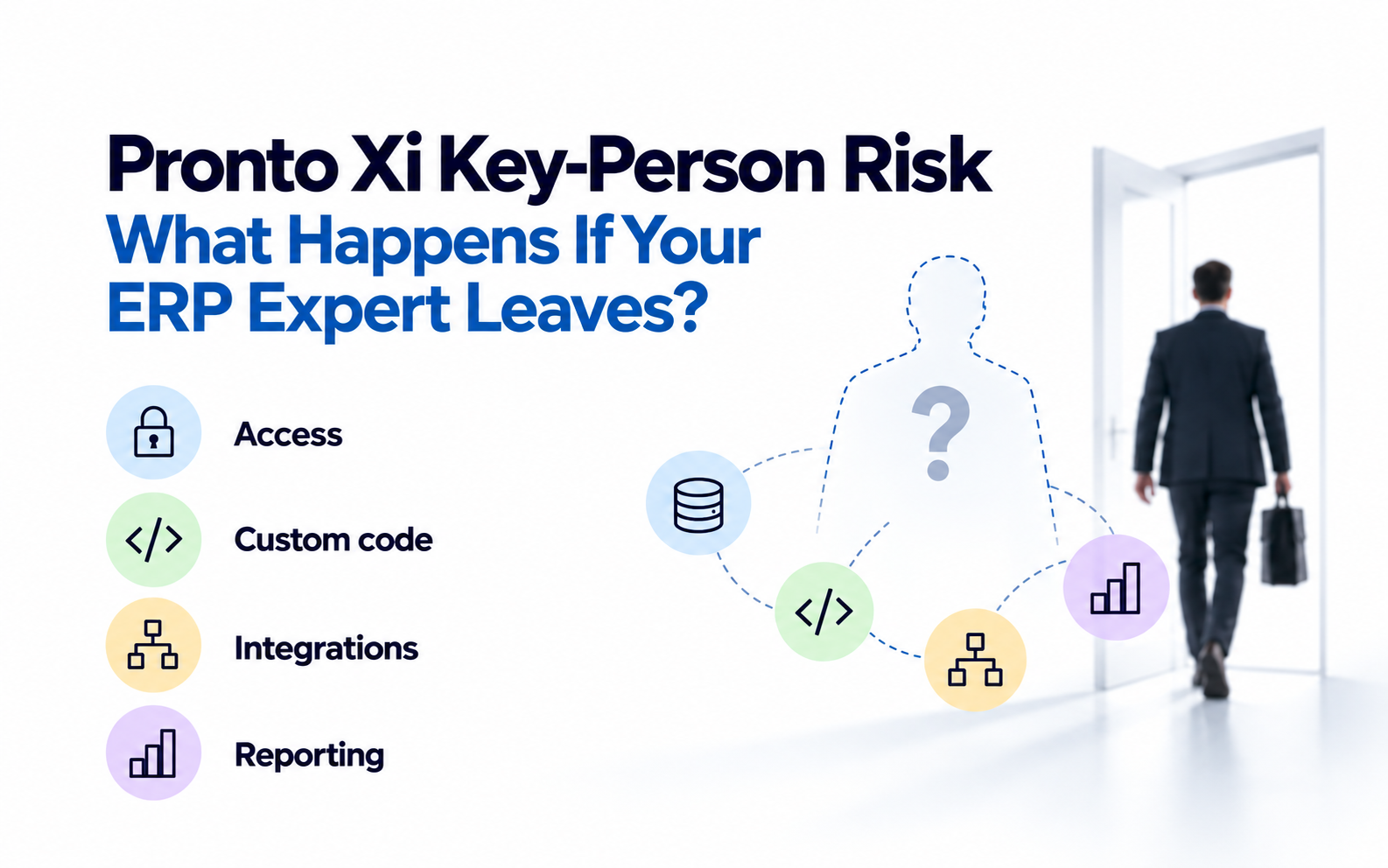
Pronto Xi Key-Person Risk: What Happens If Your ERP Expert Leaves?
An executive guide to identifying and reducing Pronto Xi key-person risk across access, customisations, integrations, Cognos reporting and handover, before one departure disrupts your ERP.
How dependent is your Pronto Xi environment on one person?
Pronto Xi key-person risk exists when an employee, contractor or external consultant holds knowledge, access or capability that the organisation needs to operate, support or change its ERP environment, and there is no credible substitute.
A quick diagnostic is to ask whether somebody else could, today:
- access the critical Pronto Xi environment and support systems;
- diagnose and recover a failed integration;
- explain the most important customisations;
- maintain a critical Cognos or management report; and
- support month-end, payroll or another business-critical process.
If several answers are no, the organisation probably has material ERP dependency.
The more useful executive question is therefore not simply:
How dependent are we on one person?
It is:
If that person disappeared tomorrow, what capability would disappear with them, and how long would it take us to recover it?
Why does Pronto Xi key-person risk matter to ERP ROI?
ERP ROI depends on more than whether the software works.
The organisation also needs the capability to operate, support, troubleshoot and improve it over time.
Pronto Xi can span finance, distribution, inventory, supply chain, manufacturing, payroll, assets, service, reporting and integrations. In some organisations, years of implementation decisions, custom development and workarounds gradually become concentrated in a small number of people.
That can increase the cost of maintaining and changing the ERP.
A typical chain looks like this:
Knowledge loss → slower diagnosis → more external consulting → delayed improvements → higher operating cost → lower realised ERP value
The risk is not that an organisation has highly knowledgeable specialists.
The risk is when valuable individual expertise has not been converted into organisational capability.
The three types of Pronto Xi key-person risk
Not all dependency is the same.
1. Access risk
Only one person can access something critical.
Examples include:
- administrator credentials;
- database environments;
- integration credentials;
- source-code repositories;
- Cognos administration;
- support portals; or
- third-party systems.
This is primarily a continuity and control issue.
2. Knowledge risk
Other people may have access, but only one person understands:
- why a configuration exists;
- how a custom process works;
- which systems depend on an interface;
- what normally fails at month-end; or
- why a historical design decision was made.
This knowledge can be difficult and expensive to reconstruct.
3. Capability risk
Documentation and access may exist, but nobody else has the practical skills to perform the task.
For example:
- maintain custom Pronto development;
- change complex Cognos reports;
- safely recover an interface failure;
- troubleshoot payroll;
- perform a difficult upgrade; or
- understand a heavily customised warehouse process.
The response should match the risk.
| Dependency | Example | Typical response |
|---|---|---|
| Access | One person controls critical credentials | Establish controlled backup access |
| Knowledge | One person understands custom pricing logic | Document design, rationale and dependencies |
| Capability | Nobody else can maintain custom development | Cross-train or secure specialist backup |
Documentation alone does not solve capability risk.
Where does Pronto Xi key-person risk usually accumulate?
The highest-risk person is not necessarily the ERP manager.
It may be:
- a long-serving finance systems analyst;
- a Pronto developer;
- a payroll specialist;
- a Cognos specialist;
- an integration developer;
- a warehouse systems expert; or
- an external consultant who has supported the environment for years.
Common dependency areas include:
| Area | Key question |
|---|---|
| Administration | Who can manage the environment if the primary administrator is unavailable? |
| Configuration | Who understands important company-specific settings and why they exist? |
| Custom development | Who understands the business logic, source code and dependencies? |
| Integrations | Who knows how interfaces fail and recover? |
| Reporting | Who can modify critical Cognos or management reports? |
| Payroll | Who can resolve complex exceptions and reconcile payroll? |
| Batch processes | Who knows what runs automatically and what happens when it fails? |
| Upgrades | Who knows which areas require regression testing? |
| Business processes | Who understands exceptions and informal workarounds? |
| Vendor relationships | Who knows which external specialist to contact for a difficult issue? |
The final point is often overlooked.
An organisation may have outsourced support but still depend almost entirely on one person at the supplier.
That has not eliminated key-person risk. It has moved it outside the organisation.
How should you measure Pronto Xi key-person risk?
A simple dependency score is useful, but dependency alone does not equal business risk.
A better approach considers three factors:
Risk = business criticality × knowledge concentration × recovery difficulty
Business criticality
What happens if the capability disappears?
For example:
- low impact: an infrequently used internal report;
- medium impact: non-urgent configuration support;
- high impact: warehouse fulfilment;
- critical impact: payroll, financial close or a revenue-generating interface.
Knowledge concentration
How many people can perform the task independently?
- several competent people;
- two capable people;
- one primary plus limited backup;
- one expert only;
- one expert with undocumented knowledge.
Recovery difficulty
How hard would it be to replace the capability?
This is where time to recover becomes particularly useful.
| Recovery position | Indicative resilience |
|---|---|
| Backup can perform task immediately | Strong |
| Recoverable within one business day | Generally manageable |
| Requires several days of external assistance | Material dependency |
| Requires specialist rediscovery | High risk |
| No credible recovery path | Critical dependency |
A low-use report known by one person may be tolerable.
A payroll process known by one person that would take three weeks to reconstruct is a different category of risk.
1. Could the business maintain access if the expert left?
Start with the simplest continuity question.
If the key person became unavailable today, would appropriately authorised people still have access to:
- Pronto Xi administration;
- hosting or infrastructure;
- databases;
- integration platforms;
- service accounts;
- source repositories;
- Cognos;
- backup systems;
- monitoring tools;
- vendor support; and
- critical third-party applications?
The objective is controlled redundancy, not shared passwords.
Critical access should use named accounts, appropriate privileges, documented ownership and secure credential-management practices.
Access should also be reviewed after role changes or departures.
2. How much customisation depends on one person?
Custom development often creates some of the highest ERP dependency because the business may rely on functionality that exists nowhere else.
Create a current customisation register.
For each material customisation, record:
- business purpose;
- business owner;
- technical owner;
- source-code location;
- interfaces and dependencies;
- users affected;
- documentation status;
- testing requirements;
- backup expertise; and
- whether the customisation is still required.
A useful example:
| Customisation | Business criticality | Backup capability | Recovery difficulty | Risk |
|---|---|---|---|---|
| Customer pricing logic | High | None | High | Immediate attention |
| Warehouse interface | Critical | Partial | Medium | High |
| Internal finance report | Medium | Good | Low | Controlled |
The objective is not to document every historical program equally.
Focus first on code whose failure could interrupt revenue, payroll, finance, inventory or critical operations.
3. Could somebody else recover a failed integration?
Many Pronto Xi environments rely on integrations with systems such as:
ecommerce → WMS → EDI → banks → payroll → freight → CRM → suppliers → customers → BI
Key-person risk becomes material when only one person knows:
- what connects to what;
- which system owns each data object;
- how credentials work;
- where errors are logged;
- how transactions are retried;
- how duplicates are prevented;
- how missing transactions are identified; and
- how the systems reconcile.
A useful continuity question is:
If a critical interface failed at 8:00 tomorrow morning and the usual expert was unavailable, how long would it take another person to restore normal processing safely?
That answer is more meaningful than simply asking whether documentation exists.
4. Is reporting dependent on one Cognos expert?
Reporting dependency can be easy to underestimate.
The business may have hundreds of users but only one person who understands:
- critical Cognos reports;
- report calculations;
- scheduled distribution;
- board packs;
- inventory valuation reports;
- payroll reporting;
- data sources; and
- report security.
For every critical report, document:
Purpose → business owner → data source → calculation logic → schedule → recipients → backup maintainer
Give particular attention to reports used for:
- financial close;
- board reporting;
- regulatory obligations;
- payroll;
- inventory valuation;
- executive KPIs; and
- customer or supplier outputs.
The test is not whether a report currently runs.
The test is whether somebody else could fix or change it.
5. What documentation actually reduces key-person risk?
The relevant question is not:
Do we have documentation?
It is:
Could a competent replacement use it to operate and support the environment?
Useful documentation should explain four things:
What exists → why it exists → how to operate or recover it → who can support it
For example:
Weak documentation:
Custom program ABC123 controls pricing.
Stronger documentation:
ABC123 was introduced because the standard pricing configuration could not support Contract Type X. It affects wholesale orders from Channels A and B. Sales and Finance approved the design. Changes require regression testing of scenarios 4–8.
The second description preserves the decision context that often disappears when experienced employees leave.
6. Include external consultants and vendors in the assessment
Key-person risk does not stop at the organisational boundary.
Ask whether the business relies on:
- one consultant at the Pronto partner;
- one freelance developer;
- one Cognos specialist;
- one integration contractor;
- one managed-service engineer; or
- one employee at a third-party software vendor.
For critical external capability, ask:
If this specialist became unavailable tomorrow, could another provider take over without rediscovering the environment from scratch?
The organisation should retain enough documentation and architectural knowledge to change suppliers without losing control of its own ERP.
7. What should happen when a Pronto Xi expert resigns?
The worst time to start continuity planning is after notice has been given, but a structured handover can still materially reduce risk.
Prioritise business impact, not completeness.
First: secure continuity
Confirm:
- critical access;
- source code;
- service accounts;
- current incidents;
- outstanding vendor tickets;
- unresolved defects;
- upcoming deadlines;
- upgrade commitments; and
- key external contacts.
Second: extract hidden knowledge
Instead of simply asking the departing person to "write documentation", ask:
- What breaks most often?
- What do only you know how to fix?
- Which customisations worry you most?
- Which integrations are fragile?
- Which reports are difficult to maintain?
- What process depends on a workaround?
- What should a replacement never change without testing?
- Which annual activities are easy to forget?
- Who outside the organisation understands the environment?
These questions tend to reveal operational knowledge that standard process documents miss.
Third: prove the handover
The designated backup should perform critical tasks while the expert is still available.
For example:
Backup diagnoses failed interface → performs recovery → reconciles transactions → expert observes → documentation updated
That proves capability rather than merely proving that documents were delivered.
8. Run a Pronto Xi continuity drill
For highly critical processes, test your resilience before somebody leaves.
Choose one capability—for example an integration, month-end activity or report, and temporarily exclude the primary expert from the exercise.
Ask the backup person to:
- identify the problem;
- locate the correct documentation;
- access the required systems;
- perform the task;
- validate the result; and
- escalate through approved support channels if necessary.
Record where the backup becomes blocked.
Those points reveal the real dependency.
This type of continuity drill can be far more informative than a theoretical risk assessment.
9. Should you replace the expert, or redesign the operating model?
A resignation can expose a deeper structural issue.
Suppose one person currently owns:
Pronto administration + development + integrations + Cognos + user support + upgrades + vendor management
Recruiting an identical replacement may simply recreate the same single point of failure.
Consider whether capability should instead be distributed across:
- internal ERP ownership;
- business process owners;
- technical development;
- reporting and BI;
- external specialist support;
- managed infrastructure; and
- documented backup arrangements.
The objective is not to eliminate specialist expertise.
It is to ensure the business remains operable if one specialist is temporarily or permanently unavailable.
10. How much documentation is enough?
Do not attempt to document every click in Pronto Xi.
Prioritise according to:
Business impact × knowledge concentration × recovery difficulty
Document most heavily where:
- failure could stop operations;
- financial or payroll control is involved;
- the process is highly customised;
- the activity happens infrequently;
- integration failure is difficult to diagnose;
- knowledge is specialised; or
- only one person can currently perform the work.
A standard daily process used by twenty trained employees presents a different continuity risk from a customised year-end process understood by one person.
Pronto Xi key-person risk scorecard
CFOs and CIOs can begin with these questions:
| Question | Yes | No |
|---|---|---|
| Can at least two authorised people access every critical environment? | ☐ | ☐ |
| Is there a current register of material customisations? | ☐ | ☐ |
| Could another person recover every critical interface? | ☐ | ☐ |
| Can someone besides the primary specialist maintain critical reports? | ☐ | ☐ |
| Are important configuration decisions documented with rationale? | ☐ | ☐ |
| Can another person execute critical month-end or payroll activities? | ☐ | ☐ |
| Can another person run upgrade regression testing? | ☐ | ☐ |
| Do we understand dependency on external consultants and suppliers? | ☐ | ☐ |
| Is the recovery time for critical capabilities acceptable? | ☐ | ☐ |
| Have backup people actually performed the tasks? | ☐ | ☐ |
Several "No" answers do not automatically mean the environment is unsafe.
They identify where a more detailed risk assessment is warranted.
How does reducing key-person risk protect Pronto Xi ROI?
Reducing key-person dependency protects ERP economics by lowering the cost and difficulty of maintaining, recovering and changing the environment.
It can improve:
- incident recovery;
- upgrade readiness;
- speed of enhancement;
- consultant efficiency;
- internal control;
- succession planning;
- recruitment flexibility; and
- confidence in changing the ERP.
The strategic objective should be:
Over time, the Pronto Xi environment should become easier for the organisation to understand and govern, not more dependent on accumulated institutional memory.
Does your Pronto Xi environment rely too heavily on one person?
If your assessment identifies gaps in Pronto functional, technical, Cognos, integration or ERP-leadership capability, SAAPRO can help assess whether suitable backup or replacement skills are available in the Australian market before the dependency becomes urgent.
Disclosure: SAAPRO is an independent Pronto Xi recruitment specialist and is not Pronto Software vendor.
The actual level of key-person risk depends on the organisation's modules, customisations, integrations, operating model and internal capability.
Frequently Asked Questions
Pronto Xi key-person risk is excessive reliance on one employee, contractor or external specialist for access, knowledge or skills needed to operate or support the ERP. The most important measure is whether the business could continue or recover the capability within an acceptable time if that person became unavailable.
Map critical ERP capabilities against the people who can perform them independently. Then assess business impact, knowledge concentration and recovery difficulty. Areas such as administration, payroll, integrations, custom development, Cognos reporting and upgrade testing often deserve particular attention.
Document critical architecture, configuration, customisations, interfaces, reports, recurring processes, security arrangements and important design decisions. Good documentation should explain what exists, why it exists, how it is supported or recovered and who owns it.
No. Documentation primarily reduces knowledge risk. The organisation can still have access risk or capability risk if no authorised backup can access the environment or nobody has the technical skill to perform the task. Critical capabilities should therefore be tested through practical handover or continuity exercises.
Prioritise critical access, customisations, integrations, reporting, current incidents and time-sensitive activities. Capture hidden knowledge through targeted questions and have backup staff perform important tasks before the person leaves. Focus first on knowledge whose loss could cause the greatest business interruption.
External support can reduce dependency but does not remove the need for internal governance. Organisations should also assess whether they depend on a single consultant or specialist within their external provider. Enough architectural and operational knowledge should remain with the business to change providers if necessary.
Key Takeaways
- ✓The most useful Pronto Xi continuity question is: If this person disappeared tomorrow, what capability would disappear with them, and how long would it take us to recover it?
- ✓Start with the areas where failure would hurt the business most: Access → critical processes → customisations → integrations → reporting → recovery capability
- ✓Distinguish whether the problem is missing access, undocumented knowledge or missing specialist capability.
- ✓Document what matters.
- ✓Create credible backups.
- ✓Test whether those backups can actually perform the work.
- ✓Where one role has accumulated too much specialist responsibility, consider redesigning the operating model rather than simply recruiting another single point of failure.
- ✓The goal is not to make Pronto Xi experts less important. It is to turn their expertise into organisational capability that survives the individual.