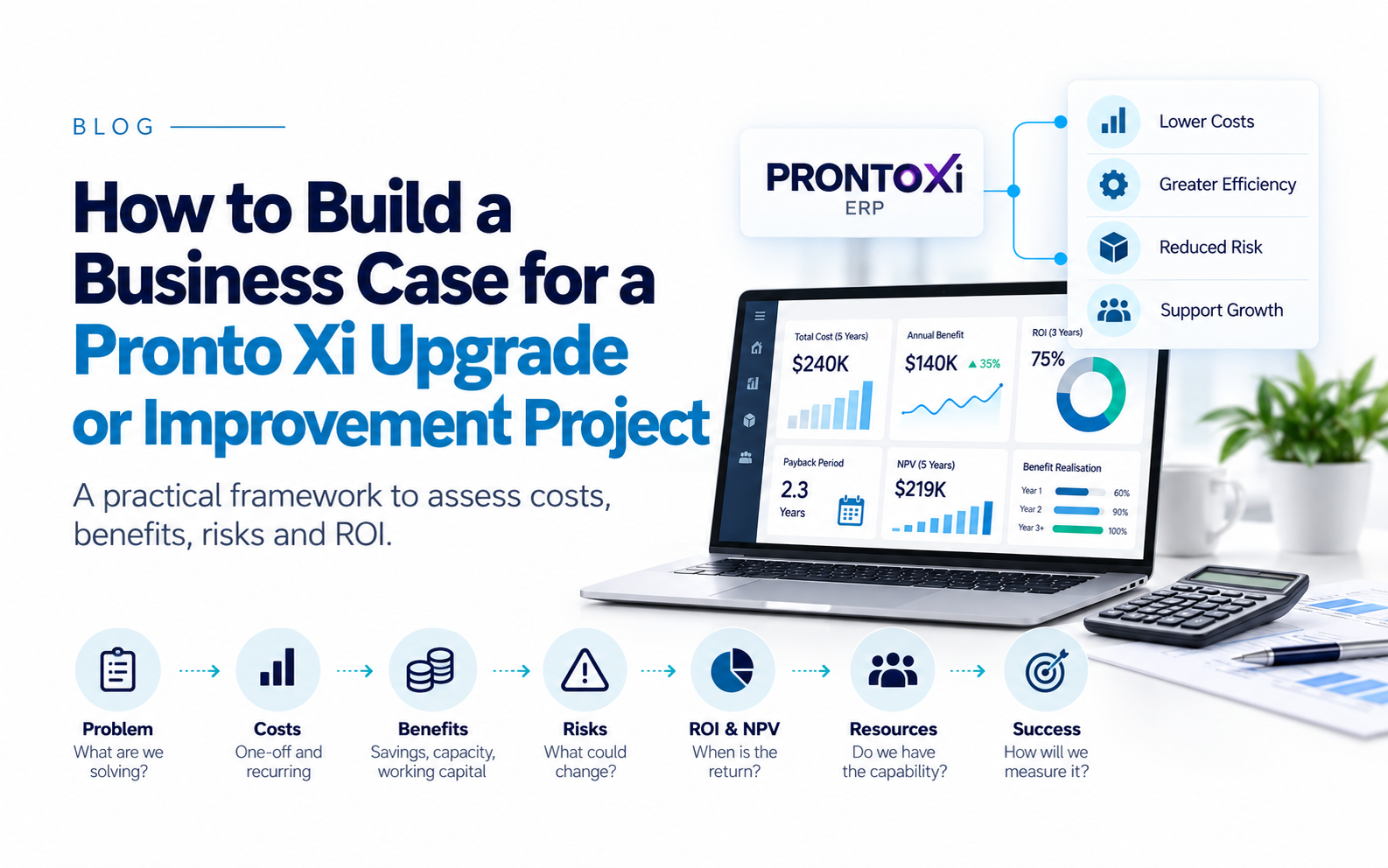
How to Build a Business Case for a Pronto Xi Upgrade or Improvement Project
A CFO-grade framework for building a Pronto Xi upgrade business case, covering costs, benefit classification, realisation factors, payback, NPV and how to avoid the double-counting and over-optimistic assumptions that make ERP business cases fall apart.
How do you justify investment in a Pronto Xi upgrade or improvement project?
A credible Pronto Xi business case should show what business problem the investment will solve, what the full economic cost will be, when benefits will arise, how likely they are to be realised and how success will be measured after go-live.
The case should distinguish between:
-
one-off and recurring costs;
-
actual cost reductions and avoided future costs;
-
productivity and capacity benefits;
-
working-capital improvements;
-
risk reduction;
-
implementation disbenefits;
-
benefit timing;
-
assumptions and dependencies; and
-
measurable business outcomes.
The central question is not:
“How much will the Pronto Xi project cost?”
It is:
“What value should this investment create compared with the alternatives—and how confident are we that the organisation can actually realise it?”
That is a much stronger basis for capital allocation.
Why “we need to upgrade Pronto Xi” is not enough
An upgrade may be justified by:
-
supportability;
-
security;
-
compliance;
-
infrastructure;
-
technical debt;
-
new functionality;
-
business growth;
-
operational inefficiency.
But none of these automatically proves the economic case.
A CFO may reasonably ask:
What becomes materially better after we spend the money?
Compare:
Weak justification
We should upgrade because the current version is old and newer functionality is available.
Stronger justification
Upgrade Pronto Xi, retire three ageing customisations and simplify finance processes so the business can absorb forecast transaction growth without another finance hire, reduce external support expenditure and shorten monthly reporting.
The second statement gives management something that can be:
measured → challenged → costed → owned → reviewed
Start with the business problem
Before discussing features, define the current state.
Typical triggers for a Pronto Xi improvement project may include:
-
slow month-end close;
-
excessive manual processing;
-
outdated customisations;
-
unreliable integrations;
-
reporting delays;
-
high consultant dependency;
-
warehouse inefficiency;
-
duplicate systems;
-
weak controls;
-
rising transaction volumes;
-
poor user experience;
-
ageing infrastructure.
Ask four questions:
-
What is happening today?
-
What does it cost us today?
-
What happens over the next three to five years if we do nothing?
-
Which proposed change directly addresses that problem?
The third question is particularly important.
The status quo is rarely free.
Compare future states, not project versus zero
A good ERP business case should compare alternatives.
For example:
| Option | Description |
|---|---|
| A. Do nothing | Continue existing environment and absorb increasing support/process cost |
| B. Optimise current Xi | Improve configuration and processes without a major upgrade |
| C. Upgrade Pronto Xi | Move to target release and remediate essential dependencies |
| D. Upgrade + simplify | Upgrade and retire customisations or redundant systems |
| E. Upgrade + infrastructure change | Upgrade combined with cloud/hosting transformation |
Evaluate each against:
-
cost;
-
benefit;
-
delivery time;
-
operational risk;
-
resource requirement;
-
strategic fit.
This helps avoid creating a business case whose real purpose is simply to justify a decision already made.
The cost of doing nothing
The relevant comparison is usually:
Future state with investment vs future state without investment
Doing nothing may mean:
-
increasing external support costs;
-
another employee required as volumes grow;
-
more fragile integrations;
-
ongoing customisation maintenance;
-
greater manual effort;
-
delayed reporting;
-
ageing infrastructure replacement later;
-
increasing operational risk.
For example:
Current AP transaction growth suggests another FTE will be required within 18 months unless processing capacity improves.
That is much stronger evidence than simply claiming:
Automation will save one FTE.
The eight parts of a CFO-grade Pronto Xi business case
A decision-ready case should answer:
-
What problem are we solving?
-
What alternatives have we considered?
-
What exactly will change?
-
What will the complete investment cost?
-
What benefits should result?
-
How likely and how quickly will those benefits be realised?
-
What risks and assumptions could change the economics?
-
How will the benefits be measured and owned after go-live?
What costs should be included?
Do not use the vendor or implementation quote as the total project cost.
External costs
Include where applicable:
-
Pronto services;
-
implementation partner;
-
specialist consultants;
-
licences and modules;
-
hosting;
-
infrastructure;
-
integrations;
-
customisation remediation;
-
reporting;
-
data migration;
-
training;
-
third-party applications.
Internal costs
Include:
-
ERP Manager;
-
Business Analysts;
-
finance and operations SMEs;
-
IT;
-
testing;
-
project management;
-
data cleansing;
-
change management;
-
training time.
Temporary disbenefits
Also consider:
-
lower productivity during implementation;
-
overtime;
-
temporary staff;
-
parallel systems;
-
duplicate processing;
-
delayed initiatives;
-
additional support during adoption.
These are real economic effects even where they never appear on an external invoice.
Separate one-off and recurring costs
This matters because the cash-flow profile affects ROI.
| Cost | One-off | Recurring |
|---|---|---|
| Implementation | ✓ | |
| Data conversion | ✓ | |
| Integration redevelopment | ✓ | |
| Training | ✓ | |
| Internal project effort | ✓ | |
| Incremental subscription | ✓ | |
| Hosting | ✓ | |
| Additional support | ✓ | |
| Third-party product | ✓ |
A $250,000 implementation with no material new recurring cost is economically different from a $200,000 project that adds $60,000 every year.
How should benefits be classified?
Not all ERP benefits are the same.
1. Actual cost reductions
These reduce existing expenditure.
Examples:
-
contractor expenditure falls;
-
overtime reduces;
-
another software application is retired;
-
external support fees decrease.
These are usually among the strongest benefits in an ROI calculation.
2. Avoided future costs
Examples:
-
forecast growth no longer requires another employee;
-
infrastructure replacement is avoided;
-
planned additional support resources are unnecessary.
These are economically real but should be clearly labelled avoided cost, not existing-cost reduction.
3. Productivity and capacity
Examples:
-
finance saves 800 hours annually;
-
reporting takes two fewer days;
-
warehouse processing improves 15%.
These are valuable.
But time released is not automatically cash saved.
It becomes financially bankable when it leads to:
-
avoided recruitment;
-
reduced overtime;
-
contractor reduction;
-
higher volume without additional headcount;
-
redeployment into measurable higher-value work.
4. Working capital
Examples:
-
lower inventory;
-
faster collections;
-
reduced safety stock;
-
faster billing.
Working-capital release can materially improve cash.
But a $400,000 reduction in inventory is not the same as $400,000 of annual profit.
Report it separately.
5. Risk and strategic benefits
Examples:
-
reduced security exposure;
-
improved supportability;
-
fewer fragile customisations;
-
lower key-person dependency;
-
improved recovery;
-
easier future upgrades.
These may be important even where reliable dollar values are difficult to establish.
Do not invent financial values simply to make the ROI look stronger.
Do not double-count benefits
This is one of the most common ERP business-case errors.
Suppose automation:
-
saves 1,000 hours per year; and
-
allows the business to avoid one planned hire.
If the avoided hire is already the economic consequence of the 1,000 hours of released capacity, counting both as separate financial savings may double-count the same improvement.
Use this rule:
Every benefit should have one clear economic pathway.
Trace:
Operational improvement → business outcome → financial consequence
Only count the financial consequence once.
Start with a baseline
A benefit is difficult to defend without current-state evidence.
Measure before approving the project.
| Problem | Useful baseline |
|---|---|
| Slow month-end | Days to close |
| High AP effort | Invoices/FTE, minutes/invoice |
| Reporting burden | Hours/month preparing reports |
| Warehouse inefficiency | Picks/hour, labour/order |
| Integration problems | Failures/month |
| Customisation burden | Annual support and testing cost |
| Inventory problems | Turns, aged/obsolete stock |
| Support dependency | External support spend |
| User issues | Tickets/month, resolution time |
The baseline should exist before implementation, not be reconstructed six months afterwards.
Build benefits from operational drivers
Avoid:
“Automation will improve finance efficiency by 20%.”
Use measurable drivers.
For example:
Annual invoice volume: 60,000
Current processing: 4 minutes/invoice
Target: 3 minutes/invoice
Capacity released:
60,000 × 1 minute = 60,000 minutes = 1,000 hours
Now ask:
What economic outcome will those 1,000 hours produce?
If forecast transaction growth would otherwise require another employee, the business case may legitimately include an avoided hiring cost.
The assumption is now visible and challengeable.
Apply a benefit-realisation factor
ERP business cases should rarely assume every proposed benefit will be achieved in full.
For example:
| Benefit | Gross potential | Realisation factor | Expected benefit |
|---|---|---|---|
| Avoided finance hire | $80,000 | 90% | $72,000 |
| Reduced external support | $40,000 | 90% | $36,000 |
| Reduced rework | $30,000 | 70% | $21,000 |
This reflects the reality that benefit leakage can occur through:
-
partial adoption;
-
remaining workarounds;
-
slower process change;
-
incomplete automation;
-
unexpected operational constraints.
This makes the business case more conservative, and more credible.
Benefits usually ramp up after go-live
Do not assume 100% of annual benefit starts immediately.
An illustrative benefit ramp might be:
| Year | Benefit realisation |
|---|---|
| Year 1 | 60% |
| Year 2 | 90% |
| Year 3 onward | 100% |
The right profile depends on the project.
A straightforward technical upgrade may realise benefits faster.
A process transformation requiring significant behaviour change may take longer.
Worked illustrative example
The following example is illustrative only and does not represent Pronto Software pricing or guaranteed outcomes.
Assume a distributor proposes to:
-
upgrade Pronto Xi;
-
retire three customisations;
-
improve finance processes;
-
rebuild two integrations;
-
simplify management reporting;
-
improve testing and supportability.
Initial investment
| Cost | Amount |
|---|---|
| Upgrade and implementation | $105,000 |
| Integration/customisation remediation | $45,000 |
| Testing, training and backfill | $35,000 |
| Reporting changes | $20,000 |
| Contingency | $35,000 |
| Total Year 0 investment | $240,000 |
Incremental recurring cost:
$20,000 per year
Gross mature annual benefits
| Benefit | Amount |
|---|---|
| Avoided finance hire | $70,000 |
| Reduced external/customisation support | $40,000 |
| Reduced overtime/temporary effort | $25,000 |
| Reduced error and rework cost | $25,000 |
| Gross mature annual benefit | $160,000 |
At full realisation:
$160,000 − $20,000 recurring cost = $140,000 annual net benefit
Add timing to the calculation
Assume:
-
Year 1 delivers 60% of gross benefits;
-
Year 2 delivers 90%;
-
Year 3 onward delivers 100%.
The illustrative cash-flow profile becomes:
| Year | Gross benefit | Recurring cost | Net cash benefit |
|---|---|---|---|
| 0 | — | — | -$240,000 |
| 1 | $96,000 | $20,000 | $76,000 |
| 2 | $144,000 | $20,000 | $124,000 |
| 3 | $160,000 | $20,000 | $140,000 |
| 4 | $160,000 | $20,000 | $140,000 |
| 5 | $160,000 | $20,000 | $140,000 |
This is more realistic than assuming $140,000 appears immediately after go-live.
Calculate payback and NPV
Payback
After Year 1:
-$164,000 cumulative
After Year 2:
-$40,000 cumulative
The remaining $40,000 is recovered during Year 3.
Illustrative payback:
approximately 27 months
rather than the 21 months implied by assuming full benefits immediately.
That difference matters.
Net Present Value
For material projects, simple ROI should be supplemented by discounted cash flow.
Using the illustrative cash flows above and a 10% discount rate, the five-year NPV is approximately:
+$219,000
A positive NPV means the discounted value of expected future cash flows exceeds the initial investment under those assumptions.
The organisation should use its own approved hurdle or discount rate.
Keep working capital separate
Assume the project may also reduce average inventory by:
$300,000
Show that separately.
| Economic outcome | Illustrative value |
|---|---|
| Five-year operating cash flows | Included in NPV |
| Potential working-capital release | $300,000 |
| Risk reduction | Assessed separately |
Do not add $300,000 to recurring annual profit.
This keeps the economics transparent.
Model the cost of doing nothing
Assume that without the project:
-
transaction growth requires a finance hire in Year 2;
-
customisation support rises;
-
integrations remain fragile;
-
reporting effort continues.
That future cost belongs in the alternatives analysis.
For example:
| Option | 3–5 year implication |
|---|---|
| Do nothing | Hire required, rising support effort, current risks remain |
| Optimise only | Lower cost, but ageing architecture remains |
| Upgrade | Improves supportability, limited process benefit |
| Upgrade + simplify | Higher project cost but removes technical/process debt |
The right decision is based on the incremental economics between realistic alternatives.
Use sensitivity analysis
A business case is only as strong as its most important assumptions.
Identify the three or four variables that influence the result most.
For example:
-
benefit realisation;
-
implementation cost;
-
ability to avoid the planned hire;
-
adoption speed.
Then test scenarios.
| Scenario | Assumption | Indicative result |
|---|---|---|
| Low | Lower adoption, 15% cost overrun | Longer payback |
| Base | Expected assumptions | Target economics |
| High | Faster adoption, full avoided hire | Shorter payback |
Do not focus only on the best case.
Ask:
Does the investment remain acceptable if benefits are lower and costs are higher than expected?
If the answer is no, the business case is fragile.
Treat risk separately from speculative ROI
An upgrade may materially reduce:
-
unsupported customisation risk;
-
cyber exposure;
-
integration fragility;
-
key-person dependency;
-
recovery risk.
These benefits matter.
But avoid building the business case around invented probabilities.
Instead use a structured risk table:
| Risk | Current exposure | Proposed improvement |
|---|---|---|
| Unsupported customisation | High | Retire three customisations |
| Integration failure | Medium/High | Redesign and monitor interfaces |
| Key-person dependency | High | Documentation and cross-training |
| Recovery | Medium | Improved recovery arrangements |
| Security | Current controls assessed as inadequate | Target environment improves controls |
If robust financial loss data exists, risk can be modelled.
Otherwise, present it transparently as strategic or risk-reduction value.
Add a resource-feasibility gate
A project can have an attractive spreadsheet ROI and still be a poor investment if the organisation cannot execute it.
Before approval ask:
Do we have—or can we realistically secure, the capability needed to deliver the benefits?
Consider availability of:
-
Pronto Xi Functional Consultants;
-
Business Analysts;
-
Support/Application Analysts;
-
Systems Administrators;
-
Cognos specialists;
-
developers;
-
integration specialists;
-
testers;
-
internal process owners;
-
ERP leadership.
This should be treated as an investment gate, not an implementation detail.
If the business case assumes specialist capability that cannot be secured within the required timeframe or budget, the economics should be revised.
Separate project ownership from benefit ownership
This is another important distinction.
Project owner
Responsible for delivering:
-
scope;
-
configuration;
-
testing;
-
migration;
-
go-live.
Benefit owner
Responsible for ensuring the organisation changes sufficiently to achieve the promised outcome.
For example:
IT may successfully implement AP automation.
But the AP Manager may own:
-
retiring the old workflow;
-
changing user behaviour;
-
reducing manual processing;
-
avoiding the forecast hire;
-
demonstrating the expected capacity gain.
A successful implementation without benefit realisation is still a failed business case.
Turn every benefit into a measurable commitment
Each material benefit should have:
Baseline → Target → Benefit owner → Measurement frequency → Review date
For example:
| Benefit | Baseline | Target | Owner |
|---|---|---|---|
| Month-end close | 7 days | 4 days | Financial Controller |
| External Pronto support | $120k/year | $80k/year | ERP Manager |
| AP processing | 4 min/invoice | 3 min | AP Manager |
| Interface exceptions | 45/month | <10 | IT Manager |
| Manual reporting | 80 hrs/month | 30 hrs | Finance Manager |
Now the business case becomes operational management rather than a pre-approval document.
Do not declare victory at go-live
Go-live means the technology changed.
It does not mean the economics were achieved.
Review benefits at:
-
30 days;
-
90 days;
-
six months;
-
twelve months.
Ask:
-
Was the old process actually retired?
-
Were customisations removed?
-
Has external expenditure fallen?
-
Was the planned hire avoided?
-
Did users adopt the new process?
-
Did reporting effort decline?
-
Did transaction capacity improve?
-
Were new recurring costs introduced?
-
Are benefits tracking to the approved case?
Where benefits fall short, investigate why.
That is benefits realisation.
A practical investment decision table
Before approving a Pronto Xi project, management should be able to answer:
| Question | Evidence required |
|---|---|
| What problem are we solving? | Current-state baseline |
| What happens without investment? | Cost-of-doing-nothing forecast |
| What alternatives exist? | Options analysis |
| What exactly changes? | Defined scope |
| What does it cost? | Full cash-flow model |
| What benefits are actual savings? | Current expenditure reduction |
| What benefits are avoided costs? | Forecast expenditure evidence |
| What benefits are capacity? | Operational driver model |
| What benefits affect working capital? | Separate cash-flow analysis |
| When do benefits occur? | Ramp-up assumptions |
| What percentage is realistically achievable? | Realisation factor |
| Could benefits be double-counted? | Benefit pathway review |
| What assumptions drive the result? | Sensitivity analysis |
| What is payback? | Cash-flow calculation |
| What is NPV? | Approved discount rate |
| Do we have the people to deliver it? | Resource feasibility |
| Who owns each benefit? | Named business owner |
| How will success be proven? | KPI and review plan |
Common business-case mistakes
Treating capacity as cash
Released hours are not automatically financial savings.
Ignoring the cost of doing nothing
The status quo often becomes more expensive over time.
Assuming 100% benefits from Day 1
Most operational improvements ramp up.
Counting the same benefit twice
Avoided headcount and hours saved may be the same economic benefit.
Ignoring internal project effort
Business-user capacity is a real project cost.
Treating working capital as profit
Cash release and earnings are different.
Using speculative risk figures
Do not manufacture probabilities to make ROI work.
Ignoring temporary disruption
Implementation itself can reduce productivity.
Failing to compare alternatives
Upgrade may not be the only viable response.
Having no benefit owner
A feature without operational ownership rarely creates sustained value.
Ending measurement at go-live
ERP value is realised after implementation, not at the deployment milestone.
Final takeaway
A credible Pronto Xi upgrade business case is not:
Cost → New functionality → ROI
It is:
Problem → Baseline → Alternatives → Investment → Benefits → Realisation probability → Cash-flow timing → Risk → Payback/NPV → Owner → Measurement
Start with the business problem.
Compare the alternatives.
Model the whole cost.
Separate:
-
actual cost reduction;
-
avoided cost;
-
capacity;
-
working capital;
-
strategic value;
-
risk reduction.
Adjust benefits for realistic adoption.
Model when the cash flows occur.
Challenge the assumptions that matter most.
And make someone accountable for delivering every material benefit.
Pronto Xi functionality creates potential. ROI is created only when the organisation changes how it operates and converts that potential into measurable economic or strategic value.
Where SAAPRO fits
One of the most overlooked assumptions in an ERP business case is that the required capability will simply be available.
A Pronto Xi investment may depend on:
-
Business Analysts;
-
Functional Consultants;
-
Support/Application Analysts;
-
Systems Administrators;
-
Cognos specialists;
-
developers;
-
testers;
-
ERP Managers.
SAAPRO specialises in the Australian Pronto Xi talent market and can help organisations assess whether the specialist capability assumed in the business case is realistically available before resource constraints undermine the expected ROI.
Disclosure: SAAPRO is an independent Pronto Xi recruitment specialist and is not Pronto Software vendor.
The framework and financial example above are illustrative. Organisations should use their own costs, approved discount rates, implementation assumptions and benefit evidence when making investment decisions.
Frequently Asked Questions
A simple formula is ROI = (Total quantified benefits − total costs) ÷ total costs × 100. For larger projects, supplement simple ROI with cash-flow timing, payback and NPV. Separate actual savings, avoided costs, capacity, working capital and risk rather than combining them into one headline figure.
Include implementation, integrations, customisations, data migration, testing, training, infrastructure, licences, internal resources, temporary productivity loss, recurring subscriptions and ongoing support. Do not rely only on the supplier quotation.
First calculate the capacity released. Then determine the economic consequence. If the time prevents a hire, reduces overtime or replaces contractor expenditure, it may become bankable. Otherwise present it as capacity rather than cash savings.
It should be included where credible but shown separately from annual operating profit. Lower inventory or faster receivables may release cash without creating an equivalent recurring earnings benefit.
Model the future cost of each option. Doing nothing may require additional staff, higher support costs or continued customisation maintenance. Compare realistic future states rather than project expenditure against a zero-cost status quo.
Net Present Value discounts future cash flows to reflect when benefits and costs occur. It is particularly useful for larger multi-year investments because $100,000 received several years from now is worth less economically than $100,000 received today.
The business leader responsible for the affected process should normally own the benefit. IT may deliver the system change, but Finance, Operations, Procurement or another function must often change behaviour to produce the expected economic result.
Key Takeaways
- ✓Justify the investment against realistic alternatives and the cost of doing nothing, not against a zero-cost status quo.
- ✓Classify benefits separately (actual savings, avoided costs, capacity, working capital, risk) and never double-count the same improvement twice.
- ✓Apply a realisation factor and a multi-year ramp-up instead of assuming 100% of benefits land immediately after go-live.
- ✓Assign a named benefit owner and measure results at 30/90/180/365 days, a successful go-live without realised benefits is still a failed business case.