Pronto Xi Integration: APIs, EDI and File Transfers Explained
A practical guide to how Pronto Xi exchanges data with other systems, the methods, a worked example of where they break, and the version, licensing and ownership dependencies that decide whether an integration stays reliable after go-live.
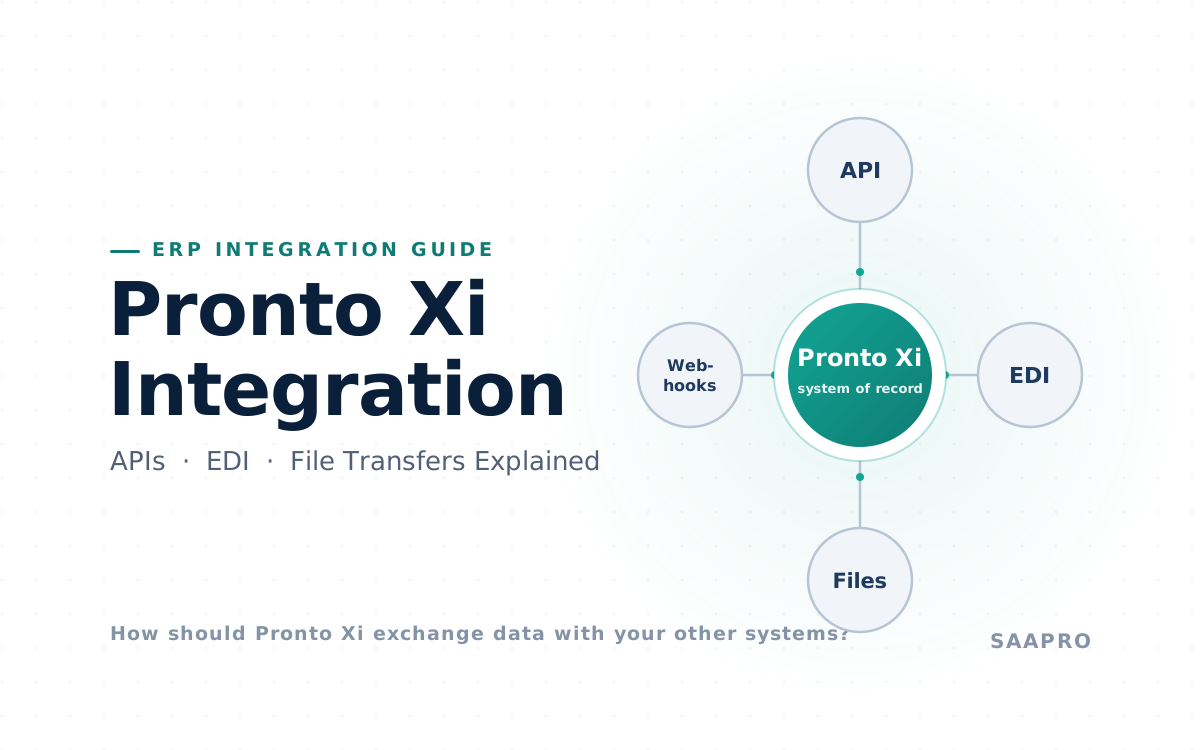
Pronto Xi exchanges data with other systems through four main mechanisms: the Pronto Connect API platform (real-time RESTful web services), EDI with trading partners, scheduled file transfers, and event-driven webhooks from Tasks & Alerts. Choosing between them is the straightforward part. The decision that actually determines success is quieter: which system owns each record, how failures are detected and recovered, and the point most integration guides skip who inside your business is capable of owning each interface once the implementation partner has gone.
That last question is where Pronto Xi integrations quietly succeed or slowly decay. An API is a capability, not an outcome. In our experience placing and assessing Pronto Xi talent across the Australian market, the interface that causes a production incident is rarely the one built last week; it is the one built three years ago, by someone who has since left, that no current staff member fully understands. This guide is written for CFOs, CIOs and IT leaders who have to live with those interfaces not as a developer reference, but as a decision framework.
Pronto Xi integration at a glance
| Attribute | Summary |
|---|---|
| Primary API platform | Pronto Connect, pre-built RESTful APIs plus a development environment for custom APIs, part of the Pronto Xi Foundation platform |
| Architecture | A Pronto Connect server (service and REST client) sits in front of the Pronto Xi server; API calls execute through Pronto Runtime against the database |
| Data formats | XML or JSON over HTTPS for web services; standard EDI documents; delimited/fixed-width files |
| Authentication | User-based security (access restricted by the connecting user), Active Directory / LDAP, and SSL for data in transit |
| EDI | Trading-partner document exchange (orders, ASNs, invoices), typically via a value-added network (VAN) or third-party EDI provider |
| File transfer | Delimited/fixed-width files over secure channels; common for banking, payroll/statutory reporting and legacy partners |
| Events | Tasks & Alerts can trigger external webhooks to applications or middleware |
| The supported path | Integrate through Pronto Connect / Runtime, which enforces application logic — not by writing directly to the underlying database |
| Current release line | Pronto Xi 780 (7.80) at the time of writing; capability varies by release |
| Confirm in writing | Your release, the APIs and integration products licensed, and who owns each interface after go-live |
Why is integration the part of Pronto Xi that decides ROI?
Integration is where an ERP either amortises its value or accumulates operational risk, because it is the only part of the system that depends on skills you may not employ.
Pronto Xi typically sits at the centre of a wider landscape, ecommerce, CRM, warehouse and freight systems, banking, payroll compliance and a BI or data-warehouse layer. Every connection either removes rekeying and reconciliation or creates a new place for data to duplicate, drift or fail silently. The modules Pronto Xi ships with are configured once and largely settle. Integrations are different: they are living code and configuration that must be monitored, and re-tested against every upgrade, for as long as they run.
For finance and technology leaders, that changes the real question. It is not "does Pronto Xi have an API?" it does. It is "do we have, or can we get, the people who understand both Pronto Xi and the systems on the other end well enough to own these interfaces?" A well-designed integration supported by no one is a latent incident. This is the lens we apply throughout the sections below.
What are the main ways Pronto Xi integrates with other systems?
Pronto Xi supports real-time RESTful APIs, EDI, file-based transfers and event-driven webhooks, and most organisations run a combination. Each carries a different ownership and skills burden, which is as important to weigh as the technology.
Pronto Connect API platform (real-time web services)
Pronto Connect is Pronto Xi's API and integration platform, and REST is its primary style, it provides pre-built RESTful APIs plus a development environment for building custom ones. Architecturally, a Pronto Connect server acts as the service and REST client in front of the Pronto Xi server; requests carry XML or JSON, authenticate against Active Directory / LDAP under user-based security, travel over SSL, and execute through Pronto Runtime. It is the modern default for interactive integrations, raising a sales order from an ecommerce checkout, checking live stock and pricing, or syncing customer records from a CRM.
Because calls run through Runtime rather than against raw tables, the application's business rules and validation are applied, which is exactly why this is the supported path. It also means the skill required is not just "REST developer" but someone who understands how Pronto Xi's application layer expects data to arrive.
EDI (Electronic Data Interchange)
EDI connects Pronto Xi with trading partners, large retailers, suppliers, logistics providers, using standardised documents such as purchase orders, advance shipping notices (ASNs) and invoices, usually through a VAN or third-party EDI provider that manages partner onboarding and mapping.
The important truth about EDI is that it is a compliance regime, not a protocol. When a major retailer mandates EDI, they dictate the document formats, the ASN and GS1 label requirements, the timing, and the functional-acknowledgement handshake that proves each message was received. Get the ASN or barcode wrong and the consequence is not a technical error message, it is a chargeback. Owning EDI well means owning the trading-partner relationship and the mapping layer, not just the connection.
File-based transfers
File transfer, delimited or fixed-width files moved over a secure channel, remains common for banking (payment and remittance files), payroll and statutory reporting, bank-statement import and some legacy partners. It is inherently batch and asynchronous. Pronto's own architecture positions web services as superior to flat-file connectivity for reducing synchronisation errors, so treat any new file interface as a deliberate choice, usually justified only when a counterparty supports nothing else.
Event-driven webhooks (Tasks & Alerts)
Pronto Xi's Tasks & Alerts can respond to defined events and trigger external webhooks, pushing data to other applications directly or via middleware, useful for "tell another system when this happens" patterns, such as notifying a freight platform on dispatch. The design caution is delivery guarantee: an event fired outbound needs the receiver to acknowledge and de-duplicate it, because a fire-and-forget notification that is missed leaves the two systems silently out of step.
Middleware and custom development
Many organisations place an integration platform (iPaaS) or middleware layer between Pronto Xi and its partners to centralise mapping, queuing, retries and monitoring, which is good architecture, but adds a third system that someone must own. Where standard interfaces do not fit, Pronto provides an SDK, Rapid Application Development (RAD) and its proprietary 4GL. Custom code widens what is possible and narrows who can maintain it: Pronto's 4GL is a specialised skill, and bespoke integration built in it is only as safe as your continued access to people who can read it.
How should you choose the right Pronto Xi integration method?
The method should follow the data and the failure mode, then be pressure-tested against who will own it. The table maps common requirements to the appropriate mechanism, the governance each needs, and the capability it assumes you can sustain.
| Decision factor | Pronto Connect API (real-time) | EDI (via VAN / provider) | File transfer (batch/SFTP) | Webhooks (Tasks & Alerts) |
|---|---|---|---|---|
| Best for | Interactive, transactional links (ecommerce orders, live stock/pricing, CRM) | Structured B2B documents with trading partners | Banking, payroll/statutory files, bulk loads, legacy partners | Notifying downstream systems when an event occurs |
| Timing | Real time / on demand | Near real time to scheduled, per partner | Scheduled batch | Event-triggered |
| System of record | Define per object before build | Usually dictated by the trading relationship | Define per object before build | Pronto Xi is the event source |
| Duplicate prevention | Idempotency via a unique external reference stored on the Pronto Xi order/record | Interchange/document control numbers + duplicate-document checks | Unique file/batch IDs and processed-file tracking | De-duplicate on event ID at the receiver |
| Recovery from failure | Safe retries, dead-letter queue, replay from source | Resubmission and functional-ACK reconciliation | Reprocess with guards against re-importing | Retry with backoff; reconcile against source |
| Monitoring | API/middleware logs and alerts on failed calls | Provider portal + ACK tracking | Job success/failure logs and reconciliation | Delivery + downstream acknowledgement |
| Skill to own it | Pronto Connect + the target system's API + Pronto data model | EDI mapping + trading-partner compliance | IT ops + banking/payroll formats | Tasks & Alerts config + receiver design |
| Licensing to confirm | API access scope and any connector limits | VAN/EDI subscription and mapping services | Secure transfer setup and support boundaries | Included in Foundation; confirm your release |
The pattern is consistent across every column: the transport is the easy choice; the system of record, duplicate prevention, recovery, monitoring, and the person who understands all four, are the work.
A worked example: an ecommerce order, end to end
Abstract capability lists hide where integrations actually fail. Consider one common flow, an online order that must become a dispatched, invoiced Pronto Xi sales order, and watch where it breaks and who has to own each break.
- Order capture. A customer checks out on your ecommerce platform. A real-time Pronto Connect call raises a sales order in Pronto Xi. Break point: if the same checkout is retried, or the webhook fires twice, you get a duplicate order, unless the ecommerce order ID is written to a unique external reference on the Pronto Xi order and checked before creation. Owner: whoever maintains the create-order interface understands both the ecommerce API and how Pronto Xi validates an order through Runtime.
- Stock and pricing. The order needs live availability and customer-specific pricing. Break point: if pricing is duplicated in the ecommerce platform instead of read from Pronto Xi as the system of record, the two drift and customers are billed inconsistently. Owner: someone who can define the system of record per object and defend it against well-meaning "let's just cache it" shortcuts.
- Dispatch. The warehouse picks and ships; a Tasks & Alerts event or API call notifies the freight platform and updates the order. Break point: a missed outbound event leaves the customer without tracking and the systems out of step. Owner: the person who designed the event to require an acknowledgement.
- ASN and invoice. If the customer is a major retailer, an EDI ASN and invoice must follow, in their exact format, on their timetable. Break point: a malformed ASN or wrong GS1 label triggers a chargeback, not an error log. Owner: whoever owns the EDI mapping and the trading-partner relationship.
- Reconciliation. At period end, ecommerce, Pronto Xi and the freight/EDI records must agree. Break point: without a reconciliation routine, a day of failed messages is discovered by finance, late. Owner: the person who built the reconciliation, not just the happy path.
Every break point is a skills question wearing a technical costume. A capable integration developer prevents most of them at design time; their absence is discovered in production.
What governance makes Pronto Xi integrations reliable?
API availability does not make an integration reliable. Reliability comes from a small set of decisions settled before any interface is built, and from someone accountable for each one afterwards.
Every interface needs a defined system of record, so two systems never both believe they own the same customer, price or order. It needs a deliberate choice between real-time and scheduled movement, matched to how the business uses the data. It needs authentication and access control appropriate to the data, in Pronto Xi's case, user-based security, Active Directory / LDAP and SSL, which also means integration service accounts must be governed like any privileged access. And it needs the four operational controls that are most often deferred and later cause incidents:
Monitoring and alerting, so a failed order or payment file is caught automatically, not by a customer or at month-end. Duplicate prevention, using a unique external reference on the Pronto Xi record, EDI control numbers and processed-file tracking, so a retry or replay cannot create a second order, invoice or payment. Safe retries with dead-letter handling, so transient failures self-heal and permanent ones are quarantined for review. And documented recovery and reconciliation, so both systems can be brought back into agreement after an outage with confidence rather than guesswork.
Two points matter specifically for finance and technology leaders. First, custom integration, especially anything in Pronto's 4GL, is an ongoing operational liability, not a one-off build: it must be owned, regression-tested against each Pronto Xi upgrade, and supported. Second, every interface needs a named owner and a defined support boundary, so that when something breaks it is immediately clear whether the issue sits with Pronto Xi, the middleware, the trading partner or your internal team. The most common failure we see is not technical; it is an interface that works perfectly and belongs to no one.
What version and licensing dependencies affect Pronto Xi integration?
What you can actually integrate depends on your Pronto Xi release and on what your licence and services agreement include, not on the product's published capabilities alone.
Pronto Connect is part of the Pronto Xi Foundation platform, and the current release line at the time of writing is Pronto Xi 780 (7.80). Several dependencies decide what is available in a specific environment, and each should be confirmed in writing. The release you run governs which web-service endpoints and formats exist; older versions may offer a narrower API surface, and some capabilities assume you are reasonably current. The scope of API access in your agreement may define which objects and operations are exposed and whether any limits apply. EDI generally depends on a separate VAN or EDI-provider subscription plus per-partner mapping. Pronto Xi Sync, a Pronto Woven product that keeps inventory, order and pricing data aligned across connected platforms such as ecommerce, is a separate engagement from the core API platform. File transfer and secure file sharing may involve additional setup and defined support boundaries, especially in hosted or cloud deployments. And your deployment model (SaaS, hosted or on-premises) affects who manages the integration infrastructure and the network and security around each interface.
Because Pronto Xi is modular and commercially quoted, a published feature is not proof it is licensed in your proposal. Before relying on any integration in a business case, require a written statement of your release, the APIs and integration products included, and the support responsibilities attached to them.
What should you confirm before building a Pronto Xi integration?
Before committing to a design, require clear answers to the following:
- the system of record for every shared data object;
- whether each interface is real time or scheduled, and why;
- the Pronto Xi release and the specific APIs or integration products it supports;
- licensing and subscription dependencies (API scope, EDI/VAN, Pronto Xi Sync);
- how failures are detected, alerted, retried and recovered;
- how duplicate transactions are prevented (the unique external reference and control-number strategy);
- the named owner and support boundary for each interface after go-live;
- regression testing of every integration against each Pronto Xi upgrade;
- whether the skills to maintain each interface, including any 4GL customisation, exist in your team or the market; and
- full data-extraction rights if you ever change platforms.
An integration that looks inexpensive at build time becomes the costliest option when monitoring, duplicate prevention, recovery, and ownership, are treated as afterthoughts.
Disclosure: SAAPRO is an independent Pronto Xi recruitment and advisory specialist. This article is general information about integration approaches and does not constitute a product endorsement or technical specification. Confirm your release, licensing and integration scope with your Pronto Xi partner before making commitments.
Most Pronto Xi integration problems trace back to a capability gap, not a technology gap. If you are weighing whether your team can design, own and support these interfaces, or whether that capability exists in the Australian market, SAAPRO can help you assess it.
Frequently Asked Questions
Yes. Pronto Connect provides pre-built RESTful APIs and a development environment for custom APIs, exchanging XML or JSON over HTTPS with user-based security and SSL. The exact endpoints available depend on your Pronto Xi release, so confirm the specifics for your environment.
This is not the supported path. Pronto Xi runs on Pronto Runtime with a proprietary 4GL and data model, and Pronto Connect executes API calls through Runtime so that application logic and validation are applied. Integrating through the API rather than writing to raw tables is what keeps data valid and upgrades safe.
Yes, commonly via real-time Pronto Connect APIs, and Pronto also offers Pronto Xi Sync (a Pronto Woven product) to keep inventory, order and pricing data aligned across connected platforms.
Pronto Xi supports EDI trading-partner connections, typically delivered through a VAN or third-party EDI provider that manages document mapping and onboarding. Treat EDI as a compliance obligation to your trading partners, usually with its own subscription and services.
That must be defined explicitly. APIs, middleware and especially 4GL customisations are ongoing responsibilities requiring monitoring, regression testing against upgrades, and clear support boundaries. The most common cause of integration failure is not the technology but the absence of a named, capable owner.
Key Takeaways
- ✓The technology choice (API, EDI, file transfer, webhook) is the easy part, reliability comes from defining system of record, duplicate prevention, monitoring and recovery for each interface.
- ✓EDI is a compliance obligation to trading partners, not just a protocol, getting the format or ASN wrong causes a chargeback, not just an error.
- ✓Custom integrations (especially in Pronto's 4GL) are an ongoing liability that must be owned and regression-tested against every upgrade, not a one-off build.
- ✓The most common cause of integration failure is not technical, it's an interface that works fine but has no named, capable owner after go-live.