How to Hire a Pronto 4GL Developer
A practical guide to hiring a Pronto 4GL developer, covering what to assess, interview questions, permanent vs contract options and common hiring mistakes.
Hiring a strong Pronto 4GL developer is not simply about finding someone who can write code.
The real question is:
Can this person extend Pronto Xi safely, understand the business problem behind the requirement, and build customisations that remain maintainable through future upgrades and changes?
For Australian organisations using Pronto Xi, that matters because the wrong developer can create long-term problems: undocumented customisations, upgrade delays, production instability, higher consulting costs and dependence on one person who understands the code.
A strong Pronto 4GL developer should not just build what is requested. They should understand when to customise, when to use standard functionality, and how to minimise technical debt.
What Should You Look for in a Pronto 4GL Developer?
Look for five things: 4GL development depth, Pronto architecture knowledge, maintainability discipline, debugging capability and stakeholder communication.
At SAAPRO, these are the five areas we would use to assess a Pronto developer.
SAAPRO’s 5-Point Pronto Developer Assessment
1. Pronto 4GL Development Depth
Do not rely on years of experience alone.
Ask what the candidate has actually built.
Relevant examples may include:
- Custom programs
- Screen modifications
- Batch processes
- Reports
- Data extracts
- Interfaces
- Validation logic
- Workflow automation
- Integration utilities
- Upgrade remediation
A candidate who has spent years maintaining existing code may not have the same capability as someone who has designed complex solutions from scratch.
One of the most common mismatches in Pronto recruitment is assuming that broad exposure to 4GL automatically means strong development depth.
2. Pronto Architecture and Module Knowledge
A developer does not need to be a functional consultant, but they do need to understand how their code interacts with the broader Pronto environment.
Relevant areas may include:
- Financials
- Accounts Payable and Receivable
- Inventory
- Purchasing
- Sales
- Warehousing
- Manufacturing
- Payroll
- CRM
- Reporting
- Integration points
The stronger developers understand both the technical layer and the business process behind the requirement.
That reduces the risk of technically correct code solving the wrong business problem.
3. Maintainability and Upgrade Discipline
This is one of the most important assessment areas.
A strong Pronto developer should be able to explain how they reduce future risk.
Look for evidence of:
- Coding standards
- Documentation
- Version control
- Testing
- Regression testing
- Upgrade remediation
- Change control
- Reducing unnecessary customisations
- Replacing old custom code with standard functionality where appropriate
The best developer is not the one who writes the most code.
It is often the one who knows when not to customise.
4. Debugging and Problem-Solving
Strong developers should be able to diagnose complex issues systematically.
Ask for examples of:
- Production defects they resolved
- Performance issues they fixed
- Legacy code they inherited
- Upgrade failures they remediated
- Integration problems they investigated
- Poorly documented customisations they stabilised
Look for structured reasoning and evidence of root-cause analysis.
5. Stakeholder Communication
Pronto development rarely happens in isolation.
Developers often work with:
- Business analysts
- Functional consultants
- Finance teams
- Operations
- Warehousing
- IT managers
- Vendors
- Senior business stakeholders
A strong developer should be able to explain technical constraints clearly, clarify ambiguous requirements and challenge poor solution design constructively.
Start With the Problem You Need to Solve
A generic brief such as:
“We need a Pronto 4GL developer with five years’ experience”
is usually too vague.
Before recruiting, define:
- What needs to be built or maintained?
- How much existing custom code is already in the environment?
- Is the requirement development, support, integration, reporting or upgrade work?
- Which Pronto modules are involved?
- How critical are the customisations?
- Will the developer work independently or as part of a team?
- What documentation and coding standards already exist?
- What should success look like after six months?
The clearer the problem, the easier it is to identify the right technical profile.
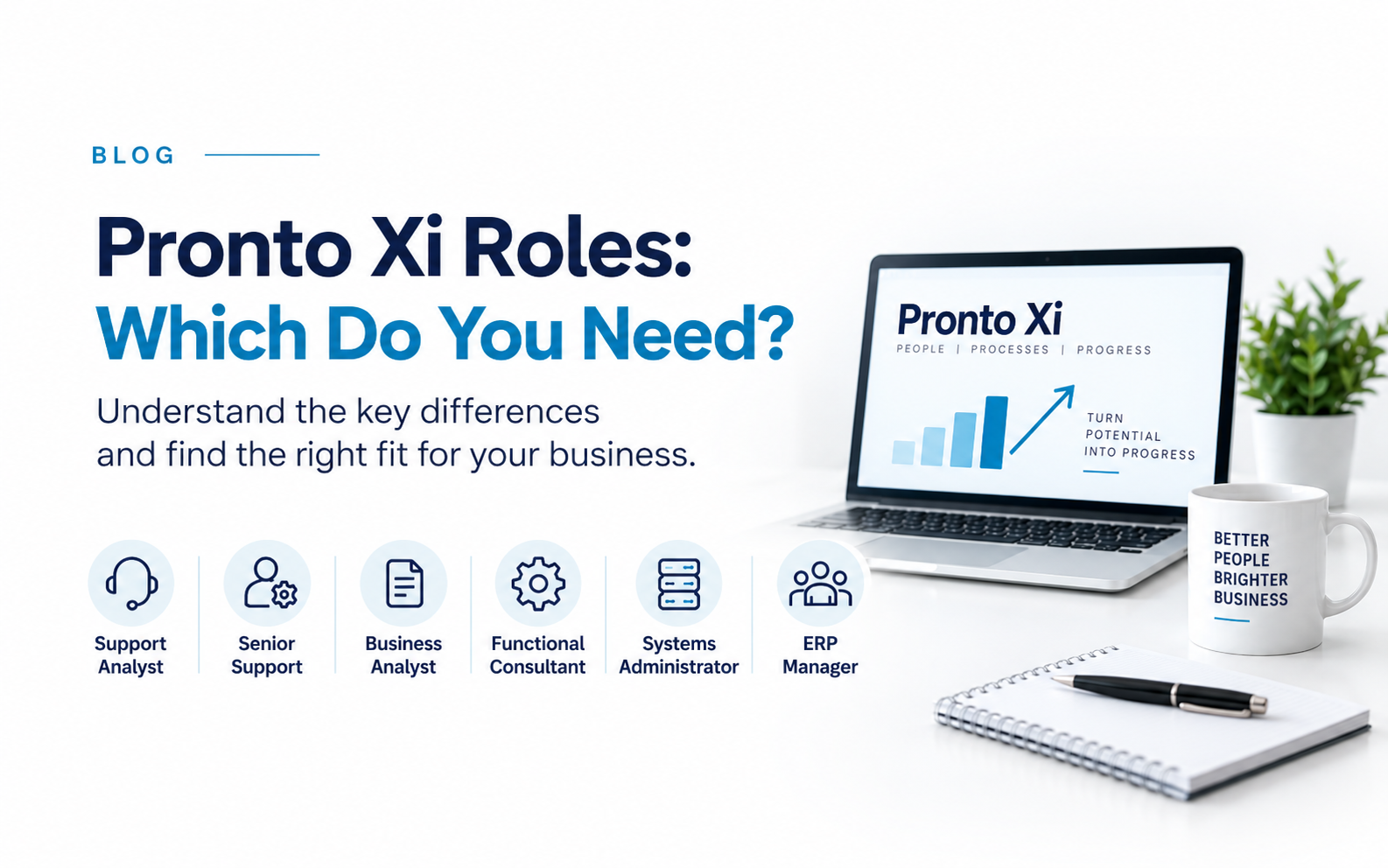
Developer, Functional Consultant or Business Analyst?
These roles are different.
A Pronto 4GL Developer primarily builds or modifies technical solutions.
A Functional Consultant focuses more on configuration, business processes and solution design.
A Business Analyst typically defines requirements, documents processes and translates business needs into functional or technical specifications.
In smaller businesses, one person may cover more than one area. But if the real requirement is process redesign or configuration, hiring only a developer may not solve the problem.
What Technical Experience Should You Assess?
The exact requirements will depend on your environment, but relevant capabilities may include:
- Pronto 4GL
- SQL
- Database structures
- Reporting
- APIs
- Web services
- File-based integrations
- Automation
- Data migration
- Interface development
- Version control
- Testing and deployment
If integrations are part of the role, ask candidates to explain exactly which systems they connected to Pronto and what part of the integration they personally built.
Interview Questions for a Pronto 4GL Developer
Avoid generic questions such as “How long have you used Pronto 4GL?”
Use evidence-based questions instead.
Tell me about the most complex Pronto 4GL solution you have built.
Look for scope, design decisions, testing and business outcome.
How do you decide whether to customise Pronto or use standard functionality?
Strong candidates should consider long-term supportability, not just development speed.
Tell me about a customisation that caused problems during an upgrade. What did you do?
Look for practical upgrade experience and accountability.
How do you document your development work?
Good answers should include technical documentation, code comments, change records and handover.
How do you test a Pronto customisation before release?
Look for structured testing and downstream-impact awareness.
Tell me about legacy Pronto code you inherited. What did you do first?
This reveals how the candidate approaches technical debt.
How do you deal with unclear business requirements?
Strong developers should clarify the requirement before writing code.
Assess Evidence, Not CV Keywords
Seeing “Pronto 4GL” on a CV does not tell you enough.
Verify:
- What the candidate personally built
- Complexity of the customisations
- Modules involved
- Number of users affected
- Size of the environment
- Upgrade experience
- Integration experience
- SQL capability
- Testing practices
- Documentation standards
- Version-control experience
- Production-support responsibility
- Examples of technical debt they reduced
The goal is to understand actual capability, not just job titles.
Permanent Hire or Contractor?
The right model depends on the requirement.
A permanent developer may be better when:
- You have ongoing custom development needs
- The environment contains significant bespoke functionality
- You want to retain technical knowledge internally
- The person will support continuous improvement
- Development is closely tied to long-term business processes
A contractor or staff-augmentation resource may be better when:
- You have an urgent development backlog
- A key developer has left
- You are preparing for a Pronto upgrade
- You need short-term integration expertise
- You need help stabilising legacy customisations
- You have a defined technical project
The engagement model should follow the workload and business risk.
Common Pronto 4GL Hiring Mistakes
Hiring by years of experience alone
Ten years of experience does not necessarily mean strong coding standards, design judgement or upgrade-safe development.
Hiring someone who only understands the technical layer
A developer who does not understand the business process may build the wrong solution efficiently.
Ignoring documentation and maintainability
Customisations become expensive when only one person understands them.
Over-customising
The best developers know when standard functionality is the better answer.
Underestimating upgrade impact
Legacy customisations can become one of the largest risks in a Pronto upgrade.
Combining too many roles into one
Trying to hire one person who is simultaneously a developer, functional consultant, business analyst, integration architect and support analyst can make the search unnecessarily difficult.
Pronto 4GL Developer Hiring Checklist
Before going to market, define:
- Pronto Xi version
- Development backlog
- Existing customisations
- Required modules
- Integration requirements
- SQL requirements
- Reporting requirements
- Upgrade history
- Documentation standards
- Version-control practices
- Testing process
- Deployment process
- Team structure
- Reporting line
- Location and flexibility
- Permanent or contract requirement
- Salary or contract rate
- Expected outcomes in the first six months
How Long Does It Take to Hire a Pronto 4GL Developer?
There is no standard timeframe.
Hiring speed depends on:
- Location
- Seniority
- 4GL development depth
- Module experience
- Integration capability
- Salary or contract rate
- Working arrangements
- Permanent versus contract engagement
Because Pronto 4GL is a specialised skill set, the available candidate pool can be limited.
Clear role definition and flexibility around secondary requirements usually improve the search.
Need Help Hiring a Pronto 4GL Developer?
Not sure whether you need a Pronto 4GL Developer, Functional Consultant, Business Analyst or integration specialist?
SAAPRO specialises in Pronto Xi recruitment, contracting and staff augmentation across Australia.
We can help define the requirement before you go to market, identify the right technical profile and access experienced Pronto professionals who may not be actively applying through job boards.
Talk to SAAPRO about your Pronto development requirement.
Frequently Asked Questions
Look for proven Pronto 4GL development depth, relevant module knowledge, upgrade-safe coding practices, structured debugging skills and evidence of building maintainable solutions.
There is no universal minimum. The complexity of work personally delivered is usually more important than years of experience alone.
If the developer needs to become productive quickly in an existing Pronto environment, practical Pronto 4GL experience is usually essential.
A developer primarily builds or modifies technical solutions. A functional consultant focuses more on configuration, business processes and solution design.
Permanent hiring generally suits ongoing development and knowledge retention. Contractors or staff augmentation can be more effective for urgent backlogs, upgrades, integration work or defined projects.
Look at solution complexity, upgrade experience, architecture judgement, debugging ability, coding standards, documentation, stakeholder management and the ability to work independently.
Key Takeaways
- ✓A strong Pronto 4GL developer does more than write code.
- ✓They help protect the stability, maintainability and upgradeability of your Pronto environment.
- ✓The best hire is the person who can understand the business problem, build the right solution, document it properly and avoid creating unnecessary technical debt.