Pronto Xi vs Odoo: Which ERP Is Right for Your Business?
An executive ERP selection guide for CFOs, CIOs and IT leaders
For CFOs, CIOs and IT leaders comparing Pronto Xi vs Odoo, the important question is not which ERP has more features. Both platforms provide substantial capability across finance, inventory, purchasing, sales and manufacturing.
The more useful question is:
Which ERP best fits the way your business needs to operate, with the least unnecessary complexity and a delivery model you can support over the next five to ten years?
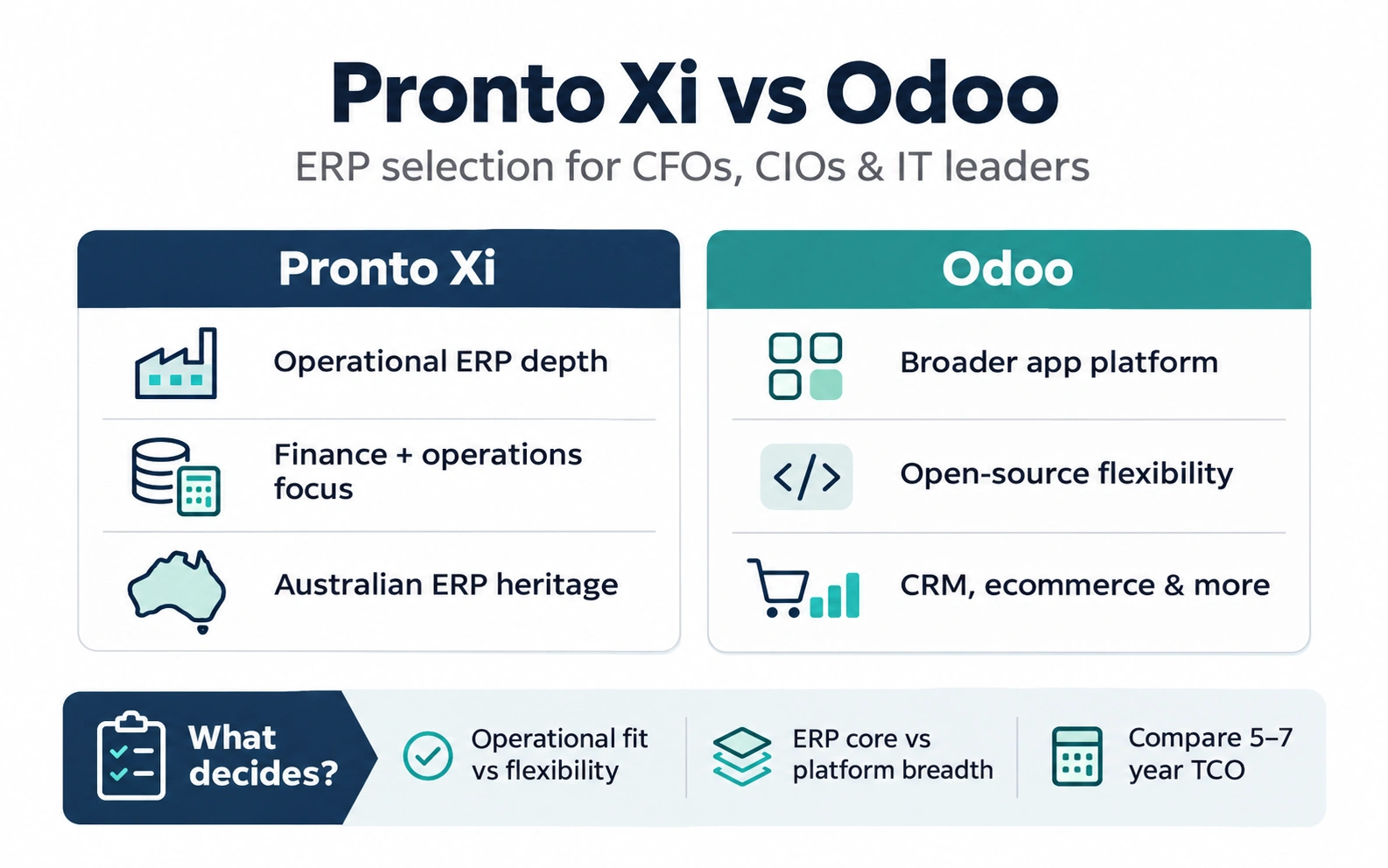
At a high level, Pronto Xi is more likely to appeal to organisations prioritising established Australian ERP depth across finance and operations, while Odoo is more likely to appeal to organisations prioritising application breadth, openness, extensibility and consolidation onto a broader business platform.
The real trade-off is operational fit versus flexibility, and control versus extensibility.
Executive decision summary: Pronto Xi or Odoo?
For most CFOs and CIOs, the choice can be reduced to one strategic question: Are you primarily selecting an ERP to run complex financial and operational processes, or a broader business platform you can extend across many functions?
Pronto Xi is more likely to fit if:
- Finance, inventory, purchasing, warehousing, manufacturing or distribution are central to the business.
- You want an established ERP core with strong Australian market experience.
- You prefer to meet requirements through standard ERP functionality where practical.
- Operational integration and control matter more than having the widest possible application catalogue.
- You want a comparatively bounded ERP ecosystem around the platform.
Odoo is more likely to fit if:
- You want ERP, CRM, ecommerce, website, projects, HR and other applications on a broader common platform.
- Open-source flexibility and extensibility are strategic priorities.
- You expect significant configuration or custom development.
- You are comfortable governing custom modules, implementation partners and upgrade dependencies.
- Application consolidation is as important as traditional ERP depth.
The deciding test
Choose Pronto Xi when operational ERP fit is the dominant requirement. Choose Odoo when platform breadth and extensibility are the dominant requirement. In both cases, validate the decision using your real processes, exceptions, integrations and reporting requirements.
Pronto Xi vs Odoo at a glance
| Decision area | Pronto Xi | Odoo |
|---|---|---|
| Core positioning | Integrated ERP and analytics platform | Broad open-source business application suite |
| Primary emphasis | Finance and operational ERP | ERP plus CRM, ecommerce, website, projects, HR and other applications |
| Financials | Integrated GL, AP, AR, fixed assets and operational postings | Accounting, invoicing, multi-company, multi-currency and localisations |
| Inventory & distribution | Inventory, purchasing, sales, WMS, forecasting, EDI and distribution capabilities | Inventory, purchasing, sales, barcode and logistics |
| Manufacturing | Shopfloor, planning, scheduling, MRP/DRP, BOMs and quality | Manufacturing orders, BOMs, work orders, shop floor, planning, quality and maintenance |
| CRM / digital | CRM, sales applications and B2B ecommerce | CRM, website, ecommerce, marketing, subscriptions and more |
| Integration | Pronto Connect APIs and Pronto Xi Sync | External API plus open-source/custom development ecosystem |
| Customisation model | Configuration, developer tools and APIs | Studio, source-code access, custom modules and community applications |
| Deployment | Pronto Cloud and supported hosting options | Odoo Online, Odoo.sh and on-premise |
| Australian context | Australian-developed ERP with local consultants and partner ecosystem | Australian fiscal localisation plus Australian implementation partners |
| Public software pricing | Quote based | Published per-user pricing |
| Implementation ecosystem | Vendor plus reseller/solution partner ecosystem | Odoo Direct plus broad certified-partner ecosystem |
What is Pronto Xi?
Pronto Xi is an Australian-developed ERP platform focused on integrated financial and operational management. Its documented product family includes Financials, Inventory, Purchasing, Sales, Warehouse Management, Supply Chain, Manufacturing, CRM, B2B ecommerce, Payroll and Resources, Asset and Facility Management, Business Intelligence and integration tools.
Pronto Xi's General Ledger is designed to receive automatic postings from operational modules, with subsidiary ledgers and the GL synchronised in real time. That operating model is particularly relevant for businesses where finance is tightly linked to inventory, purchasing, warehousing, manufacturing, distribution, service or project operations.
What is Odoo?
Odoo is a broad suite of open-source business applications. Alongside accounting, inventory, purchasing and manufacturing, its platform includes CRM, website, ecommerce, project management, HR, marketing, helpdesk, field service, point of sale and subscriptions.
Odoo's commercial model includes Standard and Custom plans, with the Custom plan supporting external APIs, Odoo Studio, Odoo.sh and on-premise deployment. This makes Odoo particularly relevant when an organisation wants to consolidate a wider set of business applications onto one platform.
Which businesses are more likely to suit Pronto Xi?
- Finance and financial controls are central to the operating model.
- Inventory, wholesale distribution or warehousing are operationally important.
- Manufacturing, supply chain, asset or service management are substantial requirements.
- Operational reporting and integrated finance-to-operations processes matter.
- Australian ERP expertise and a comparatively bounded ERP ecosystem are valued.
Typical strategic objective
Run complex operational and financial processes through an integrated ERP core.
Which businesses are more likely to suit Odoo?
- Application breadth is a strategic priority.
- CRM, website, ecommerce, projects, HR or marketing need to sit alongside ERP.
- Open-source extensibility and custom development are valued.
- Multiple deployment options are important.
- Application consolidation is a major goal.
Typical strategic objective
Replace several separate applications with a broader integrated business platform.
1. Finance: how tightly does ERP need to connect with operations?
Pronto Xi
Pronto Xi Financials includes General Ledger, Accounts Payable, Accounts Receivable, Fixed Assets, multi-company and multi-currency capabilities. A notable design characteristic is that operational transactions can post automatically into the General Ledger.
Odoo
Odoo provides integrated accounting and Australian localisation. Its Australian localisation includes GST configuration, BAS reporting, TPAR and payroll-related functionality. Odoo documents that BAS values can be calculated and audited within the system, although the BAS is not directly submitted to the ATO from Odoo.
Selection test
Ask both vendors to demonstrate: operational transaction → accounting treatment → reconciliation → management reporting, using your own business scenarios.
2. Inventory, distribution and supply chain
Pronto Xi
Pronto Xi documents functionality across Inventory, Purchasing, Sales, Warehouse Management, Distribution Requirements Planning, Advanced Forecasting, EDI, RF, ScanPack and Proof of Delivery.
Odoo
Odoo provides integrated Inventory, Purchase and Sales applications as part of its wider application suite.
Selection test
Test real scenarios involving multi-warehouse inventory, replenishment, supplier lead times, pricing, picking, dispatch, returns, EDI, freight, ecommerce, costing and approval controls.
3. Manufacturing: both have serious capability
Pronto Xi
Pronto's manufacturing product family includes Shopfloor, Planning, Scheduler, Laboratory and Quality Management, alongside MRP and related supply-chain functionality.
Odoo
Odoo Manufacturing supports manufacturing orders, work orders, multi-level BOMs, Shop Floor, planning, work-centre capacity, quality, maintenance, traceability and manufacturing cost analysis.
Selection test
Test your actual BOM complexity, routings, work centres, scheduling, labour, costing, quality, maintenance, traceability, subcontracting and production exceptions.
4. The hidden decision: ERP product versus ERP ecosystem
Buying ERP means selecting not only software, but also who implements it, who designs customisations, who supports it, who owns integrations, who handles upgrades and what skills must remain internally.
Pronto Xi ecosystem
Pronto Software works directly with customers during implementation and also operates through a solution-partner ecosystem. Buyers should assess delivery capability, industry knowledge, consultant availability, support ownership and specialist dependency.
Odoo ecosystem
Odoo offers both direct implementation and a broad partner ecosystem. Its flexibility can be valuable, but it makes partner selection and governance especially important where partners deliver significant custom development, integrations or industry-specific workflows.
Executive question
Are we choosing an ERP product we can govern, or creating an ecosystem dependency we do not fully understand?
5. Customisation: flexibility has an economic cost
Odoo's Custom plan supports Odoo Studio, external API access, custom development, Odoo.sh and on-premise deployment. Odoo also states that maintenance of custom code is not included in its standard subscription pricing.
Pronto provides developer tools, API capabilities and Pronto Xi Sync for extending and integrating the platform.
The critical question is not which ERP can be customised more. It is how much customisation the business will actually need, and who will own it through future upgrades.
- Development
- Testing
- Support
- Documentation
- Regression testing
- Integration impact
- Upgrade remediation
6. Integration: compare operating responsibility, not just APIs
Both platforms provide integration mechanisms. The presence of an API should be the beginning of the conversation, not the end.
- Authentication
- Required endpoints
- Transaction volumes
- Error handling
- Monitoring
- Middleware
- Security
- Upgrade compatibility
- Failure recovery
- Support ownership
CIO question
When an integration fails, who detects it, who fixes it, and how does the business recover?
7. Deployment: both offer options, but the models differ
Pronto Xi
Pronto provides Pronto Cloud and other supported hosting options within its ecosystem.
Odoo
Odoo offers Odoo Online, Odoo.sh and on-premise deployment, with the available options depending on the plan selected.
CIO decision
Compare hosting responsibility, backup, disaster recovery, patching, upgrade cadence, customisation restrictions, performance, security and exit options.
8. Pricing: licence price is not ERP cost
Odoo publishes subscription pricing, while Pronto Xi does not publish a directly comparable standard per-user price in the official material reviewed. That makes headline licence comparison potentially misleading.
The right comparison: 5–7 year total cost of ownership
1. Software: Subscription or licences; required modules; number and type of users.
2. Implementation: Discovery; process design; configuration; project management; testing; training; data migration.
3. Technology: Hosting; environments; backup; security; monitoring.
4. Integration and customisation: Interfaces; middleware; custom development; third-party modules; testing; documentation.
5. Ongoing operation: Support; internal ERP administration; reporting; integration maintenance; partner support.
6. Upgrades: Upgrade services; regression testing; custom-code remediation; integration changes; user retraining.
7. Business change: Internal project resources; backfill; process redesign; change management; transition productivity impact.
CFO principle
Do not compare an Odoo subscription price with a Pronto implementation quote. Compare complete lifecycle cost against equivalent business outcomes.
9. Australian context
Pronto is an Australian ERP developer with local consultants and a partner ecosystem. Odoo is a global platform but provides Australian fiscal localisation and has an Australian implementation-partner ecosystem.
Practical comparison
The meaningful question is which implementation and support model gives your business the depth of Australian financial, operational and industry capability it needs.
Pronto Xi vs Odoo: the executive trade-off
Pronto Xi is more likely to fit when:
- The ERP core is the priority.
- Finance and operations are tightly interconnected.
- Inventory, warehousing, manufacturing or distribution are central to the business.
- Australian ERP expertise is important.
- The organisation prefers an established, bounded ERP ecosystem.
Odoo is more likely to fit when:
- Application consolidation is a strategic objective.
- CRM, ecommerce, website, projects or HR need to sit alongside ERP.
- Open-source extensibility is valued.
- Greater customisation flexibility is required.
- The organisation is prepared to govern a broader partner and custom-development ecosystem.
These are selection tendencies, not rules. Actual fit must be validated against the organisation's processes.
Practical CFO/CIO evaluation scorecard
Score each ERP against your own business requirements. Do not assign generic industry scores.
| Decision area | Pronto Xi | Odoo | Evidence required |
|---|---|---|---|
| Financials & controls | ___ | ___ | End-to-end finance scenario |
| Inventory & distribution | ___ | ___ | Real operating process |
| Manufacturing | ___ | ___ | Actual production scenario |
| CRM / ecommerce | ___ | ___ | Required customer workflows |
| Reporting & analytics | ___ | ___ | Current management reports |
| Australian requirements | ___ | ___ | Compliance demonstration |
| Integration architecture | ___ | ___ | Interface design |
| Standard-functionality fit | ___ | ___ | Gap analysis |
| Customisation required | ___ | ___ | Customisation register |
| Implementation team | ___ | ___ | Named consultants |
| Partner dependency | ___ | ___ | Support ownership |
| Internal skills required | ___ | ___ | Capability plan |
| Upgrade complexity | ___ | ___ | Upgrade methodology |
| 5–7 year TCO | ___ | ___ | Full financial model |
Evaluation rule
Require evidence using your transactions, data, exceptions and reports, not only a scripted vendor demonstration.
Final perspective
Pronto Xi and Odoo are both capable ERP platforms, but they represent different strategic choices.
Pronto Xi is more likely to appeal to organisations prioritising established Australian ERP depth across finance and operations.
Odoo is more likely to appeal to organisations prioritising breadth, openness, application consolidation and extensibility.
Which platform supports our critical business processes largely through standard functionality, creates an architecture we can govern, and delivers an acceptable five- to ten-year lifecycle cost?
That is the comparison a CFO and CIO should take to the board.
Contact SAAPRO to discuss your requirement.
Disclosure: SAAPRO is an independent Pronto Xi recruitment specialist and is not the vendor of either platform. This article does not constitute a product endorsement. Vendors are welcome to provide corrections where publicly available information changes.
Frequently Asked Questions
There is no universal winner. Pronto Xi is more focused around integrated financial and operational ERP, while Odoo provides a broader open-source business application platform. The better choice depends on operational requirements, application strategy, customisation appetite, implementation capability and lifecycle cost.
Yes. Odoo provides accounting, purchasing, inventory, sales and manufacturing functionality alongside many other business applications.
Yes. Odoo provides Australian fiscal localisation including Australian accounting, BAS and TPAR-related functionality. Odoo documentation states that BAS values can be calculated within Odoo, while lodgement is handled outside the system.
Yes. Pronto's documented application family includes manufacturing, planning, scheduling, quality and related inventory and supply-chain capabilities.
Yes. Odoo Manufacturing includes work orders, multi-level BOMs, shop-floor functionality, work-centre capacity, quality, maintenance, traceability and manufacturing cost analysis.
Published software pricing alone is not enough to answer this. Odoo publishes subscription pricing, while comparable Pronto Xi public pricing is not available. Implementation, integration, customisation, hosting, support, upgrades and internal capability must also be included in total cost of ownership.
Key Takeaways
- ✓The real trade-off between Pronto Xi and Odoo is operational fit versus flexibility, and control versus extensibility.
- ✓Pronto Xi is more likely to fit when finance, inventory, warehousing, manufacturing or distribution are central and an established, bounded ERP ecosystem is preferred.
- ✓Odoo is more likely to fit when application consolidation, open-source extensibility and greater customisation flexibility are strategic priorities.
- ✓Do not compare an Odoo subscription price with a Pronto implementation quote; compare 5–7 year total cost of ownership against equivalent business outcomes.
- ✓Validate either ERP with your own transactions, data, exceptions and reports, not only a scripted vendor demonstration.
Sources · Last reviewed
- Pronto Software, What is ERP / product information
- Pronto Xi 780 ERP & Analytics overview (PDF)
- Pronto Xi 780 Financials overview (PDF)
- Pronto Software, About
- Pronto Xi 780 Pronto Xi Sync overview (PDF)
- Pronto Software teams with IBM to offer cloud integration services to the mid-market
- Introducing Pronto Cloud
- Odoo, Pricing
- Odoo, Australian fiscal localisation
- Odoo, Manufacturing features