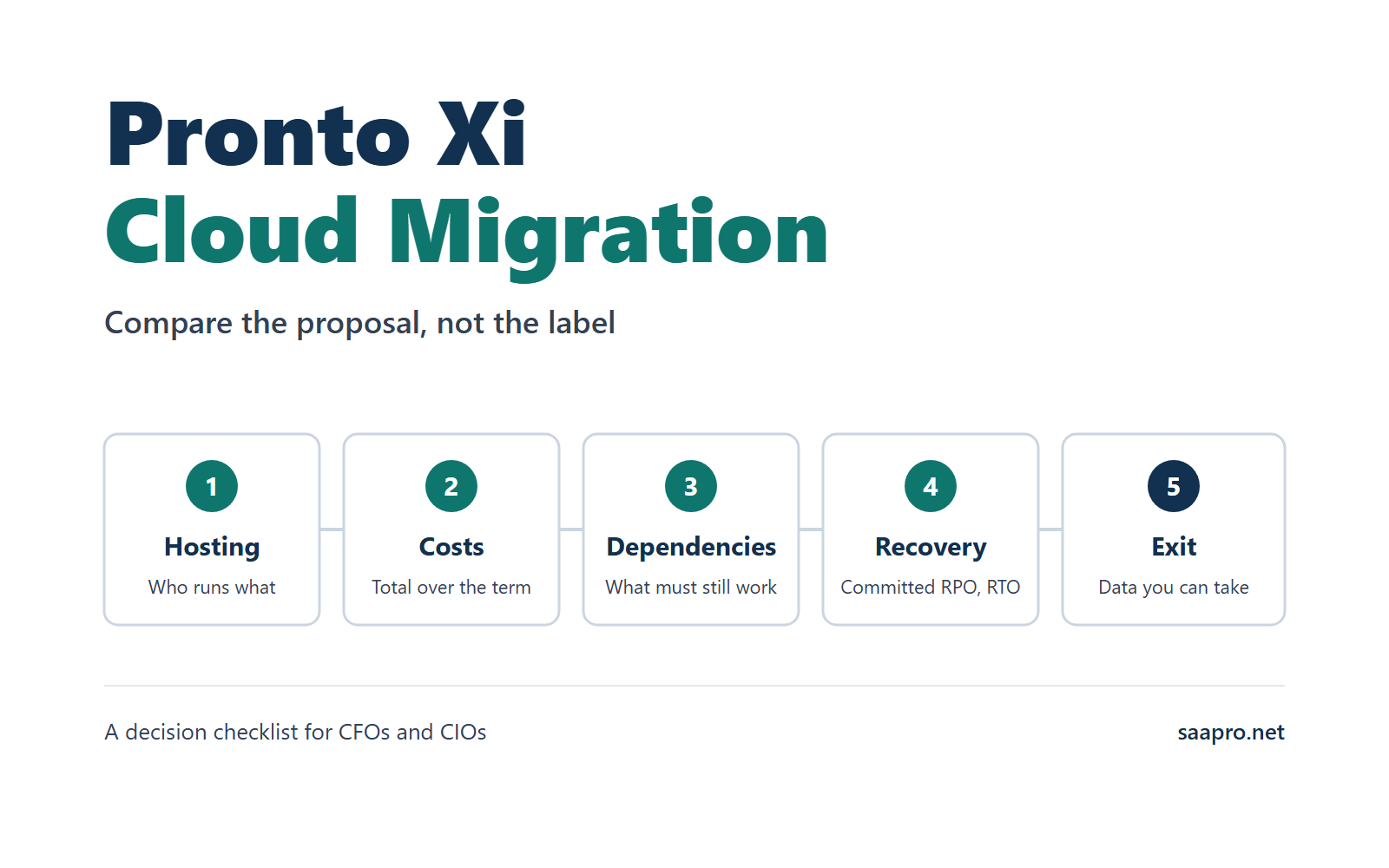
Pronto Xi Cloud Migration: A Decision Checklist for CFOs and CIOs
A decision checklist for moving Pronto Xi to the cloud, with ten tests for comparing proposals on responsibility, cost, customisations, recovery and exit, plus guidance on when not to move.
Short answer: Do not decide on "cloud" as a label. Decide on a specific written proposal, using ten tests (listed below). If a proposal fails a critical test, do not sign it. If it passes, compare it with your current arrangement on hosting, total cost, dependencies, recovery and exit. A cloud move pays off when those are clear and acceptable. It does not pay off simply because the infrastructure belongs to someone else. For some organisations, staying as they are, or hosting with different terms, is the better decision.
Important: several things that decide this move are specific to Pronto Xi and to your environment: how SaaS and hosted differ in tenancy, how customisations and custom code are handled, what licensing changes, what format your data takes on exit, and how recovery services behave in a real failover. Speak to a Pronto infrastructure consultant about those, and have a lawyer review the contract. This article gives you the questions and the decision framework, not those answers.
What Pronto actually offers
Pronto Software offers Pronto Xi in three deployment models: software as a service (SaaS, through Pronto Cloud), hosted, and on-premises. Its public pages describe them like this:
| Model | What Pronto's pages say | What to confirm |
|---|---|---|
| SaaS (Pronto Cloud) | Cloud-hosted ERP accessed from any device, with no installation, local storage or maintenance required; Pronto manages infrastructure and security | What "manages" covers and excludes; tenancy; customisation limits |
| Hosted | ERP runs on servers (owned, rented or Pronto-provided) with managed services, including updates and upgrades, on a monthly model | Who owns the servers; what the monthly fee includes; who decides upgrade timing |
| On-premises | You maintain infrastructure; Pronto offers optional consultation, backup and disaster recovery strategy help, and remote monitoring | Which services you would still buy, and from whom |
Pronto's pages also state that Pronto Cloud covers hosting and management of Pronto Xi, including application, web, file and database servers, cloud storage and identity and access management; that facilities are purpose-built data centres; that Pronto Cloud complies with ISO 27001 and ASAE 3402; that data is stored in Australia; and that data is retained in a standard format with full customer ownership.
Treat these as starting points for questions, not contract terms. The pages do not state pricing, contract terms or commitment periods, migration procedures between models, named data centre locations, or backup retention. The pages are also not fully consistent: one states a 99.99% uptime guarantee for hosting while another says "guaranteed uptime" without a figure. Your contract, not a web page, defines what is guaranteed, how it is measured, and the remedy if it is missed.
SAAPRO's guide to Pronto Xi makes the same point: neither deployment model is automatically safer, cheaper or more suitable.
The ten tests that decide it
Of the many questions you could ask, these ten decide most outcomes. Rate each proposal against them first, and use the detailed checklist afterwards.
| # | Test | Why it matters | Critical? |
|---|---|---|---|
| 1 | Responsibility matrix: who does what, in writing, for every layer | "Managed" means little until it is itemised | Yes |
| 2 | Customisations and integrations confirmed workable in the proposed environment, tested not assumed | The most common source of post-move surprises | Yes |
| 3 | Total cost over the full term, including extras, escalation and exit | Headline monthly price hides the real cost | Yes |
| 4 | Committed recovery targets (RPO and RTO) in the contract, with test evidence | Web page figures are not commitments | Yes |
| 5 | Exit proven: data extract tested by restoring it and running your reports | Exit rights you cannot use are worth nothing | Yes |
| 6 | Remedies that matter: what you actually get if service targets are missed | Small credits do not offset business harm | Medium |
| 7 | Security assurance relevant to your service: scope, period and exceptions | A certificate on the provider is not evidence about your service | Medium |
| 8 | Upgrade control: who decides timing and how your testing fits | Affects your ability to plan and to protect customisations | Medium |
| 9 | Performance from your real locations, tested | Remote sites, warehouses and devices expose problems | Medium |
| 10 | Internal capability to manage the arrangement | You still need Pronto Xi skills to hold the provider to account | Medium |
A simple go / no-go rule
- Do not sign if any critical test (1 to 5) is unresolved or answered with "not stated".
- Sign only with a named plan to close medium tests, with owners and dates.
- Stay put, or renegotiate your current arrangement, if the proposal does not beat your current position on total cost and risk after exit costs are included.
When not to move
A move may not be right now if:
- Your customisations or integrations are extensive and cannot be confirmed in the proposed environment.
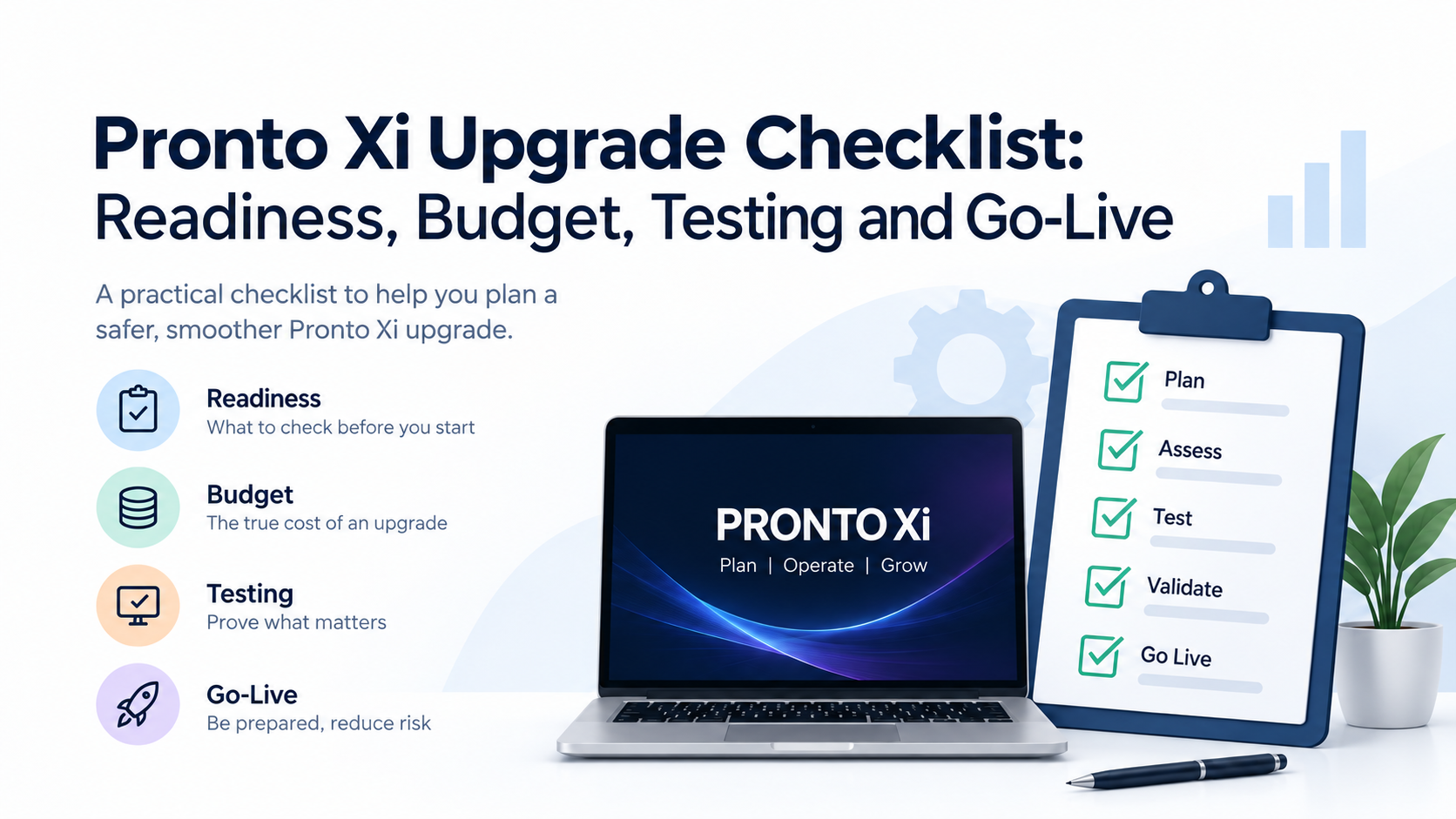
- You are about to upgrade or restructure and would be stacking several major changes at once. See our upgrade business case guidance.
- Data residency, regulatory or contractual obligations are not clearly met by the proposal.
- The total cost over the term is not lower or the risk is not lower, and the other benefits cannot be evidenced.
- You lack the capability to manage the provider, and cannot hire or contract it. See our guide to Pronto Xi roles.
- Exit terms are not acceptable. If you cannot leave on reasonable terms, you are buying dependency, not service.
The detailed checklist
Use this to compare each proposal, and your current arrangement as the baseline.
1. Hosting arrangements and shared responsibility
- A responsibility matrix: for each item (servers, database, application layer, storage, networking, identity, backups, monitoring, patching, upgrades, logging), who does it, who pays, who is accountable if it fails.
- Application-layer clarity: who patches and manages Pronto Xi itself, who manages user access, and who owns configuration changes?
- Environments: production, test, development and training. How many, how sized, what extra cost?
- Data location, including backups and recovery copies, in writing.
- The contracting parties and sub-contractors: who is accountable end to end, and what obligations flow down to sub-contractors?
- Availability commitment: the figure, how it is measured, what is excluded (for example planned maintenance), and the remedy.
- Support: hours, channels, response and resolution targets, escalation, and whether support staff have Pronto Xi skills or only infrastructure skills.
- Monitoring and logging: what is monitored, what you can see, and how long logs are kept.
- Access: what access do you have to the data and environment for reporting, integrations, audits and investigations?
- Control you give up: maintenance windows, change approval, server access, and the ability to run your own tools.
2. Security and assurance
- Certificate scope: does the ISO 27001 certificate cover the data centres, systems and services you would use?
- Assurance reports: for any ASAE 3402 report, ask whether it is a point-in-time or period-based report, which period it covers, which controls were tested, what exceptions were found, and which sub-service organisations were excluded.
- Independent testing: how often, by whom, and can you see a summary?
- Incident response: how quickly will you be told of a security incident, in what form, and what are the obligations to cooperate?
- Privacy and data handling: your obligations as the data owner continue. Confirm obligations with your legal and privacy advisers.
- Your own responsibilities: access control, user management and endpoint security remain with you.
3. Costs, over the full term
Compare total cost over the same term for every option. Pronto's pages describe a monthly model and low up-front investment for hosting, but your figures depend on the proposal.
- Recurring fees, and what drives them (users, modules, storage, environments, volumes).
- Variable and overage charges: storage growth, extra environments, extra users, bandwidth, out-of-hours support.
- Licensing: are Pronto Xi licence and subscription costs included, separate, or changed by moving? Confirm with Pronto.
- One-off costs: migration project, testing, integration rework, network changes, training, parallel running.
- Escalation and renewal: indexation, price-review rights and renewal terms.
- Recovery services: included, optional or extra. See Pronto Xi disaster recovery.
- Costs you will stop paying: hardware refresh, data centre or rack space, backup systems, some administration time. Count only those you will actually remove.
- Costs you will keep or add: internal Pronto Xi administration, vendor management, network upgrades, security and compliance work, integration support.
- Exit costs: include them from the start.
- Accounting treatment: confirm with your finance and accounting advisers rather than assuming.
4. Dependencies
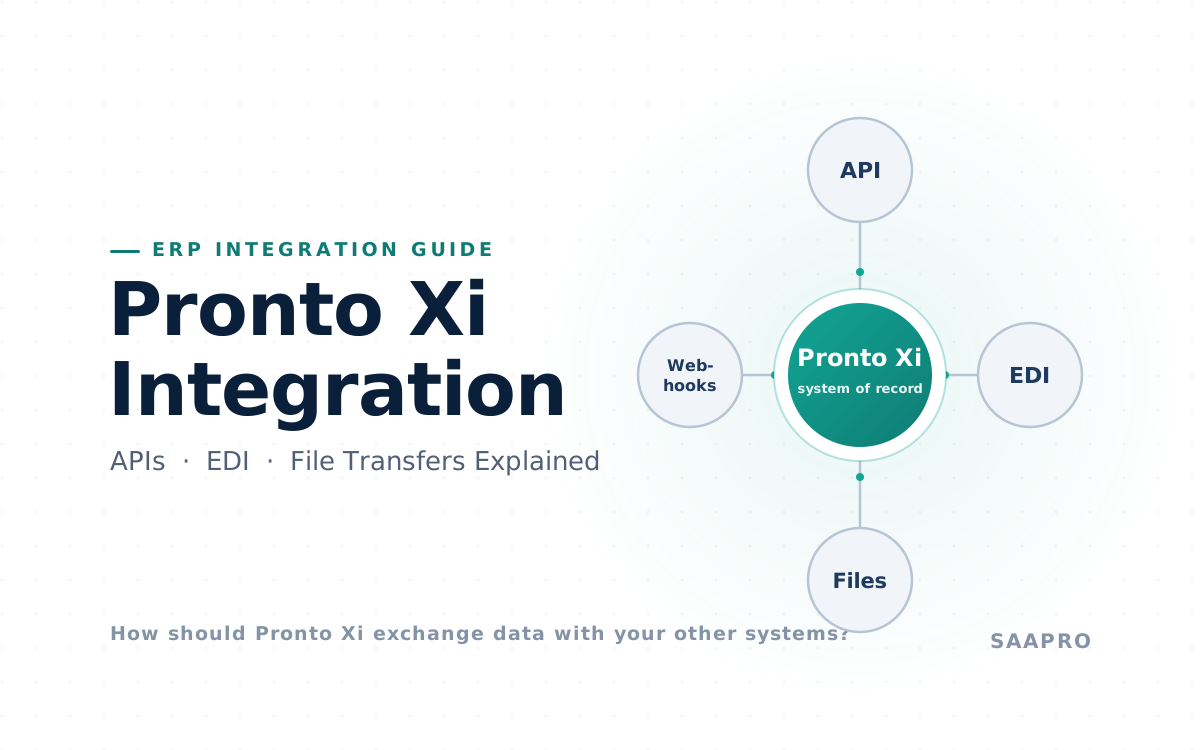
- Integrations: list every connected system (EDI, banks, ecommerce, logistics, reporting and others), how each connects, and whether it will still work from the new location with the same security and network paths. See our Pronto Xi integration guide.
- Reporting and analytics: where the embedded IBM Cognos Analytics integration or other reporting tools will run and connect.
- Customisations and custom code: which are in use, and whether each can be deployed and supported in the proposed arrangement. Confirm with a Pronto consultant.
- Network and performance: bandwidth, latency, remote sites, warehouse and shop-floor devices. Measure from real locations, with a baseline from today.
- Identity and access: how users authenticate and how it integrates with your directory.
- Devices and peripherals: printers, scanners, label printers, handhelds.
- Version and upgrade position: are you on a current release, and does the move depend on or trigger an upgrade?
- Other change in flight: avoid stacking several major changes.
5. Recovery
Ask for recovery commitments in writing and in numbers. Pronto describes System Recovery Service (SRS) for hosted and cloud-hosted customers and EverSync for on-premises organisations. Its public pages give differing figures for SRS and none for EverSync, so do not rely on a web page.
- Which recovery service is included, and which is optional?
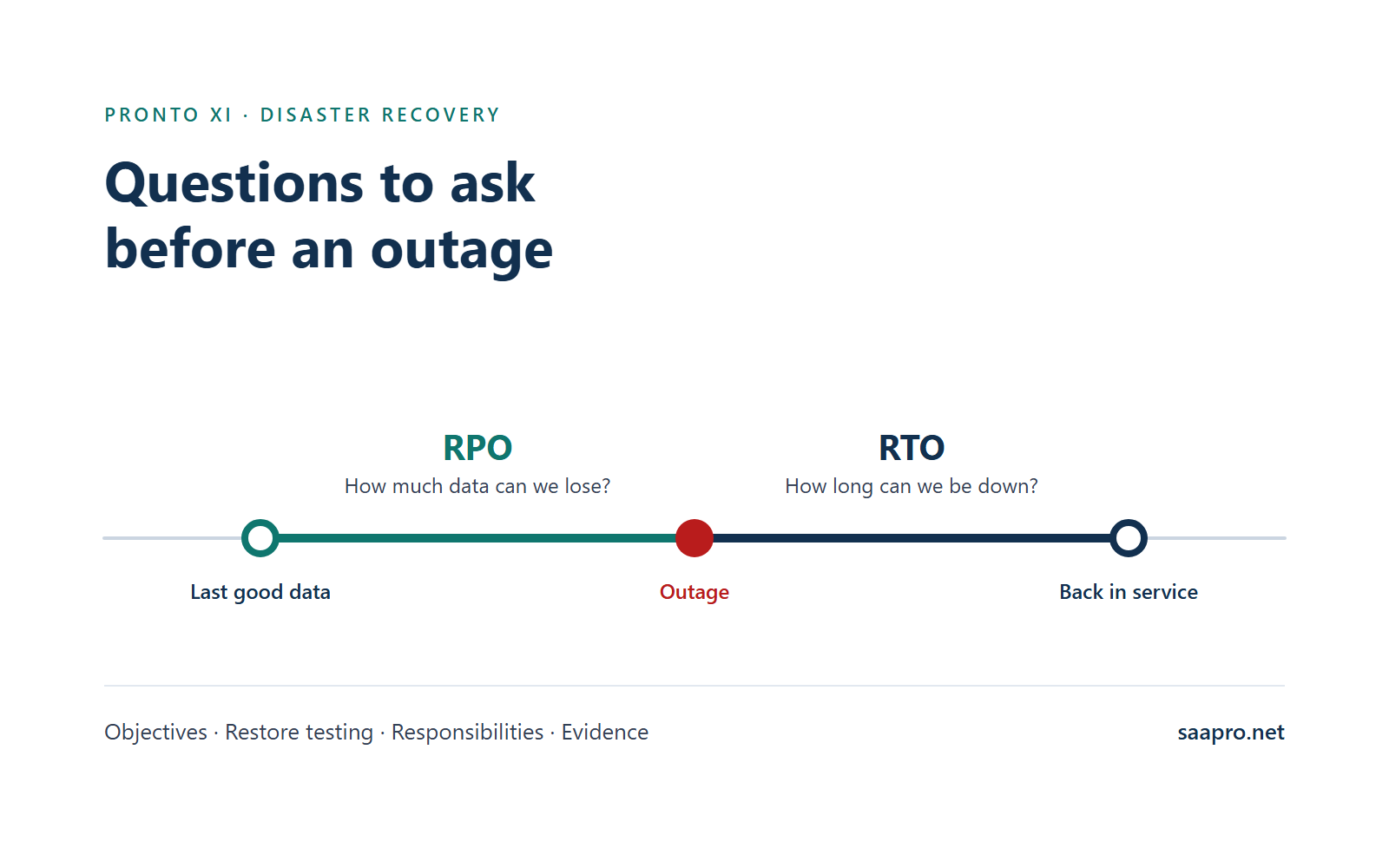
- Committed RPO and RTO in the contract, and for which scenarios.
- Protection against corruption, deletion and ransomware, not only hardware or site failure.
- Testing: how often, by whom, and what evidence you receive.
- Your responsibilities in a disaster, including validating data afterwards.
- Reconnection of integrations and users after failover.
See Pronto Xi disaster recovery: questions to ask before an outage.
6. Contract terms to review with your lawyer
The following are general topics to raise. They are not legal advice, and the right position depends on your circumstances and jurisdiction.
- Service levels and remedies: are remedies limited to small service credits, and is there a right to terminate for repeated or serious failure?
- Limits on liability: caps and exclusions, and how they compare with your potential loss from an outage or data breach.
- Termination: rights for cause and for convenience, notice periods, and minimum term.
- Pricing: indexation, price-review rights, and change-control for scope changes.
- Change of control, sub-contractor change or service withdrawal: your rights if the provider's circumstances change.
- Provider continuity: the provider's own business continuity arrangements and what happens to your service and data if the provider fails.
- Data protection and privacy obligations and breach notification.
- Audit rights: your ability to audit or obtain assurance.
- Governing law and dispute resolution.
- Intellectual property and custom code: who owns and can access custom work you depend on.
7. Exit provisions
Exit terms feel remote when you sign and are the hardest to negotiate later. Pronto's pages state that data is retained in a standard format with customer ownership; ask what that means in practice, and prove it.
- Data ownership stated in the contract, including backups and relevant logs.
- Extraction rights: what you can extract, when, how often, in what format, and at what cost.
- A proven extract: before signing, request a sample extract, restore it into a clean environment you control, run your key reports, and reconcile balances. If it cannot be done without the provider's tooling, understand what that means.
- Termination assistance: included or not, duration, and rates.
- A written exit plan agreed at the start, not at the end, covering who does what, in what order and how long.
- Return and deletion: how and when your data is returned and then securely deleted, and how that is evidenced.
- Moving elsewhere: technical or licensing barriers to moving to another host or back on-premises, with estimated cost and time.
- Records after exit: ability to meet statutory retention and audit needs.
- Escrow or access to code and configuration for anything custom you depend on.
Questions only a Pronto infrastructure consultant can answer
Speak to a Pronto infrastructure consultant, with your own environment in front of you, about each of the following. Do not accept generic answers; ask for them in writing.
- Tenancy and customisation. How do the SaaS and hosted models differ (for example shared versus dedicated environments), and what does that mean for customisations, custom code, and control over upgrade timing?
- Customisations and integrations. Which of ours can be deployed and supported as they are, which need rework, and which are not supported?
- Licensing. What changes to licensing or subscription arise from moving, and what applies at a recovery site?
- Data format on exit. What exactly do we receive, in what form, and can it be restored and used without the provider's tooling?
- Alternatives. Are other hosting options viable for Pronto Xi, such as a third-party host or self-managed infrastructure, and what would change in support and licensing?
- Recovery behaviour. How do the recovery services behave in a real failover for our environment? See our disaster recovery article.
- Performance. What sizing and network assumptions are made for our users, sites and devices?
- Upgrade path. If we are not on a current release, should the upgrade come before, during or after the move?
Compare proposals with a scorecard
Use "Not stated" rather than assuming. A proposal with many "Not stated" entries is not ready to compare.
| Test | Current | Proposal A | Proposal B |
|---|---|---|---|
| 1. Responsibility matrix provided | |||
| 2. Customisations and integrations confirmed | |||
| 3. Total cost over the term, including extras and exit | |||
| 4. Committed RPO and RTO in the contract, with test evidence | |||
| 5. Exit proven by a tested extract | |||
| 6. Remedies and liability position | |||
| 7. Security assurance scope, period and exceptions | |||
| 8. Upgrade control | |||
| 9. Performance tested from real locations | |||
| 10. Internal capability to manage | |||
| Critical tests (1 to 5) all passed? |
A CFO worksheet: total cost over the term
Use your own figures, and the same term for every option, for example five years.
| Cost line | Current | Proposal A | Proposal B |
|---|---|---|---|
| Hosting or infrastructure fees | |||
| Pronto Xi licence or subscription | |||
| Disaster recovery and backup | |||
| Internal and contractor administration | |||
| Network, security and compliance | |||
| Migration, testing and training (one-off) | |||
| Integration and customisation rework | |||
| Overage and escalation allowance | |||
| Exit costs | |||
| Total over the term |
Then test the answer:
- Time value: discount future costs using your organisation's usual method.
- Break-even: in which year, if any, does the proposal become cheaper than the current arrangement?
- Sensitivity: how does the total change if users, storage, transactions or environments grow faster than expected, or if the migration overruns?
- Risk: what is the cost of a serious outage or a forced exit, and how does each option change it?
- Benefits: count only what you can evidence in your own business, such as hardware renewals avoided or administrator time genuinely released. Do not use generic claims that cloud is cheaper.
Plan the migration itself
Moving environments is a project, not only a contract. At minimum plan for:
- Data migration and reconciliation, including a rehearsal. See Pronto Xi data migration checklist.
- Testing of integrations, reports, customisations and printing in the new environment.
- Performance and user acceptance testing from real sites.
- Cutover and rollback planning, and hypercare after go-live.
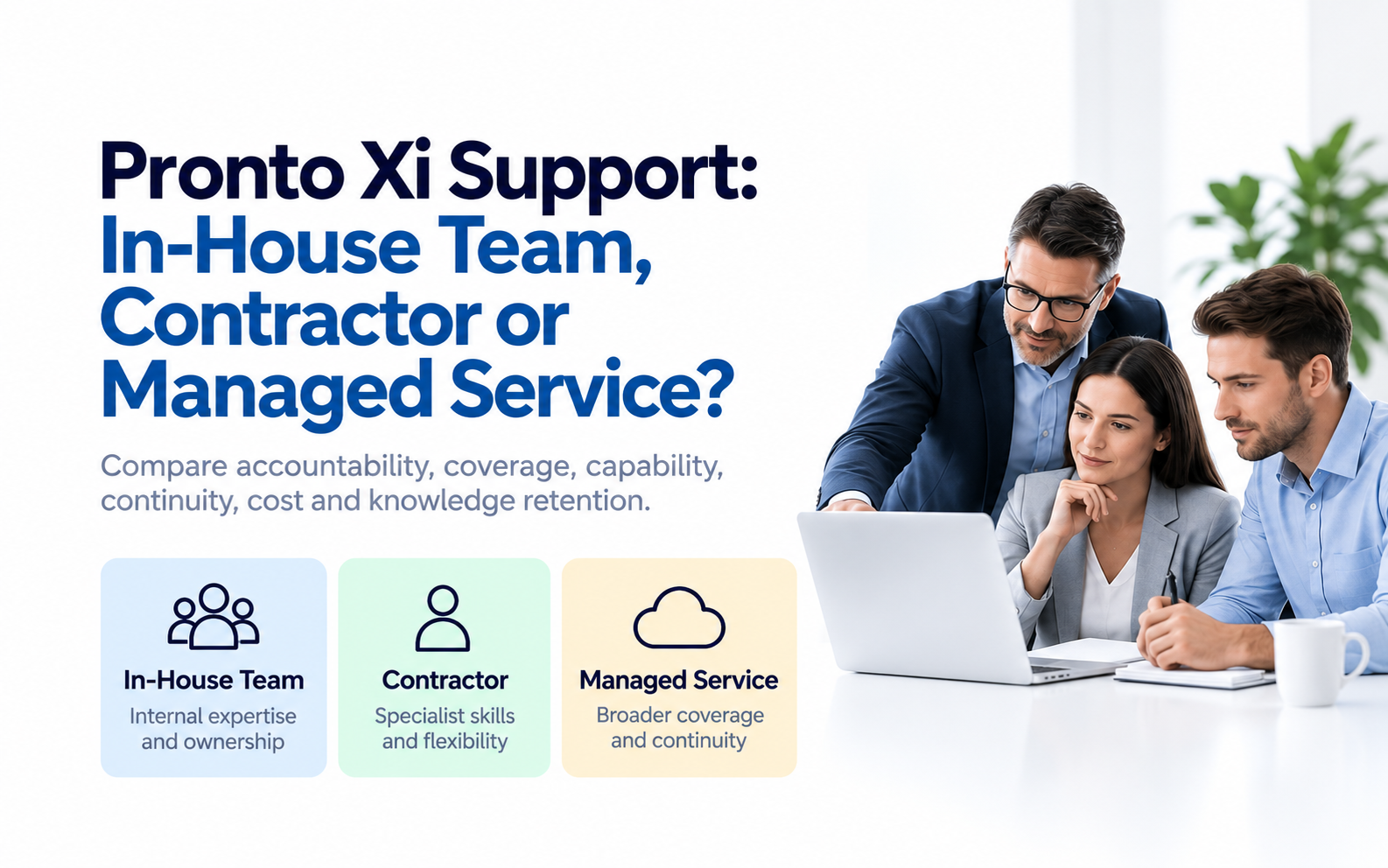
- Resourcing: Pronto Xi business analysts, functional consultants, system administrators and project managers who know your environment.
Warning signs in a proposal
- A monthly headline price with no list of what changes it
- "Managed" used without a responsibility matrix
- Availability or recovery figures that appear only in marketing material
- No test of data extraction, or exit terms described as "standard" but not provided
- Integrations and customisations assumed to work without testing
- No clear owner for upgrades and testing
- Sub-contractors not named
- Remedies limited to small credits
- Pressure to sign before due diligence is finished
Match the move to the expertise required
Identify the capability gap before signing: Pronto infrastructure expertise to assess proposals, project management and testing capacity to run the migration, or system administration to manage the provider afterwards.
Contact SAAPRO to discuss permanent or contract Pronto professionals who can help you evaluate and deliver the move.
Frequently Asked Questions
Yes. Pronto Software offers Pronto Xi as SaaS through Pronto Cloud, as a hosted service, or on-premises. Confirm the details of any specific arrangement in writing.
In SaaS, Pronto describes managing the infrastructure and security. In hosted, the ERP runs on servers (owned, rented or provided) with managed services. On-premises, your organisation maintains the infrastructure, with optional Pronto consultation and monitoring. Ask a Pronto infrastructure consultant how they differ in tenancy, customisation and upgrade control.
Not automatically. It depends on your proposal, your current costs and your term. Compare total cost over the full term, including migration, extras and exit costs, using your own figures.
When customisations or integrations cannot be confirmed in the proposed environment, when you would be stacking major changes, when obligations such as data residency are not clearly met, when the total cost and risk are not better than today, or when exit terms are unacceptable.
Pronto's hosting page states that data is stored in Australia. Confirm location, including backups and recovery copies, in your contract.
Pronto's pages state that data is retained in a standard format with full customer ownership. Confirm extraction rights, the format, termination assistance and charges in the contract, and prove it by restoring a sample extract and running your reports before you sign.
Pronto describes System Recovery Service and EverSync. Its public pages give differing figures for SRS and none for EverSync. Ask for the committed RPO and RTO, and the testing evidence, in your contract.
SAAPRO is a Pronto Xi-focused recruitment and staff augmentation firm operating in Australia since 2010. We help you find and place Pronto Xi business analysts, functional consultants, system administrators, ERP managers and project managers for your evaluation and migration team. We do not provide hosting, legal or implementation services.
Key Takeaways
- ✓Decide on a specific written proposal, not on "cloud" as a label.
- ✓Five critical tests decide most outcomes: a responsibility matrix, confirmed customisations and integrations, total cost over the term, committed RPO and RTO in the contract, and a proven exit. Do not sign if any of them is unresolved.
- ✓Treat Pronto's public pages as starting points for questions, not contract terms.
- ✓Compare total cost over the same term for every option, including migration, extras, escalation and exit costs.
- ✓Prove exit before signing by restoring a sample extract into an environment you control and running your key reports.
- ✓Staying put or renegotiating can be the better decision if a proposal does not beat your current position on both cost and risk.
- ✓Tenancy, customisations, licensing, exit data format and recovery behaviour need a Pronto infrastructure consultant, and the contract needs a lawyer.