Pronto Xi Inventory Accuracy: How to Investigate Stock and Valuation Differences
A practical framework for investigating why physical stock, Pronto Xi quantities and inventory values don't agree, from location, timing and UOM errors to costing and integration failures.
When physical stock, Pronto Xi quantities and financial inventory values do not agree, the discrepancy should be treated as a symptom, not immediately corrected as a counting error.
A material inventory variance can originate from several different places:
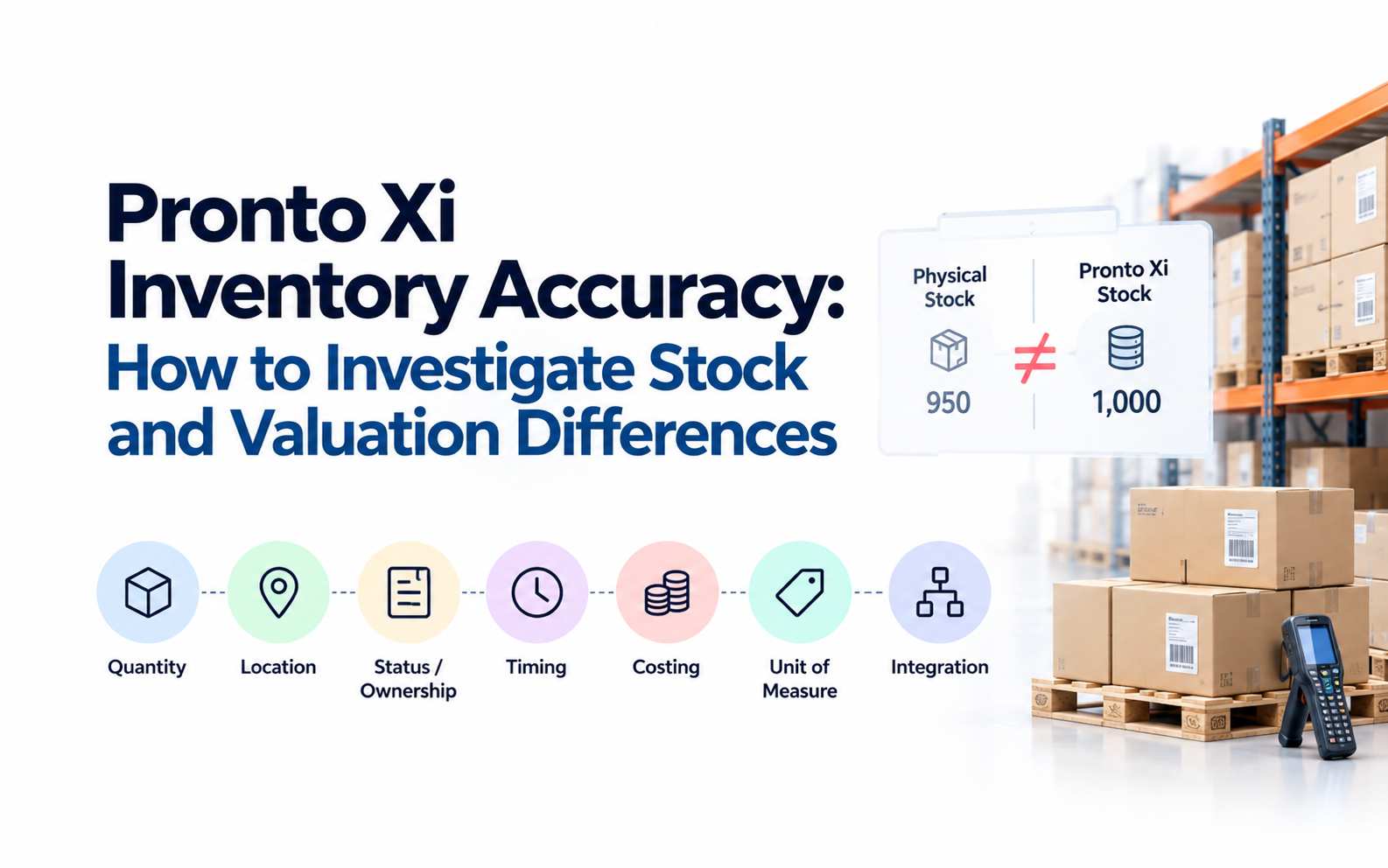
Quantity → Location → Status/ownership → Timing → Costing → Unit of measure → Integration
The first task is therefore to determine what type of discrepancy exists.
Only then should the organisation determine its root cause and corrective action.
That distinction matters because posting an inventory adjustment may make today's numbers agree while leaving the underlying process, master-data or integration problem untouched.
For CFOs and CIOs, poor inventory accuracy can affect:
- working capital;
- purchasing;
- customer fulfilment;
- gross margin;
- cost of goods sold;
- production planning;
- stock provisioning;
- financial reporting; and
- trust in the ERP.
Pronto Xi's published Inventory functionality includes transaction history by item and warehouse, source-document and financial information, inventory adjustments, multiple costing methods and inventory valuation reporting. Its WMS also supports locations, packaging configurations and unit-of-measure conversion factors.
The objective is not simply to make stock agree.
It is to establish:
What control failed, why did it fail, and what will prevent the discrepancy recurring?
What does inventory accuracy actually mean?
Inventory accuracy has more than one dimension.
1. Physical quantity
What physically exists in the warehouse, store, production area or other stock-holding location?
2. ERP quantity
What does Pronto Xi record as being on hand or associated with the relevant warehouse or location?
3. Location
Is the stock physically where Pronto Xi says it is?
The total quantity can be correct while individual warehouses, bins or logical locations are wrong.
4. Status or ownership
Is the inventory actually available and owned by the business?
Stock may be:
- awaiting putaway;
- quarantined;
- allocated;
- held for inspection;
- customer-owned;
- supplier-owned;
- consignment stock;
- in repair; or
- in transit.
Pronto Xi WMS, for example, supports logical holding states such as inventory awaiting putaway and non-pickable locations.
5. Financial value
Does the value attributed to the stock agree with the organisation's expected costing and accounting treatment?
These distinctions immediately narrow the investigation.
For example:
Physical quantity = 100
Pronto Xi quantity = 100
Financial value = wrong
This points away from counting and towards costing or valuation.
Whereas:
Physical quantity = 95
Pronto Xi quantity = 100
Unit cost = correct
suggests a movement, location, timing or transaction problem.
The seven-part Pronto Xi inventory investigation framework
| Investigation area | Main question |
|---|---|
| Quantity | Was the physical stock movement recorded correctly? |
| Location | Is the stock in the warehouse or location where Pronto Xi says it is? |
| Status / ownership | Is the stock available and economically owned by the business? |
| Timing | Are physical and ERP transactions being compared at the same cut-off? |
| Costing | Is quantity correct but valuation wrong? |
| Unit of measure | Was quantity converted correctly between pack sizes or units? |
| Integration | Was a transaction omitted, duplicated, rejected or processed out of sequence? |
These categories describe the symptom.
Once the symptom is understood, investigate the deeper root cause.
Symptom versus root cause
A mature investigation separates two questions.
What is wrong?
For example:
- quantity;
- location;
- cost;
- timing;
- UOM.
Why did it happen?
Root causes usually sit in one of five areas:
People → Process → Master data → Configuration → Integration/control design
For example:
Physical stock differs because a transfer was never completed.
That describes the symptom.
But the root cause might be:
Warehouse staff can physically move stock before the receiving location confirms the transfer, and no exception report identifies incomplete transfers.
Fixing only the quantity would not fix the control weakness.
1. Is the physical quantity actually wrong?
Start by comparing physical and ERP stock at a defined point in time.
Pronto Xi Inventory retains detailed transaction information for items and warehouses, including source documents, serial or lot information and associated financial details.
Possible causes of quantity differences include:
- goods physically received but not receipted;
- system receipt completed before goods arrived;
- goods picked but not despatched;
- stock transferred physically without completing the system transfer;
- stock returned physically but not processed;
- scrap or damage not recorded;
- production materials issued incorrectly;
- unused production materials not returned;
- manual inventory adjustments;
- duplicate movements;
- stock counted incorrectly.
Example
Pronto Xi shows 500 units, but the physical count finds 480.
Do not immediately post a -20 adjustment.
Ask:
- When was the inventory last known to be correct?
- What movements occurred after that point?
- Were any receipts or despatches incomplete?
- Were goods transferred between warehouses or locations?
- Are goods in staging, quarantine or returns?
- Did another system create the transaction?
- Were manual adjustments posted?
The adjustment should normally be the conclusion of the investigation, not its starting point.
2. Is the stock simply in the wrong location?
This deserves separate treatment from quantity.
Suppose Pronto Xi shows:
- Warehouse A: 70
- Warehouse B: 30
but physical counts show:
- Warehouse A: 50
- Warehouse B: 50
Total stock is correct.
The problem is not inventory quantity. It is location accuracy.
Potential causes include:
- incomplete transfer;
- incorrect warehouse selected;
- incorrect bin;
- stock physically moved before system confirmation;
- returns put into the wrong area;
- stock awaiting putaway;
- quarantine or inspection stock treated as available.
Pronto Xi WMS provides item location information and supports putaway processes and non-pickable locations.
Location accuracy matters because incorrect location data can still cause:
- failed picking;
- unnecessary replenishment;
- customer-service problems;
- duplicate purchasing;
- warehouse labour waste.
3. Is this an availability or ownership problem?
Physical possession does not always mean available inventory.
A warehouse may contain:
- consignment stock;
- customer-owned goods;
- supplier-owned stock;
- goods awaiting quality inspection;
- returns awaiting disposition;
- repairable stock;
- stock allocated to another order.
Pronto Xi Inventory supports quality control processes where goods may be held until released, rejected, scrapped or returned.
This matters because users may report:
“We have 50 units sitting in the warehouse, but Pronto says only 20 are available.”
The ERP may not necessarily be wrong.
The investigation should determine whether the difference is between:
physical possession and available-to-use inventory.
4. Could this simply be a timing difference?
Timing differences are common around:
- month-end;
- year-end;
- stocktake;
- manufacturing completion;
- warehouse despatch;
- overnight integrations.
Imagine goods physically arrive at 4:45 pm.
They are unloaded before close of business, but the purchase receipt is entered in Pronto Xi at 8:30 the next morning.
At midnight:
Physical inventory increased.
Pronto Xi inventory did not.
That does not necessarily indicate a permanent error.
The two systems of evidence simply represent different cut-off times.
Timing differences can also arise when:
- goods are despatched before system confirmation;
- interfaces process overnight;
- transfer transactions remain incomplete;
- production consumption posts after output;
- backdated transactions are entered;
- returns wait for inspection.
Critical control
Before investigating any variance, establish:
Are physical stock, Pronto Xi quantities and financial reports all being measured at the same cut-off?
If not, apparent errors may simply reflect transaction timing.
5. Is quantity correct but valuation wrong?
A valuation problem requires a different investigation.
Pronto Xi Inventory supports several cost measures, including standard, average, FIFO and actual cost, for purposes including posting, valuation and margin reporting. It can also produce valuation reports using different costing bases, while landed costs form part of shipment costing.
Potential causes of valuation differences include:
- wrong cost basis used in reporting;
- purchase price changes;
- average-cost movement;
- FIFO layers;
- landed-cost allocation;
- retrospective receipts or invoices;
- production costing;
- inventory adjustments;
- supplier invoice variances;
- negative-stock effects.
Example
Physical stock: 1,000 units
Pronto Xi stock: 1,000 units
Expected value: $100,000
Reported value: $117,000
A recount is unlikely to solve this.
Investigate:
- the relevant costing method;
- recent purchase costs;
- landed-cost postings;
- retrospective transactions;
- adjustments;
- production costs;
- the valuation basis used by the report.
Can negative inventory distort the investigation?
Potentially.
Where transactions result in inventory temporarily becoming negative, subsequent receipts and retrospective transactions can complicate cost analysis.
The practical questions are:
- When did quantity become negative?
- Which transaction caused it?
- What cost was applied at that point?
- What happened when later receipts were entered?
- Were transactions subsequently backdated?
- Did margin or valuation reports change as a result?
Negative inventory should therefore be investigated not only as a stock-control issue but, where relevant, as a costing and sequencing issue.
The exact behaviour depends on configuration and the transactions involved, so material cases should be validated against the organisation's Pronto Xi environment.
6. Could unit of measure be causing the difference?
UOM problems often produce distinctive discrepancies.
Pronto Xi WMS supports packaging configurations across several levels and allows dimensions, weights, conversion factors and GTINs to be defined for each unit of measure.
Consider:
1 carton = 24 each
If ten cartons are incorrectly interpreted as ten each:
Expected quantity = 240
Recorded quantity = 10
The physical count may be accurate. The supplier documentation may be accurate. The problem lies in conversion.
Investigate:
- purchase UOM;
- stock UOM;
- sales UOM;
- picking UOM;
- manufacturing UOM;
- supplier pack size;
- barcode or GTIN mapping;
- conversion factors;
- packaging changes.
A useful diagnostic clue is:
If the difference is a consistent multiple—6, 12, 24, 100—investigate unit-of-measure conversion early.
7. Could an integration be creating the discrepancy?
Pronto Xi environments often exchange inventory-related data with:
- WMS;
- ecommerce;
- freight;
- scanning;
- POS;
- manufacturing;
- EDI;
- logistics providers; or
- custom applications.
Pronto Connect supports integration with external applications through web services and real-time data exchange.
The presence of an API does not guarantee transaction accuracy.
A discrepancy can occur where a message is:
- never sent;
- sent twice;
- rejected;
- queued;
- mapped incorrectly;
- retried incorrectly;
- processed out of order.
Example
A scanner records despatch of 20 units.
The initial interface call fails.
A user manually retries the transaction.
The automatic retry later succeeds.
The result could become:
Physical stock: -20
Pronto Xi: -40
The warehouse process was correct.
The failure was in integration recovery.
The relevant control question is therefore:
Did one valid business event create exactly one correct inventory transaction in the correct location, UOM and period?
Pronto Xi inventory discrepancy decision tree
Use this sequence before making an adjustment.
Does physical quantity equal Pronto Xi quantity?
No
Investigate:
quantity → location → timing → UOM → integration
Yes
Then ask:
Does the financial value agree?
No
Investigate:
costing → landed costs → retrospective transactions → adjustments → valuation basis
Yes
There may be no true stock discrepancy. Check whether the issue is a reporting definition, availability status or location presentation.
Then use additional clues:
Is the difference a consistent multiple?
Check UOM and pack conversions.
Is one location short while another is over?
Check transfers, bin/location processing and putaway.
Does the discrepancy appear mainly around month-end?
Check cut-off and transaction timing.
Does it follow interface failures or retries?
Check integration monitoring, uniqueness and retry controls.
Does physical quantity agree but margin looks wrong?
Check costing and valuation.
This decision tree will not identify every cause, but it can prevent large amounts of unfocused investigation.
How material does a variance need to be before investigating it?
Not every discrepancy deserves the same level of analysis.
Investigation effort should reflect four factors:
Financial value
A $50 variance and a $50,000 variance usually justify different levels of review.
Recurrence
Ten small recurring differences may indicate a more important control problem than one isolated variance.
Operational impact
A low-value component that can stop production may deserve immediate attention.
Control significance
A discrepancy involving payroll, regulated goods, serialised stock or a critical interface may require investigation regardless of dollar value.
A useful principle is:
Materiality should consider value, recurrence, operational impact and control significance, not quantity alone.
Organisations should establish their own approval and investigation thresholds rather than rely on arbitrary universal numbers.
Who should investigate what?
Inventory accuracy is rarely owned by one department.
| Issue | Typical lead | Supporting roles |
|---|---|---|
| Physical count | Warehouse / Operations | ERP |
| Location discrepancy | Warehouse | ERP / WMS |
| Ownership/status | Operations | Finance |
| Timing/cut-off | Operations / Finance | ERP |
| Costing | Finance | Purchasing / ERP |
| UOM/master data | ERP / Master Data | Purchasing / Warehouse |
| Integration | IT / ERP | Operations |
| Financial reconciliation | Finance | ERP |
| Root-cause remediation | Process owner | Cross-functional team |
This prevents every inventory issue being handed to either Warehouse or Finance when the real cause may sit elsewhere.
Correct the balance, but also correct the cause
Sometimes Pronto Xi does need to be adjusted.
But a material adjustment should normally leave behind an evidence trail:
Difference → investigation → root cause → approval → adjustment → prevention action
For example:
Symptom: 48-unit stock shortage
Cause: Pallet UOM incorrectly mapped as cartons
Correction: Inventory adjusted and reconciled
Prevention: UOM master data corrected and validation added to receiving process
That is significantly more useful than:
“Stocktake variance adjusted.”
How should cycle counting be used?
Cycle counting should be risk-based rather than treating every SKU equally.
A useful model is:
A items
High value, business-critical or historically problematic stock.
Count frequently.
B items
Moderate value and operational importance.
Count at an intermediate frequency.
C items
Lower-risk inventory.
Count less frequently where appropriate.
Then add exception-triggered counts for items showing:
- repeated adjustments;
- negative inventory;
- unusual transaction activity;
- integration failures;
- frequent warehouse-location errors;
- high shrinkage;
- UOM complexity.
The purpose is not to increase counting indiscriminately.
It is to identify control failures earlier.
The hidden cost of poor inventory accuracy: the confidence tax
The financial impact of inaccurate inventory is not limited to the variance itself.
When employees stop trusting Pronto Xi, they often compensate by creating:
- spreadsheets;
- manual stock checks;
- extra safety stock;
- unnecessary expedited purchasing;
- duplicate reconciliations;
- conservative customer commitments;
- manual approval steps.
That creates what can be thought of as an inventory confidence tax.
The business pays twice:
- once for the inaccurate data; and
- again for all the work people perform because they do not trust it.
Pronto positions its ERP and integration architecture around keeping operational information connected and current.
The practical return depends on the organisation maintaining data that users are willing to rely on.
A useful ROI principle is therefore:
Better inventory accuracy increases the number of decisions that can safely be automated or made directly from Pronto Xi.
Pronto Xi inventory investigation checklist
When stock or valuation differs, work through these questions in order:
- Are physical and ERP quantities measured at the same cut-off?
- Has the physical count been independently verified?
- Is the stock in the correct warehouse and location?
- Is its availability or ownership status understood?
- Are receipts, issues, transfers and returns complete?
- Are transactions awaiting putaway, inspection or another status change?
- Are there backdated or incomplete transactions?
- Is negative inventory involved?
- Is the correct costing basis being examined?
- Have landed costs, supplier invoices or retrospective transactions changed value?
- Are purchasing, stocking and selling UOMs correct?
- Are pack conversions and GTIN mappings accurate?
- Have interfaces been checked for omissions, duplicates and retries?
- Do inventory values reconcile to Finance?
- Is the variance material because of value, recurrence or operational impact?
- Has the root cause been established before adjustment?
- Has a prevention action been assigned?
Repeated inability to answer these questions indicates a broader ERP governance issue rather than merely a stocktake problem.
Need Pronto Xi expertise to investigate recurring inventory problems?
Persistent inventory discrepancies can span Inventory, WMS, finance, master data, integrations and business processes.
If an investigation exposes gaps in Pronto functional, technical, BA or ERP-management capability, SAAPRO can help assess specialist availability in the Australian Pronto Xi market.
Disclosure: SAAPRO is an independent Pronto Xi recruitment specialist and is not Pronto Software vendor.
The appropriate treatment of an inventory discrepancy depends on the organisation's Pronto Xi release, modules, costing configuration, warehouse processes, integrations and accounting policies.
Frequently Asked Questions
Physical and Pronto Xi quantities can differ because of movement, location, timing, status, UOM or integration issues. Establish the same cut-off time, verify the physical count and trace receipts, issues, transfers, returns and external-system transactions before adjusting the ERP.
That usually points towards costing rather than stock quantity. Review the applicable cost basis, recent purchasing, landed costs, retrospective transactions, inventory adjustments and the valuation basis used by the report. Pronto Xi maintains multiple inventory cost measures for valuation and posting purposes.
Yes. Inventory may be in a different location or status, such as awaiting putaway, inspection or another non-pickable state. Physical possession and available inventory are therefore not always the same measure.
Yes. Incorrect conversions between units, cartons, pallets, weights or other pack levels can multiply a small transaction error. Pronto Xi WMS allows multiple packaging levels and conversion factors, making master-data accuracy important.
Yes. Missing, duplicated, rejected or incorrectly retried messages can create stock differences even when the physical warehouse process is correct. Integration controls should verify one valid business event results in one correct ERP transaction.
Not before material variances have been investigated. An adjustment may correct the immediate balance without correcting the underlying process, data or integration failure. Material adjustments should ideally retain evidence of cause, approval and prevention action.
The frequency should reflect business risk. High-value, fast-moving, critical or historically inaccurate inventory may justify frequent cycle counting, while lower-risk stock can be reviewed less often. Recurring exceptions should trigger additional counts regardless of normal frequency.
Key Takeaways
- ✓Inventory discrepancies are symptoms. The real task is to find the control failure that created them.
- ✓A disciplined investigation follows this path: Define the difference → classify the symptom → trace the transactions → identify root cause → reconcile the financial impact → correct the balance → prevent recurrence
- ✓For Operations, that means understanding what physically happened.
- ✓For Finance, it means validating quantity, costing and ledger impact.
- ✓For IT, it means determining whether configuration, data or integrations altered the transaction.
- ✓For the CFO and CIO, the wider objective is protecting trust in Pronto Xi.
- ✓The hidden cost of poor inventory accuracy is not simply the value of the adjustment. It is the confidence tax paid every time employees feel they must check the ERP with a spreadsheet, physical count or manual workaround before making a decision.
- ✓The goal should not be perfect stock only on stocktake day. It should be an operating environment where purchasing, fulfilment, planning and financial decisions can safely rely on Pronto Xi throughout the year.