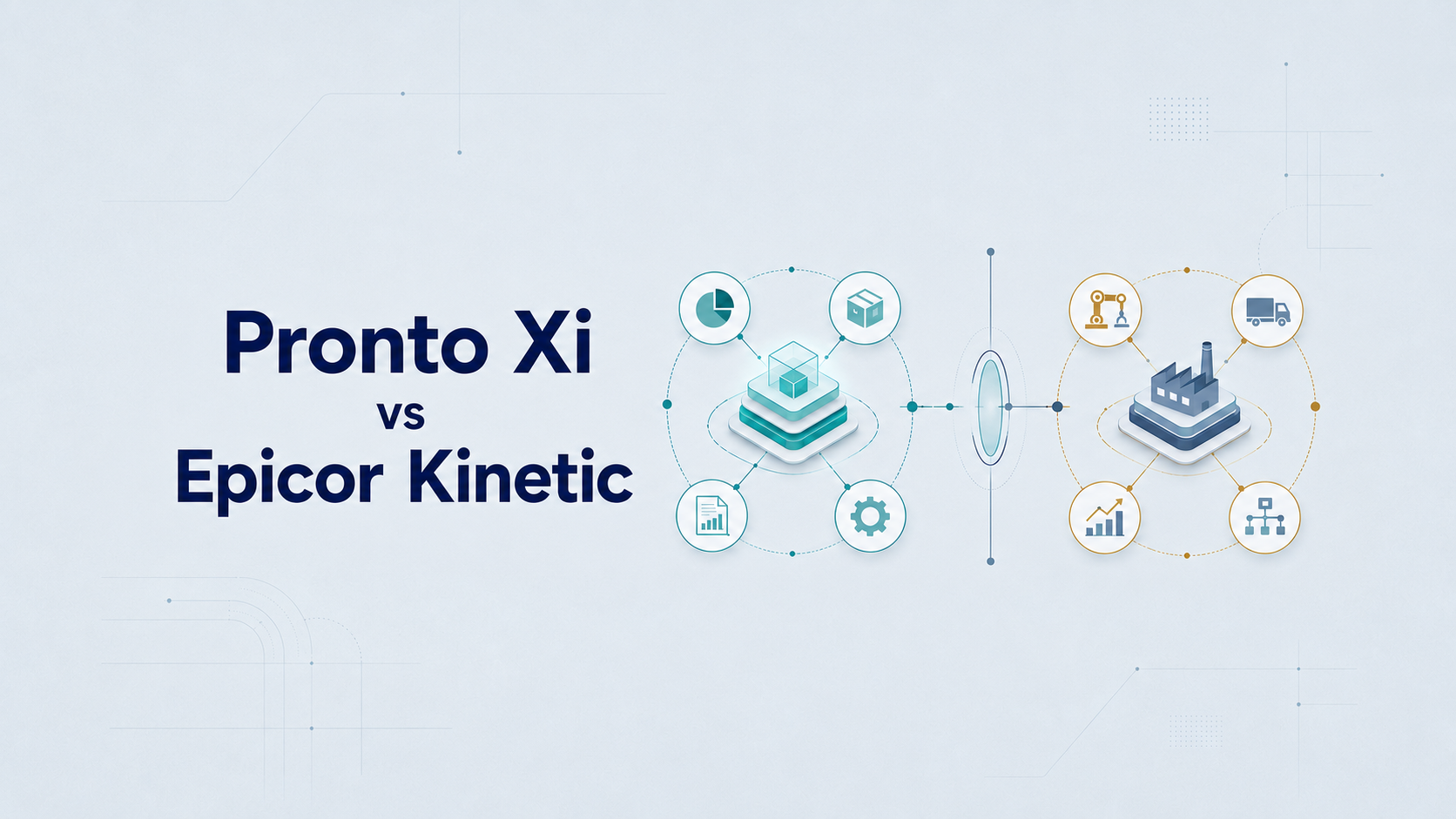
Pronto Xi vs Epicor Kinetic: Which ERP Is the Better Fit for Your Business?
An objective guide to comparing Pronto Xi and Epicor Kinetic for Australian mid-market businesses, evaluating operational fit, manufacturing depth, cloud strategy, and total cost of ownership to help you choose the right ERP.
Choosing between Pronto Xi and Epicor Kinetic is not simply a software decision.
The selected ERP may shape how an organisation manages finance, inventory, manufacturing, supply chain, assets, customer orders, reporting and technology investment for the next decade.
It may also affect:
-
The amount of process standardisation required
-
The level of customisation and technical debt
-
The availability of specialist skills
-
The cost and control of future releases
-
The reliability of management information
-
The organisation’s ability to scale across sites, entities and countries
Both are credible, modular ERP platforms. However, their published positioning reflects different areas of emphasis.
Pronto Xi is an Australian-developed ERP and analytics platform covering financials, distribution, supply chain, manufacturing, retail, assets, service, payroll and reporting. It supports cloud-hosted and on-premises deployment models. Epicor Kinetic is Epicor’s manufacturing-focused ERP platform, with published capabilities across production, planning, scheduling, product management, finance, projects, service and multi-site operations. Epicor’s strategic direction is increasingly cloud-led.
The answer in brief
There is no universal winner.
Pronto Xi may be the stronger shortlist option for Australian mid-sized organisations seeking broad operational coverage across distribution, inventory, retail, assets, service, payroll and manufacturing—particularly where local capability and deployment flexibility are important.
Epicor Kinetic may be the stronger shortlist option where manufacturing is the centre of the operating model and the organisation requires advanced production planning, scheduling, engineering, multi-site operations or a global cloud-led platform.
These are selection hypotheses, not definitive conclusions.
The correct choice depends on four types of fit:
- Product fit: Can the software support the required processes?
- Architecture fit: Does it align with the organisation’s cloud, security, integration and data strategy?
- Delivery fit: Can the proposed implementation team deliver it reliably?
- Operating fit: Can the organisation support and improve it after go-live?
A product can win a feature comparison and still be the wrong strategic decision.
Methodology: This article compares current publicly stated capabilities and positioning from Pronto Software and Epicor. It is not an independent technical benchmark. Material requirements should be validated through detailed demonstrations, solution design, customer references and proof-of-concept testing.
Pronto Xi and Epicor Kinetic at a glance
Both products are modular. Buyers should compare the exact proposed licence bundles, editions and services—not assume every capability in a vendor’s wider portfolio is included.
| Area | Pronto Xi published emphasis | Epicor Kinetic published emphasis | What buyers should validate |
|---|---|---|---|
| Overall position | Broad ERP and analytics coverage across several operational models | Manufacturing-centred ERP with global and cloud capabilities | Which platform supports the critical processes with less customisation? |
| Manufacturing | Manufacturing integrated with finance, inventory, purchasing and supply chain | Strong emphasis on production, product data, planning and scheduling | Demonstrate the most complex production scenarios |
| Distribution | Inventory, purchasing, sales, forecasting, WMS, EDI and fulfilment | Inventory and supply-chain processes connected to manufacturing | Test warehouse, replenishment and customer-order exceptions |
| Finance | Multi-company and multi-currency financials integrated with operations | Global financial management, currencies, allocations and multi-company requirements | Compare consolidation, reporting and localisation |
| Payroll | Published integrated Australian payroll functionality | Proposed Australian payroll design should be confirmed | Is payroll native, separately licensed or integrated? |
| Analytics | IBM Cognos Analytics integrated with Pronto Xi | Kinetic analytics plus adjacent Epicor products such as EDA, powered by Phocas | Compare included licences, self-service and internal skill requirements |
| Deployment | Cloud-hosted and on-premises options | Cloud-led direction with a published transition from new on-premises feature releases | Confirm current roadmap, support terms and exit arrangements |
| Extensibility | APIs, SDK and Pronto 4GL development environment | APIs, integration services and configurable application tools | Assess lifecycle cost and release impact of customisations |
| Likely fit | Operationally diverse Australian mid-market organisations | Manufacturing-led, multi-site or internationally complex organisations | Validate against actual processes and future strategy |
The comparison reflects vendor-published emphasis rather than independently measured superiority.
1. Operating-model and industry fit
The most important question is not:
Which ERP has more functionality?
It is:
Which ERP most closely reflects how our organisation creates value?
Where Pronto Xi may fit well
Pronto Xi publishes integrated applications across:
-
Financial management
-
Inventory, purchasing and sales
-
Supply-chain and warehouse management
-
Manufacturing
-
Retail and ecommerce
-
Asset and maintenance management
-
Projects and service
-
Australian payroll
-
Analytics
This breadth may be attractive where the business has a mixed operating model.
For example, an Australian organisation may need to manage:
-
Imported inventory
-
Several warehouses
-
Wholesale and retail transactions
-
Customer-specific pricing
-
Equipment maintenance
-
Field service
-
Local payroll
-
Financial and operational reporting
Pronto Xi’s potential advantage in this scenario is not that every module will necessarily be superior in isolation. It is the possibility of supporting several connected functions within one Pronto-centred environment.
Where Epicor Kinetic may fit well
Epicor positions Kinetic around manufacturing and the wider “make” economy. Its published coverage places substantial emphasis on:
-
Production management
-
Product and engineering data
-
Material planning
-
Resource planning
-
Scheduling
-
Projects
-
Financials
-
Multi-site and global operations
This may be particularly relevant where manufacturing is the centre of the operating model rather than one function among many.
Examples include:
-
Engineer-to-order production
-
Configure-to-order products
-
Complex bills of materials
-
Multi-stage routing
-
Capacity-constrained scheduling
-
Job shops
-
Multi-plant production
-
Detailed production costing
Selection hypothesis
Pronto Xi may deserve greater consideration where the organisation requires broad coverage across distribution, retail, assets, service, payroll and manufacturing.
Epicor Kinetic may deserve greater consideration where advanced manufacturing processes and global production standardisation dominate the business case.
Neither conclusion should be accepted until both vendors demonstrate the organisation’s actual processes.
2. Manufacturing, planning and supply chain
Both platforms support manufacturing and supply-chain operations, but the required depth should be examined carefully.
Pronto Xi
Pronto publishes manufacturing functionality covering areas such as:
-
Product data
-
Manufacturing planning
-
MPS and MRP
-
Scheduling
-
Work orders
-
Shopfloor processes
-
Materials and resources
-
Costing
-
Quality
-
Multi-site planning
Its manufacturing applications operate within the broader Pronto Xi environment, including inventory, purchasing, supply chain, financials and analytics. Pronto Xi also publishes substantial supply-chain coverage, including forecasting, inventory control, warehouse operations, scanning, picking, packing, dispatch and EDI-related processes.
Epicor Kinetic
Epicor’s published Kinetic materials emphasise manufacturing planning, scheduling and production visibility for both single-site and global manufacturers.
Its planning and scheduling capabilities include forecasting, MRP, resource planning and advanced scheduling options. Some advanced capabilities or related Epicor products may require additional licensing and should be identified clearly in the proposed scope.
What should be demonstrated
A manufacturing-led organisation should ask both vendors to complete scenarios involving:
-
Complex bills of materials
-
Alternative production methods
-
Material shortages
-
Finite capacity
-
Rework and scrap
-
Subcontract operations
-
Labour and machine costing
-
Quality holds
-
Engineering changes
-
Production rescheduling
-
Multi-site supply
-
Actual-versus-standard costing
A generic demonstration of creating a work order is insufficient.
The evaluation should determine how each platform behaves when real operations deviate from the ideal process.
3. Finance, Australian payroll and reporting
For CFOs, ERP selection should begin with control, visibility and the ability to connect financial outcomes to operational activity.
Financial management
Pronto Xi Financials publishes support for multiple companies, currencies, budgets, hierarchies and cost centres. It is integrated with Pronto’s operational applications.
Epicor Kinetic Financial Management publishes configurable accounting, allocation, currency, taxation and global-management capabilities. Epicor also offers adjacent applications for areas such as planning, forecasting and analytics; buyers should distinguish between functionality included in Kinetic and separately licensed products.
CFOs should ask both vendors to demonstrate:
-
Multi-company reporting
-
Intercompany transactions
-
Multi-currency processing
-
Consolidation
-
Budgeting and forecasting
-
Cash-flow visibility
-
Inventory valuation
-
Manufacturing variances
-
Project profitability
-
Approval controls
-
Audit trails
-
Month-end processing
-
Management-report production
Australian payroll and localisation
Pronto Xi publishes a fully integrated payroll application designed for Australian organisations, including multiple pay frequencies and employee self-service functionality.
Epicor buyers should confirm the exact Australian payroll and localisation architecture proposed, including whether requirements are delivered through Kinetic, another Epicor product, a local solution or third-party integration.
The evaluation should cover:
-
Australian payroll and superannuation
-
Single Touch Payroll
-
GST and taxation
-
Banking
-
Statutory reporting
-
Local support
-
Data residency
-
Any award or enterprise-agreement complexity
Being Australian-developed is not automatically a business advantage. It becomes relevant when it produces measurable benefits in localisation, implementation capability, support access or regulatory alignment.
Analytics and business intelligence
Pronto Xi includes reporting and analytics powered by IBM Cognos Analytics, including report authoring, scheduling, visualisation and dashboards.
Epicor publishes Kinetic business-intelligence capabilities and offers adjacent analytics products, including Epicor Data Analytics powered by Phocas. Buyers should establish which capabilities are included in the proposed solution and which require additional subscriptions or implementation.
The better reporting platform is not necessarily the one with more dashboards. The organisation should test:
-
Can finance maintain its own reports?
-
Can analysts combine ERP and external data?
-
Can users drill from KPIs into transactions?
-
Is data sufficiently current?
-
Are KPI definitions governed?
-
Which specialist skills are required?
-
What is the cost of adding or changing reports?
AI features should receive material selection weight only when they are generally available, included in the proposed contract, secure and proven against a relevant business process.
4. Cloud, architecture and integration
Cloud direction is one of the more important strategic differences for CIOs and CTOs.
Pronto Xi deployment direction
Pronto Xi currently publishes cloud-hosted and on-premises deployment options. This may appeal to organisations that require flexibility because of existing infrastructure, remote operations, connectivity, data policy or internal technology strategy.
Epicor Kinetic deployment direction
Epicor positions Kinetic as a cloud ERP and has publicly announced a planned final on-premises Kinetic feature release of 2028.1, tentatively scheduled for January 2028. Buyers should verify the latest timeline and support terms directly with Epicor because roadmap policies can change.
For a new selection, Epicor Kinetic should therefore be assessed primarily as a cloud-led strategic direction.
Architecture questions
CIOs and CTOs should evaluate:
-
Data residency
-
Availability commitments
-
Backup and disaster recovery
-
Cybersecurity
-
Identity and access management
-
Integration latency
-
Release control
-
Test environments
-
Customisation compatibility
-
Internal infrastructure requirements
-
Data portability
-
Exit arrangements
Integration and extensibility
Pronto publishes API and web-service capabilities, together with an SDK and proprietary development environment. These can support tailored integrations and extensions, but long-standing Pronto environments may also contain historical 4GL modifications that need careful review.
Epicor publishes integration, API and application-configuration capabilities across Kinetic and its wider data and integration portfolio. The proposed architecture should identify which services are included, separately licensed or provided by a partner.
For either platform, buyers should ask:
-
Which integrations are standard?
-
Which require custom development?
-
Are transactions real-time, scheduled or both?
-
How are failures detected?
-
Can failed transactions be retried safely?
-
How are changes version-controlled?
-
What happens during product releases?
-
Who owns custom code and documentation?
-
Can the implementation partner be changed?
-
How easily can data be extracted?
Low-code tools and APIs do not remove architectural risk. Poorly governed configuration can still create support and upgrade complexity.
5. Delivery fit, talent and total cost of ownership
ERP outcomes depend on more than product capability. The proposed implementation partner, internal team and post-go-live operating model can materially affect cost and risk.
Delivery fit
Assess:
-
The partner’s experience in the organisation’s industry
-
Experience with the proposed modules
-
Availability of senior consultants
-
Data-migration capability
-
Integration capability
-
Testing methodology
-
Knowledge-transfer commitments
-
Local support coverage
-
Customer references
-
Escalation arrangements
A global product implemented by an unsuitable partner may create more risk than a less extensive product delivered by a highly capable team.
Operating fit
The organisation should identify who will own:
-
ERP administration
-
Business processes
-
Data quality
-
Reporting
-
Integrations
-
Security
-
Vendor management
-
Release testing
-
Continuous improvement
Pronto Xi has a specialised professional ecosystem, particularly in Australia. Epicor has a broader international presence, but the availability of relevant Kinetic manufacturing expertise may vary by location and industry.
The meaningful question is not how many consultants exist globally.
It is:
Can we secure and retain people who understand both the ERP and our operating model?
Total cost of ownership
Compare equivalent five-year solution designs covering:
-
Software subscriptions or licences
-
Implementation
-
Data migration
-
Integration
-
Custom development
-
Reporting and analytics
-
Testing
-
Training
-
Internal project resources
-
Infrastructure
-
Support
-
Additional vendor products
-
Release management
-
Specialist recruitment or contracting
The lower initial proposal can become the more expensive solution if it requires extensive customisation, multiple add-on products or continuing consultant dependency.
6. Which ERP is likely to suit your organisation?
Pronto Xi may be the stronger shortlist option when:
-
The organisation primarily operates in Australia.
-
It requires broad coverage across distribution, inventory, retail, assets, service, payroll and manufacturing.
-
Integrated Australian payroll is important.
-
Manufacturing is significant but not the sole centre of the operating model.
-
Cloud-hosted and on-premises flexibility remains strategically relevant.
-
Local Pronto expertise, support and existing integrations can be retained.
-
The organisation wants to consolidate several operational functions within a Pronto-centred environment.
Epicor Kinetic may be the stronger shortlist option when:
-
Manufacturing is the centre of the operating model.
-
Complex planning, scheduling, engineering or production control is critical.
-
The organisation operates across multiple plants, entities or countries.
-
A cloud-led ERP strategy is accepted.
-
Global manufacturing standardisation is a major objective.
-
The organisation is prepared to assess and license the required Epicor applications around Kinetic.
-
Experienced Epicor manufacturing resources are available.
Neither platform should be selected until the organisation has:
-
Defined critical end-to-end processes
-
Agreed measurable business outcomes
-
Assessed data quality
-
Documented Australian and international localisation requirements
-
Identified integrations
-
Evaluated internal capability
-
Compared equivalent five-year costs
-
Completed reference checks
-
Tested realistic scenarios
Proof-of-concept scenarios
Do not select either platform based solely on scripted vendor demonstrations.
Ask both vendors to demonstrate, using representative data:
-
Order to cash
-
Procure to pay
-
Month-end close
-
Multi-company consolidation
-
Customer-specific pricing
-
Inventory planning
-
Warehouse fulfilment
-
A material shortage
-
Production rescheduling
-
A quality failure
-
A subcontract operation
-
An engineering change
-
A customer return
-
An integration failure
-
A user-access conflict
-
Operational and financial reporting
-
Recovery from a failed transaction
Representatives from finance, manufacturing, operations, supply chain, IT and business analysis should participate.
Score each scenario against:
-
Standard functionality
-
Required configuration
-
Required customisation
-
User experience
-
Control and auditability
-
Integration complexity
-
Reporting impact
-
Support requirements
-
Lifecycle cost
Final perspective
Pronto Xi and Epicor Kinetic approach the ERP market from different starting points.
Pronto Xi’s potential advantage is its operational breadth across finance, distribution, supply chain, retail, assets, service, payroll and manufacturing.
Epicor Kinetic’s potential advantage is its manufacturing-centred approach to production, planning, scheduling and multi-site operations.
These are useful selection hypotheses—not substitutes for evaluation.
Before selecting either platform, build a requirements and capability matrix covering:
-
Critical business processes
-
Australian and international obligations
-
Integrations and data
-
Architecture strategy
-
Internal skills
-
Implementation capability
-
Five-year operating cost
-
Measurable business outcomes
Then require both vendors to prove their fit using your organisation’s most difficult scenarios.
The quality of that preparation will often influence the outcome more than the difference between two polished product demonstrations.
Whichever ERP is selected, the organisation will still need capable people who understand the system, data, integrations and operating model well enough to challenge decisions and govern continuous improvement.
Software selection is only one part of the risk equation.
The implementation model and capability retained inside the business will ultimately determine whether the ERP becomes a strategic asset or an expensive system of record.
Disclosure: SAAPRO is an independent Pronto Xi recruitment specialist and is not the vendor of either platform. This article does not constitute a product endorsement. Vendors are welcome to provide corrections where publicly available information changes.
Frequently Asked Questions
Pronto Xi is positioned as a broad ERP and analytics platform covering finance, distribution, supply chain, manufacturing, retail, assets, service and Australian payroll. Epicor Kinetic is positioned more explicitly around manufacturing, production, planning, scheduling and global operations.
Epicor’s current manufacturing ERP is called Epicor Kinetic. “Epicor ERP” remains a commonly used term, particularly when referring to older product versions or searching for the product family.
Epicor Kinetic may warrant greater consideration where advanced production planning, scheduling, engineering or multi-site manufacturing are dominant requirements. Pronto Xi may fit organisations where manufacturing must operate within a broader distribution, retail, service, asset and payroll environment. Both positions should be tested against actual production scenarios.
Pronto Xi publishes substantial functionality across inventory, purchasing, sales, forecasting, warehousing and EDI. Epicor Kinetic also supports inventory and supply-chain processes, particularly within manufacturing-led operations. The better fit depends on whether the organisation is primarily distribution-led, manufacturing-led or operationally mixed.
Pronto Xi may be attractive where integrated Australian payroll, local capability, operational breadth and deployment flexibility are important. Epicor Kinetic may be attractive to Australian manufacturers requiring global scale, complex production or a cloud-led roadmap. The decision should be based on validated requirements rather than vendor origin alone.
Pronto Xi currently publishes cloud-hosted and on-premises options. Epicor has announced a planned transition away from new on-premises Kinetic feature releases, with the final release tentatively scheduled for 2028. Buyers should verify current terms directly with both vendors.
Pronto Xi publishes integrated IBM Cognos Analytics functionality. Epicor publishes Kinetic analytics and offers adjacent tools such as Epicor Data Analytics powered by Phocas. The better choice depends on the proposed licence bundle, reporting requirements, data architecture and available internal skills.
There is no reliable universal answer. Cost depends on the required modules, users, deployment model, implementation, data migration, integrations, customisation, analytics, support and internal staffing. Compare equivalent five-year solution designs rather than headline licence or subscription prices.
Key Takeaways
- ✓The right choice depends on your organization's specific product, architecture, delivery, and operating fit.
- ✓Best suited for diverse Australian businesses requiring broad, integrated operational coverage across distribution, retail, service, and local payroll.
- ✓Best suited for manufacturing-centric organizations that need advanced production scheduling, multi-site capabilities, and a cloud-led global platform.
- ✓Always evaluate platforms using your company's actual, complex operational data and stress-test scenarios rather than relying on scripted vendor demonstrations.
- ✓Total cost of ownership and project success rely heavily on implementation partners, required customizations, and your internal team's capabilities.