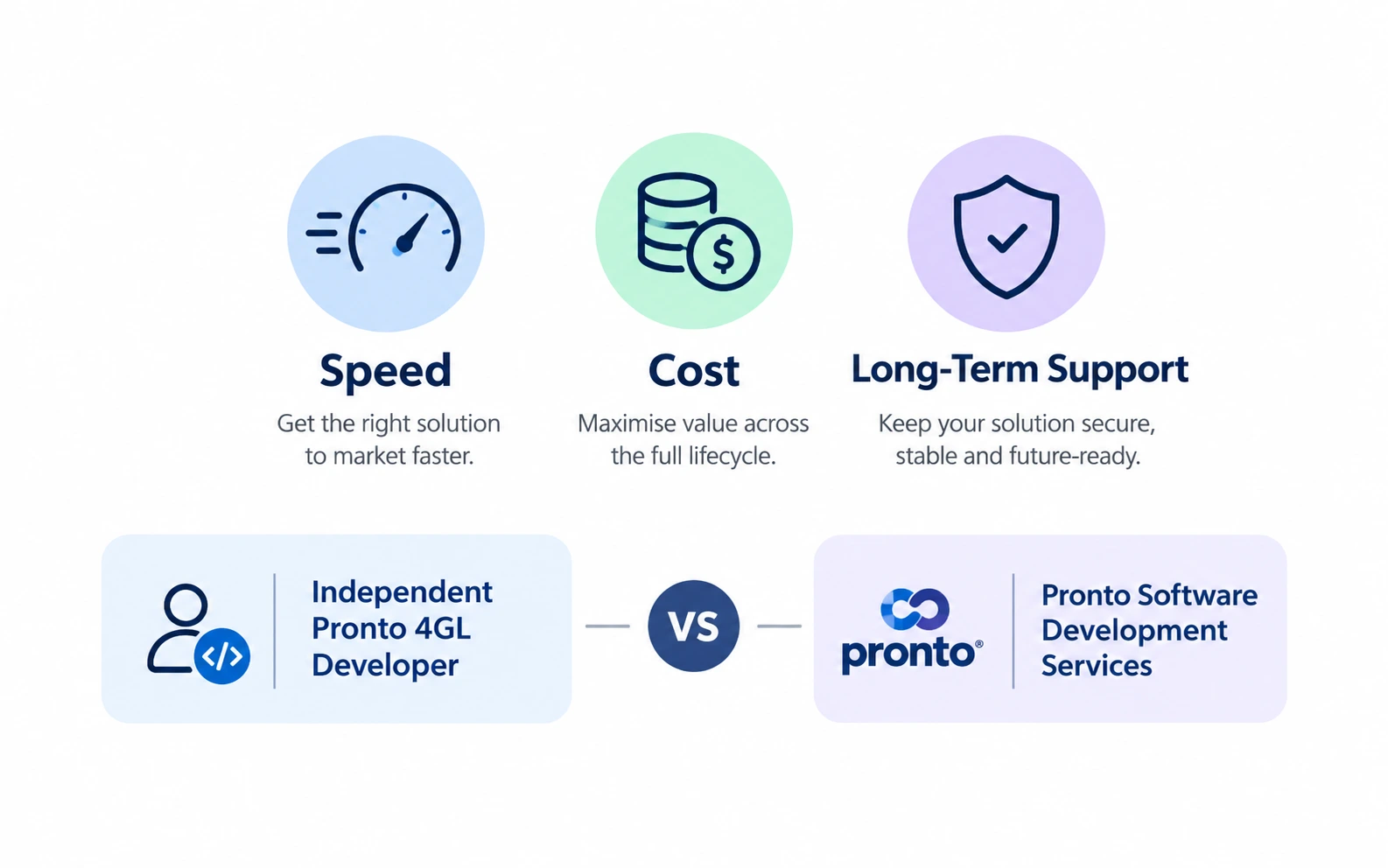
Pronto 4GL Developer vs Pronto Software: Which Is Better for Speed, Cost and Long-Term Support?
An independent Pronto 4GL developer can deliver faster for a focused enhancement. Learn when that advantage applies and how to compare scope, support, upgrades and lifetime cost before choosing a provider.
Quick answer
An independent Pronto 4GL developer can be the better fit for a focused, customer-specific enhancement when speed, direct access and specialist expertise matter. Pronto Software may be better suited where development requires close coordination with a wider implementation, upgrade or vendor-led delivery program. Neither option is universally faster, cheaper or lower risk; compare equivalent scope, capability, support arrangements and lifetime cost.
For CFOs and CIOs, the decision is not simply who can write the code. It is which delivery model can achieve the required business outcome with acceptable delivery time, control, maintainability, support and lifetime cost.
Evidence note
Pronto Software documents that Pronto Xi can be extended using its proprietary 4GL, Rapid Application Development (RAD), Software Development Kit (SDK), Pronto Connect APIs and other platform tools. Pronto Software also documents project management, customisation, training and testing within its implementation methodology. These sources do not establish that either Pronto Software or independent developers are universally faster, cheaper or better; those comparisons depend on the actual proposal and project evidence.
What Is an Independent Pronto 4GL Developer?
In this article, an independent Pronto 4GL developer means an external specialist or consultancy engaged separately from Pronto Software to deliver customer-specific development. Pronto Software development services means customer-specific development commissioned from Pronto Software itself. An authorised reseller or another delivery partner may operate under different arrangements and should be assessed on its own proposal.
Pronto Software identifies its proprietary 4GL as a core part of the Pronto Xi platform and provides development tools including Rapid Application Development (RAD) and a Software Development Kit (SDK). Pronto Connect provides APIs for integrating Pronto Xi with external applications. These capabilities make custom development possible, but they do not determine who should perform it.
Why Customer-Specific Pronto Development Is Different From Standard-Product Development
A customer-specific enhancement is designed for a defined Pronto Xi environment, business process and requirement. Functionality intended for the standard product has a broader purpose and may need to accommodate more configurations, interactions, compatibility requirements and release coordination.
This distinction matters because delivery time should be compared on equivalent scope. Do not assume that every customisation commissioned from Pronto Software follows the same process as standard-product development. Equally, do not assume that an independent developer can ignore the effect of a change on related transactions, permissions, reporting or integrations.
| Development scope | What must be considered | Implication for timing |
|---|---|---|
| Independent developer delivering a customer-specific enhancement | Agreed environment, workflows, dependencies, testing and maintenance obligations | Focused scope and direct decisions can shorten delivery. |
| Pronto Software delivering a customer-specific enhancement | Agreed customer scope and applicable delivery controls | Compare the actual proposal; do not assume broader product-release requirements. |
| Functionality intended for the standard product | Supported configurations, product behaviour, compatibility and release requirements | Broader design and validation can require more effort and coordination. |
Do You Actually Need Custom Pronto Xi Development?
Before selecting a developer, first establish why the current system does not meet the requirement. Bespoke code may not be the best answer. Depending on the problem, a configuration change, user training, reporting change, existing Pronto Xi functionality or integration may solve it with less lifetime complexity.
Start with the business outcome. For example, if the objective is to automate an accounts payable process, identify where time is lost, which controls must be preserved, what data is involved and what measurable improvement is expected. Then decide whether to configure, integrate or develop.
A useful buyer question for both providers: Why is your proposed approach preferable to the available standard, configuration or integration alternatives?
Independent Pronto 4GL Developer vs Pronto Software: Comparison at a Glance
| Consideration | Independent Pronto 4GL developer | Pronto Software development services |
|---|---|---|
| Working relationship | Potential for direct access to the person designing and coding the solution. | Potential to coordinate development through the existing vendor relationship. |
| Delivery speed | Focused scope, direct decisions and fewer handovers can shorten delivery materially. | Timing depends on scope, resource allocation and any applicable review or release requirements. |
| Cost | May offer competitive rates and flexible engagement sizes. | May offer broader delivery scope within one proposal; compare inclusions carefully. |
| Expertise | May bring deep experience in particular modules, industries or workflows. | May facilitate coordination with relevant product and functional specialists. |
| Delivery management | May require more coordination by the customer. | May provide a more coordinated structure, depending on scope. |
| Support | Requires explicit boundaries between custom-code support and existing ERP support. | May simplify escalation, but custom-work coverage still needs explicit agreement. |
| Continuity | Assess backup, documentation, source access and substitute-developer arrangements. | Assess team continuity and knowledge transfer if assigned staff change. |
| Upgrades | Budget for impact assessment, regression testing and required changes. | Vendor delivery does not establish automatic future upgrade coverage; confirm responsibilities. |
Important: These are potential differences to investigate, not fixed characteristics of either option.
Is an Independent Pronto 4GL Developer Faster Than Pronto Software?
Direct answer
Potentially, particularly for a contained customer-specific enhancement. An experienced specialist who already understands the Pronto Xi environment may reduce discovery, handovers and decision delays. Actual delivery time still depends on scope, developer availability, customer decisions, testing and deployment. There is no verified universal speed benchmark.
Where the advantage exists, it usually comes from four mechanisms:
- A focused scope: the solution serves the agreed customer requirement rather than becoming a general-purpose product feature.
- Direct clarification: process owners can discuss exceptions and proposed behaviour directly with the person implementing the change.
- Fewer handovers: analysis, design and development may be handled by the same experienced specialist.
- Short feedback cycles: available business owners can review increments and make decisions quickly.
The advantage can disappear if the independent developer is unavailable, unfamiliar with the relevant modules, weak on testing or documentation, or waiting for customer decisions. A Pronto Software team may also deliver quickly when scope is clear and resources are available.
Development Effort vs Delivery Time: What Should You Compare?
Do not compare only estimated development hours. Separate engineering effort from elapsed delivery time.
| Ask the provider for | What it tells you |
|---|---|
| Engineering effort | How much analysis, design, coding, testing, documentation and deployment work is required. |
| Earliest start date | When capable resources are actually available. |
| Expected UAT date | When the business can begin user acceptance testing. |
| Expected production date | When the business benefit can begin. |
| Dependencies | Which approvals, decisions, integrations, reviews or release windows can delay delivery. |
A change can require relatively few engineering hours yet take much longer to reach production because of scheduling, approvals, UAT or release dependencies. A faster delivery model creates value only if it removes unnecessary waiting without removing essential controls.
What Are the Advantages of an Independent Pronto 4GL Developer?
Direct access and practical collaboration
Working directly with an experienced developer can shorten the path between explaining the business problem and reviewing a technical solution. This is especially useful when users need to clarify exceptions, review a prototype or refine an operational report.
Specialist experience relevant to the requirement
A specialist who has solved comparable Pronto Xi problems may identify important dependencies earlier. Module and process experience matter: expertise in inventory processing, for example, is not interchangeable with payroll or accounts payable experience.
Flexible engagement and potentially competitive cost
An independent specialist may be engaged for a short assessment, a defined enhancement or ongoing development without permanent headcount. However, compare equivalent scope. A coding-only estimate should not be compared directly with a proposal that also includes business analysis, project management, testing, documentation and post-go-live support.
What Are the Risks of Using an Independent Pronto Developer?
Dependency on one individual
If one person becomes the only source of knowledge for critical custom code, the organisation may create a continuity problem. Confirm backup arrangements, source-code access, documentation, maintenance rights and what another suitably authorised developer would need to take over.
More supplier coordination
A defect may involve custom code, standard Pronto Xi functionality, an integration or infrastructure. If several providers are involved, define who performs initial diagnosis, when an issue moves to another party and how investigation effort is charged.
Variable delivery disciplines
Independent developers vary in requirements discipline, security, testing, version control, documentation and deployment practices. Strong coding ability does not automatically mean the engagement includes a complete delivery service. Confirm who owns business analysis, project management, user acceptance testing and release coordination.
When Does Pronto Software Development Make More Sense?
Pronto Software may be the stronger fit where the requirement needs close coordination with a broader vendor-led implementation, upgrade or product team, or where the customer values a more consolidated delivery structure.
Coordination with the software provider
Pronto Software publishes an implementation methodology covering project management, activation and customisation, training and testing. For a particular development engagement, buyers should confirm which of those activities are actually included in the proposal.
Potential access to broader expertise
Where a requirement crosses functional and technical disciplines, a vendor-led engagement may provide access to additional specialists. Confirm who will actually participate, how specialist input is obtained and whether that input is included in the estimate.
Potentially simpler accountability
Where development and related services sit within one clearly defined engagement, the customer may have fewer supplier boundaries to coordinate. This advantage depends on the contract: confirm delivery ownership, defect handling, escalation and ongoing support for the customisation.
What Should You Check Before Commissioning Development From Pronto Software?
- Is the proposed work customer-specific, or is it intended for the standard product?
- Which design reviews, compatibility checks or release requirements actually apply?
- Can the work be delivered separately from a wider implementation or upgrade?
- Who is assigned, when are they available and what specialist input is included?
- How will customer-specific code be documented, supported and assessed during future upgrades?
- What maintenance rights, transition arrangements and source access will the organisation retain?
A broader process may be justified for a high-impact change. The buyer should understand what each activity contributes rather than assuming either that formal coordination is waste or that vendor delivery automatically removes future maintenance risk.
Who Supports Custom Pronto Xi Development After Go-Live and Upgrades?
Support, licensing and upgrade responsibility need explicit answers under either delivery model. The existence of Pronto Xi development tools does not establish what a customer or external developer is licensed or permitted to use in a particular environment.
- Confirm the licences, permissions and environment access required for development and deployment.
- Clarify development access separately from the right to run the completed solution.
- Define which party supports the custom component and which party supports standard Pronto Xi.
- Confirm source-code ownership, documentation, deployment records and handover requirements.
- For future upgrades, define who assesses affected customisations, performs regression testing and fixes incompatibilities.
Avoid universal assumptions. Neither “external development invalidates all support” nor “vendor development includes every future fix” should be treated as a general rule. Obtain written confirmation for the actual arrangement.
Cheaper Development or Better ROI? Compare Lifetime Cost and Cost of Delay
CFO view
The lowest development quote is not necessarily the lowest-cost option. Compare the lifetime cost of the customisation and the value of receiving the business benefit earlier.
Use the same time horizon for both proposals. The original article suggests a realistic period such as three years, but the appropriate period should reflect the expected life of the change. Include:
- Discovery, requirements and technical design.
- Development, licences and required environments.
- Testing, deployment, training and internal staff time.
- Support, defect correction and subsequent enhancements.
- Upgrade assessment, regression testing and maintenance.
- Documentation and future handover.
Then compare those costs with measurable business value such as fewer processing hours, reduced errors, faster order handling or more timely reporting. Earlier delivery can also have value because each month of delay postpones the benefit.
Distinguish staff capacity from cash savings. Saving employee hours does not automatically reduce payroll cost. Faster delivery is valuable when the improvement is actually adopted and releases capacity or avoids measurable expense.
13 Questions to Ask Before Choosing a Pronto 4GL Developer
- What comparable Pronto Xi work has the proposed developer completed?
- Can standard functionality, configuration or integration meet the requirement without bespoke code?
- What is included in the scope, and what would trigger additional charges?
- Which licences, permissions, environments and technical dependencies are required?
- Who approves the design and signs off user acceptance testing (UAT)?
- How will access, sensitive data and deployment be controlled?
- What source code, documentation and maintenance rights will we receive?
- Who handles defects and urgent incidents after go-live?
- What happens if the assigned developer becomes unavailable?
- Who assesses and maintains the customisation during future upgrades?
- Is the work customer-specific or intended for the standard product?
- What are the estimated engineering hours, earliest start date and expected go-live date?
- Which reviews, customer decisions or release dependencies determine that date?
Use the same brief, assumptions and acceptance criteria when seeking proposals. Otherwise, differences in price and timing may simply reflect different scope.
Independent Developer or Pronto Software: Which Should You Choose?
Decision summary
Consider an experienced independent Pronto 4GL developer when the enhancement is well defined, speed matters, relevant specialist expertise is available and your organisation can support timely decisions, testing and handover. Consider Pronto Software when the requirement needs close coordination with a broader implementation, upgrade or vendor-led delivery program. In either case, compare equivalent scope, delivery time, testing, documentation, support, upgrade responsibility and lifetime cost.
A combined approach can also be practical. For example, an independent business analyst or developer may work alongside the existing Pronto provider with responsibilities agreed in advance. This introduces additional coordination, so use it where the benefit of specialised capability justifies the extra interface.
The strongest decision is the one supported by evidence of relevant expertise, maintainable design, clear accountability and acceptable lifetime economics, not by a general preference for “independent” or “vendor”.
Disclosure: SAAPRO is an independent Pronto Xi recruitment specialist and is not Pronto Software or an ecommerce implementation vendor.
Frequently Asked Questions
An experienced independent developer can deliver materially faster for a focused customer-specific enhancement, especially when they already understand the Pronto Xi environment and can work directly with decision-makers. Actual timing still depends on scope, availability, testing, customer decisions and deployment. There is no verified universal speed benchmark.
Do not assume this. Ask whether the proposed work is customer-specific or intended for the standard product and which compatibility, review and release requirements actually apply. Independent developers must also assess the effect of their changes on the affected workflows and dependencies.
Possibly, but hourly rate alone does not establish value. Compare equivalent scope, internal coordination effort, testing, support, documentation, upgrade costs and the cost of delay. Obtain current proposals rather than relying on general rate assumptions.
Confirm the exact licence, permission and environment requirements for the proposed development and deployment arrangement with Pronto Software or the authorised account provider before approving work or granting access.
Custom development can create additional testing and maintenance obligations. The impact depends on the design, dependencies and changes in the target release. Define responsibility and budget for upgrade assessment and regression testing regardless of who writes the code.
That depends on maintenance rights, source-code access, development tools, documentation quality and the availability of suitable expertise. Establish handover and continuity requirements before development starts.
Pronto Software may be the stronger fit when the requirement needs close coordination with a broader implementation, upgrade or vendor-led delivery program, or when the organisation wants a more consolidated delivery arrangement.
Yes. SAAPRO specialises in Pronto Xi recruitment and specialist resourcing in Australia, including 4GL developers. SAAPRO can help define the capability required and identify professionals whose demonstrated experience matches the project.
Key Takeaways
- ✓An independent Pronto 4GL developer can be the better fit for a focused, customer-specific enhancement when speed, direct access and specialist expertise matter.
- ✓Pronto Software may suit requirements that need close coordination with a wider implementation, upgrade or vendor-led delivery program.
- ✓Neither option is universally faster, cheaper or lower risk; compare equivalent scope, capability, support arrangements and lifetime cost.
- ✓Compare engineering effort separately from elapsed delivery time, including the earliest start date, UAT date and production date.
- ✓Settle source-code access, documentation, support boundaries and upgrade responsibility in writing before development starts.
- ✓Confirm that bespoke code is needed at all, because configuration, training, reporting or integration may solve the problem with less lifetime complexity.