Pronto Xi Purchase Order Approvals: How to Reduce Approval Delays Without Weakening Control
A guide to how Pronto Xi purchase order approvals can reduce approval delays without weakening financial control.
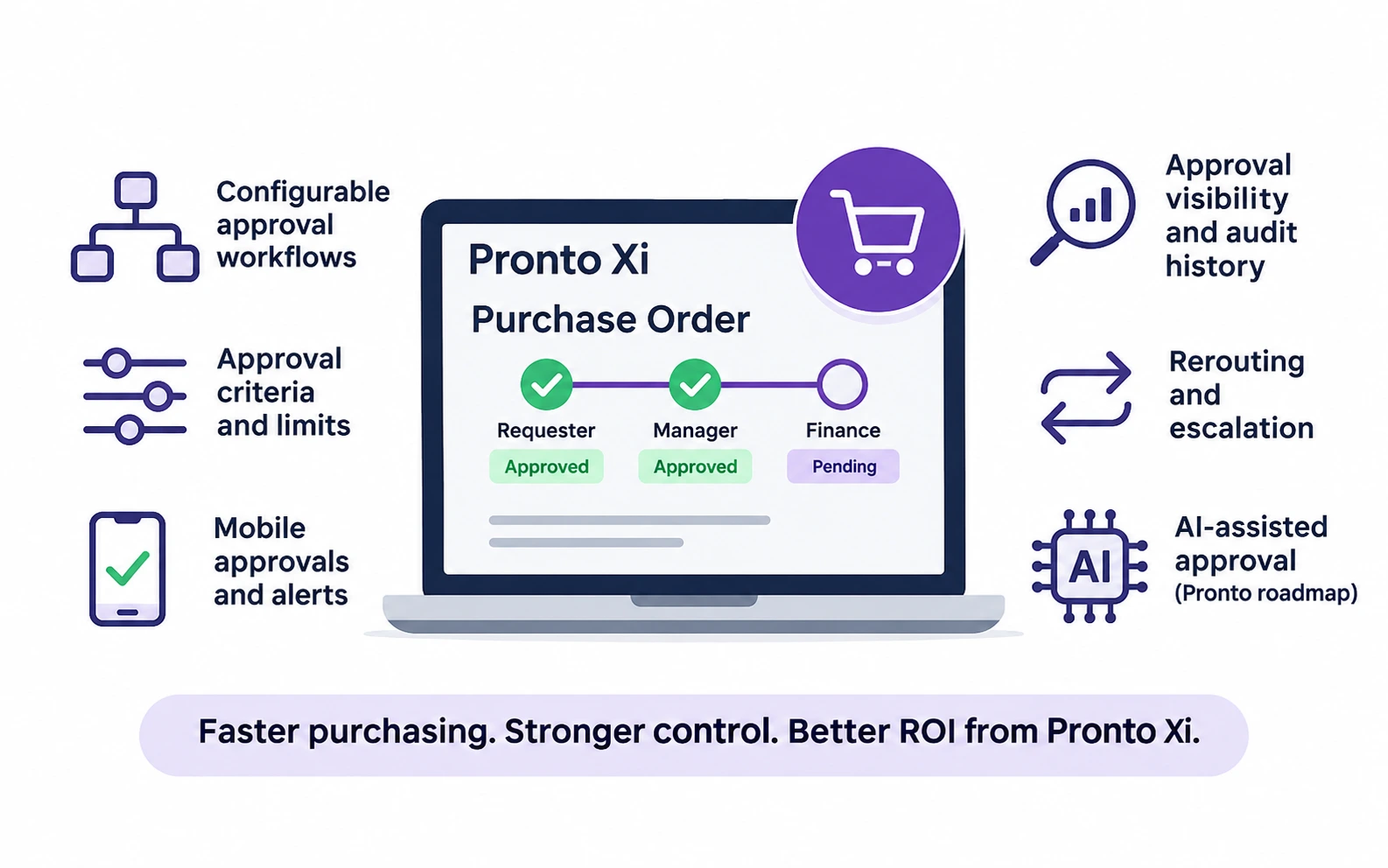
Pronto Xi supports configurable purchase-order approval workflows with multiple approval levels, advanced criteria, commentary, audit history, workflow visibility, rerouting and mobile notifications. The business objective should be to apply enough control to material or unusual purchases without forcing routine transactions through unnecessary approval delays.
The executive question is not:
How many approvals should every purchase order have?
It is:
What is the minimum approval friction required to achieve the organisation’s required financial control?
For CFOs, purchase-order approval is primarily a spend-control and delegated-authority issue.
For CIOs, it is a workflow, security, auditability and access issue.
For Procurement and Operations, it is often a cycle-time issue.
A poorly designed process can fail in either direction:
Too little control → inappropriate or unauthorised commitments
Too much friction → delayed purchasing, manual chasing and off-system workarounds
The strongest approval process is therefore not the one with the most approvals. It is the one that applies the right control to the right transaction at the right time.
Pronto Xi functionality versus independent guidance
This article separates three evidence categories.
Documented Pronto Xi capability
Statements labelled Documented Pronto Xi capability describe functionality published by Pronto Software, including:
- purchase requisitions and requisition approval;
- multiple purchase-order approval levels;
- advanced approval criteria;
- approver and requester commentary;
- approval audit history;
- workflow progress visibility;
- workflow rerouting;
- configurable approval administration;
- purchase-order approval notifications; and
- mobile access through Pronto Notifier.
Pronto AI direction
Pronto Software announced agentic assisted purchase order approval on 8 September 2026 as part of its expanding AI roadmap.
Customers should confirm which AI capabilities are currently available, licensed and applicable to their own Pronto Xi environment before relying on them.
Independent guidance
The recommendations on approval design, segregation of duties, financial materiality, cycle-time measurement, governance, diagnostics and ROI are independent procurement and ERP guidance.
They are not official Pronto Software methodologies or guaranteed Pronto Xi outcomes.
Do you actually have a purchase-order approval problem?
Independent diagnostic guidance
Before changing Pronto Xi configuration, determine what is actually going wrong.
| Symptom | Issue to investigate |
|---|---|
| Purchase orders wait days for approval | Workflow, delegation or notification bottleneck |
| Executives approve large volumes of routine spend | Approval thresholds or authority design |
| Many purchase orders are rejected | Request quality, policy or training |
| Approvals regularly happen by email or chat | Workflow friction or poor adoption |
| Urgent purchases routinely bypass approval | Planning, policy or process design |
| Approvals are frequently rerouted | Coverage, escalation or role design |
| Buyers repeatedly chase approvers | Visibility, notification or accountability |
| POs change materially after approval | Timing or quality of the approval point |
The useful question is:
Where does the transaction wait, and what risk is that waiting time actually controlling?
That should be established before adding more approval rules.
Is the problem workflow design, or a Pronto Xi capability gap?
If purchase orders are regularly delayed, bypassed or escalated manually, determine whether the root cause is:
policy → process → Pronto Xi configuration → delegated authority → user adoption → capability
A practical starting point is to review a sample of delayed and rejected purchase orders and identify:
- where each transaction stopped;
- who was expected to act;
- how long it waited;
- why approval was required;
- whether the approver added distinct control value; and
- whether the process eventually moved outside Pronto Xi.
If the problem requires deeper Pronto Xi functional, Business Analyst or ERP-management capability, SAAPRO can help assess which specialist skill set is actually required before you recruit or engage someone.
What purchase-order approval functionality does Pronto Xi provide?
Documented Pronto Xi capability
Pronto describes Purchase Order Approval as supporting both straightforward and complex approval processes.
Published functionality includes:
- multiple approval layers;
- advanced criteria sets;
- approval triggered by specific items;
- approver commentary;
- requester commentary;
- audit history;
- central visibility of approvals;
- visibility of the current approval holder;
- workflow rerouting for urgent attention; and
- mobile purchase-order approval.
Pronto's Purchase Order Approval Administration also supports configuration around areas including:
- direct or sequential workflow;
- approval groups or individual officers;
- stock limits;
- non-stock limits;
- warehouse criteria;
- item criteria;
- self-approval;
- rejection behaviour; and
- time-based workflow controls.
This means approval logic does not have to depend solely on purchase value.
Purchase requisition approval versus purchase order approval
Documented Pronto Xi capability
Pronto Xi Purchasing supports requisitions before purchase-order entry.
A requisition can be raised and approved by an authorised person before the purchase order is created.
Conceptually:
Requisition → Approval → Purchase order → Supplier commitment
Independent governance guidance
The two approval points answer different questions.
Requisition approval:
Should the organisation incur this expenditure?
Purchase-order approval:
Should the organisation commit to this specific transaction?
Some organisations need both controls.
Others may discover that the same managers are approving substantially the same decision twice.
The key design question is:
What distinct control purpose does each approval perform?
If that cannot be explained, the organisation may have duplicated approval rather than stronger governance.
Why do Pronto Xi purchase approvals become slow?
Independent guidance
The ERP may execute the configured workflow correctly while the workflow itself remains inefficient.
Common causes include:
- excessive approval layers;
- obsolete delegation limits;
- executives approving routine expenditure;
- sequential approvals where another design may be more efficient;
- one individual becoming a bottleneck;
- unclear backup authority;
- insufficient information for approvers;
- duplicate requisition and PO approvals;
- poorly designed exception handling;
- excessive manual chasing.
A useful investigation separates:
System processing time → Approval waiting time → Purchasing processing time → Supplier lead time
That distinction prevents the wrong part of the process being blamed.
How can users see where an approval is waiting?
Documented Pronto Xi capability
Pronto provides central visibility of approval activity.
Requesters can see information such as:
- how approval is progressing;
- who currently holds the approval; and
- associated commentary.
Approvers can also review audit history.
Pronto's education material for Pronto Xi 780 includes specific content around:
- Approvals required;
- My approvals;
- My requests;
- Purchase order approvals dashboard;
- approval groups and officers;
- advanced criteria; and
- approval history.
Independent guidance
Use that visibility to measure where transactions actually wait.
For example:
PO created: Monday 9:05 am
Approval requested: Monday 9:06 am
Approved: Wednesday 3:45 pm
The dominant delay is not purchase-order entry.
It is approval waiting time.
That distinction gives management something specific to investigate.
Can Pronto Xi notify approvers on mobile devices?
Documented Pronto Xi capability
Yes.
Pronto documents mobile purchase-order approval capability.
The Pronto Notifier app for iOS and Android can also notify users about purchase-order approval requests and link them to relevant Pronto Xi screens.
Independent guidance
Mobile access can remove one type of delay:
The approver is away from their desk.
It does not fix:
The wrong person is approving the transaction.
Nor does it fix:
The workflow contains unnecessary approval levels.
A poorly designed process does not become a good process simply because it is available on a phone.
How should purchase-order approval thresholds be designed?
Documented Pronto Xi capability
Pronto approval administration supports financial limits and criteria relating to warehouses, items, suppliers and purchase-order characteristics.
Independent guidance
Purchase value is important, but it is not always equivalent to purchasing risk.
Consider:
Purchase A: $25,000 of a routinely purchased, budgeted item from an established supplier.
Purchase B: $8,000 from a new supplier for an unusual category outside the normal purchasing pattern.
The larger transaction is not automatically the one requiring greater scrutiny.
A broader approval model may consider:
Value + spend type + supplier + category + exception status + business unit + delegated authority
Pronto Xi provides the workflow configuration mechanisms.
The organisation must decide what risks those rules should control.
Should every purchase order have several approval levels?
Independent guidance
No.
More approvers do not automatically create better financial control.
Each approval level should answer a distinct question.
| Approver | Possible control purpose |
|---|---|
| Operational manager | Is the expenditure genuinely required? |
| Budget owner | Is it appropriate against the budget? |
| Procurement | Are the supplier and commercial arrangements appropriate? |
| Finance | Does the commitment comply with financial policy? |
| Executive | Is the commitment material enough to require executive authority? |
If two approvers perform effectively the same review, the second approval may increase delay without adding meaningful control.
Independent governance principle: Every approval level should have a distinct control purpose.
What is segregation of duties?
Independent governance guidance
Segregation of duties (SoD) reduces the concentration of incompatible purchasing responsibilities in one person.
A purchasing lifecycle may involve:
Request → Approve → Order → Receive → Invoice → Pay
The exact role separation depends on organisational size, risk and internal-control requirements.
Pronto Xi allows configurable approval groups, officers and self-approval settings.
But the organisation, not the ERP, must determine which combinations of responsibilities are acceptable.
The key question is:
Can one person initiate, approve and complete an inappropriate transaction without meaningful independent review?
What happens if the normal approver is unavailable?
Documented Pronto Xi capability
Pronto documents workflow rerouting and time-based workflow controls that can help manage approvals requiring attention.
Independent guidance
Approval continuity should be designed before the primary approver becomes unavailable.
For important paths, define:
- who provides backup approval;
- what limits apply;
- when escalation occurs;
- how delegated authority remains traceable.
The objective is:
Controlled continuity, not uncontrolled bypass.
What should happen when a purchase order is rejected?
Documented Pronto Xi capability
Pronto's approval workflow supports commentary and configurable rejection-related behaviour.
Independent guidance
A rejection should create useful information.
Possible reasons include:
- incorrect supplier;
- missing justification;
- wrong account or cost centre;
- quantity error;
- budget issue;
- duplicate transaction;
- missing quotation;
- policy exception.
Repeated rejection reasons can expose a broader process problem.
For example, if requests are repeatedly rejected because the same supporting information is missing, the organisation may have a request-quality problem, not an approval problem.
Approval ROI: control value versus friction and delay
Independent ROI framework
A useful executive model is:
Approval ROI = Control value − Administrative friction − Cost of delay
This is a decision framework, not an accounting formula.
Control value
Does the workflow reduce inappropriate or unauthorised commitments?
Administrative friction
How much employee time is spent:
- preparing approvals;
- chasing approvers;
- checking status;
- correcting rejected transactions;
- manually managing exceptions?
Cost of delay
Can slow approval contribute to:
- late ordering;
- expedited freight;
- material shortages;
- production disruption;
- project delays;
- maintenance delays;
- customer-service problems?
The objective should be:
Minimum approval friction consistent with the organisation's required control environment.
Does your approval process warrant action?
Executive self-assessment
A purchasing workflow deserves closer review if several of these conditions apply:
- Routine purchase orders regularly wait longer than the business considers acceptable.
- Executives approve large volumes of low-risk transactions.
- Buyers frequently chase approvers manually.
- Purchase approvals routinely occur outside Pronto Xi.
- Requisition and PO approval appear to duplicate the same decision.
- Urgent orders frequently bypass the normal process.
- Delegated-authority limits no longer reflect current roles.
- Approval bottlenecks depend heavily on one person.
- Rejected requests repeatedly fail for the same reason.
- The organisation cannot easily identify where purchase orders are waiting.
Several “yes” answers do not automatically mean Pronto Xi needs reconfiguration.
They indicate that the organisation should determine whether the root cause is:
Policy → Process → Configuration → Capability → Capacity
How should purchase-order approval performance be measured?
Independent guidance
Useful measures include:
| Measure | What it helps reveal |
|---|---|
| Median approval cycle time | Typical approval speed |
| Approval time by level | Where workflow waits |
| Orders outside target time | Material exceptions |
| Approval volume by person | Bottleneck concentration |
| Rejection rate | Request quality |
| Rejection reasons | Recurring process weaknesses |
| Rerouted approvals | Coverage or delegation problems |
| PO changes after approval | Timing or transaction-quality issues |
| Off-system approvals | Workflow adoption or friction |
| Emergency purchasing | Wider planning or approval problems |
There is no universal approval-time target suitable for every Pronto Xi customer.
Targets should reflect transaction volume, financial materiality and operational risk.
Build the business case before changing workflow
Independent guidance
Before investing in workflow redesign or additional automation, establish a baseline:
Approval volume → Approval cycle time → Bottleneck stage → Rejection/rework → Manual chasing → Operational impact
Then ask:
If we removed unnecessary approval friction, what measurable outcome would improve?
Potential outcomes include:
- less administrative chasing;
- faster purchasing decisions;
- fewer off-system workarounds;
- clearer accountability;
- stronger auditability; and
- reduced operational delay caused by late purchasing.
That produces a stronger investment case than simply asking whether Pronto Xi can automate more approvals.
What has Pronto announced about AI-assisted purchase-order approvals?
Pronto AI direction
On 8 September 2026, Pronto Software announced agentic assisted purchase order approval among the AI capabilities being introduced across Pronto Xi.
Pronto's AI material also describes intelligent workflow automation intended to streamline purchase-order approvals.
Important qualification
These statements should not be interpreted to mean that every Pronto Xi customer automatically has identical AI-assisted purchase-order approval capability.
Customers should confirm:
- current availability;
- release requirements;
- licensing or subscription;
- Pronto Cloud dependency;
- configuration requirements; and
- governance implications
for their specific environment.
Should businesses redesign approvals before applying more automation?
Independent guidance
Yes, where the existing process is visibly inefficient.
A useful test is:
If we automated today's approval policy exactly as it exists, would we be happy with the resulting process?
If the answer is no, improve the policy first.
Automation cannot fix:
- obsolete authority limits;
- unnecessary approvals;
- unclear delegation;
- inappropriate self-approval;
- weak purchasing information;
- duplicated approval;
- unclear accountability.
The stronger sequence is:
Policy → Risk → Workflow → Authority → Exceptions → Measurement → Automation
This is independent process-improvement guidance, not a Pronto Software methodology.
Who should own purchase-order approvals?
Independent governance guidance
Purchase approvals cross Finance, Procurement, Operations and IT.
| Area | Typical responsibility |
|---|---|
| Purchasing policy | Finance / Procurement |
| Delegated authority | Executive / Finance |
| Operational justification | Business manager |
| Supplier/commercial process | Procurement |
| Budget responsibility | Budget owner |
| Workflow configuration | ERP team |
| Access and security | IT / ERP |
| SoD design | Finance / Risk / IT |
| Approval-performance measurement | Procurement / Finance |
| Overall control effectiveness | CFO / delegated executive owner |
A useful principle is:
IT can configure the workflow. The business must define who can commit organisational funds and under what conditions.
What Pronto Xi capability does the business actually need?
A purchase-order approval problem is not always a “workflow configuration” problem.
The required capability may differ depending on the root cause.
| Problem | Capability that may be required |
|---|---|
| Approval process itself is poorly designed | Pronto Xi Business Analyst |
| Business rules are clear but Pronto configuration needs changing | Pronto Xi Functional Consultant |
| Support, configuration and recurring issues overlap | Senior Pronto Application Analyst |
| Approval problems reflect weak ERP ownership or governance | ERP Manager |
| Security, permissions or technical workflow issues dominate | Systems Administrator / technical specialist |
The better resourcing question is not:
“Who knows Pronto Xi?”
It is:
“What capability does this problem require?”
A practical Pronto Xi purchase-order approval review
Independent guidance
Before changing configuration, work through six questions.
1. What risk is each approval controlling?
If nobody can explain why an approval exists, challenge it.
2. Where do transactions actually wait?
Measure rather than guess.
3. Are approval limits still appropriate?
Delegated authority often changes faster than ERP configuration.
4. Are requisition and PO approval duplicating each other?
Confirm that each performs a distinct control.
5. What happens when the normal path fails?
Test absence, rejection, urgent purchases and escalation.
6. Which parts should be automated?
Automate repetitive administration after the control design is sound.
Pronto Xi purchase-order approval checklist
Before redesigning the workflow, confirm:
- Approval limits reflect current delegated authority.
- Every approval level has a distinct purpose.
- Requisition and PO approvals are not unnecessarily duplicated.
- Stock and non-stock approval rules are intentional.
- Warehouse, item or supplier criteria are used where relevant.
- Self-approval settings are deliberate.
- Segregation-of-duties risks have been reviewed.
- Backup approval arrangements exist.
- Escalation and rerouting are understood.
- Requesters can see approval progress.
- Approvers receive enough information to decide.
- Rejections generate useful feedback.
- Audit history is retained.
- Mobile notifications are configured where useful.
- Approval cycle time is measured.
- Off-system workarounds are monitored.
- Pronto AI capabilities are validated against the customer's actual environment before reliance.
Need to improve Pronto Xi purchase approvals but lack the internal capability?
A purchase-order approval problem can involve more than configuration.
The organisation may need someone who can understand:
Purchasing process → Pronto Xi configuration → Delegated authority → Controls → User behaviour → Testing → Business impact
That capability may sit with a:
Pronto Xi Business Analyst, where the process and requirements need to be diagnosed.
Pronto Xi Functional Consultant, where the requirement is clear but Pronto configuration needs redesign.
Senior Pronto Application Analyst, where support, configuration and recurring operational problems overlap.
ERP Manager, where the issue reflects wider governance, ownership and prioritisation.
SAAPRO specialises in the Australian Pronto Xi talent market and can help organisations identify the capability actually required before engaging or recruiting a specialist.
Not sure which Pronto Xi capability you need?
Send SAAPRO a short description of:
What is happening → Where the workflow is slowing down → Who currently owns it → What outcome you need
SAAPRO can help determine whether the problem is likely to require a Business Analyst, Functional Consultant, Senior Application Analyst, ERP Manager or another Pronto specialist. Discuss Your Pronto Xi Requirement or Compare Pronto Xi Roles
Disclosure: SAAPRO is an independent Pronto Xi recruitment specialist and is not Pronto Software or an ecommerce implementation vendor.
Frequently Asked Questions
Yes. Pronto Xi supports configurable purchase-order approval workflows with multiple levels, advanced criteria, commentary, audit history, workflow visibility, rerouting and mobile approval capability.
Yes. Pronto supports configurable approval levels, groups or officers, financial limits and workflow controls.
Yes. Pronto Xi supports advanced criteria and can use factors beyond dollar value when configuring approval workflows.
Yes. A requisition can be raised and approved before the purchase order is created.
Yes. Pronto supports mobile purchase-order approval, and Pronto Notifier can alert users to approval requests.
Yes. Pronto provides approval audit history and workflow-progression visibility.
Yes. Pronto documents workflow rerouting and time-based workflow controls.
Pronto Software announced agentic assisted purchase order approval on 8 September 2026. Customers should confirm current availability, licensing and deployment requirements for their own environment.
No universal rule applies. Approval should reflect delegated authority, financial materiality and purchasing risk.
Evaluate control value, administrative friction and cost of delay using the organisation’s own transaction volumes, cycle times, exception rates and operational impacts.
Key Takeaways
- ✓Pronto Xi provides configurable purchasing approval functionality covering: Requisitions → Approval levels → Criteria → Commentary → Audit history → Workflow visibility → Rerouting → Mobile notifications
- ✓Pronto has also announced agentic assisted purchase order approval as part of its evolving AI direction.
- ✓The objective is not maximum approval. It is: The minimum approval friction required to achieve the organisation’s required financial control.
- ✓For CFOs, that means appropriate authority, materiality and segregation of duties.
- ✓For CIOs, it means secure, auditable and maintainable workflow.
- ✓For Procurement and Operations, it means legitimate purchasing should not stall because the control process itself has become a bottleneck.
- ✓The four most useful questions are: Who needs to approve this transaction? What distinct risk does that approval control? How quickly should the decision occur? What happens if the normal approver is unavailable? Once those questions are answered, Pronto Xi workflow configuration can support the purchasing policy rather than accidentally becoming the policy.