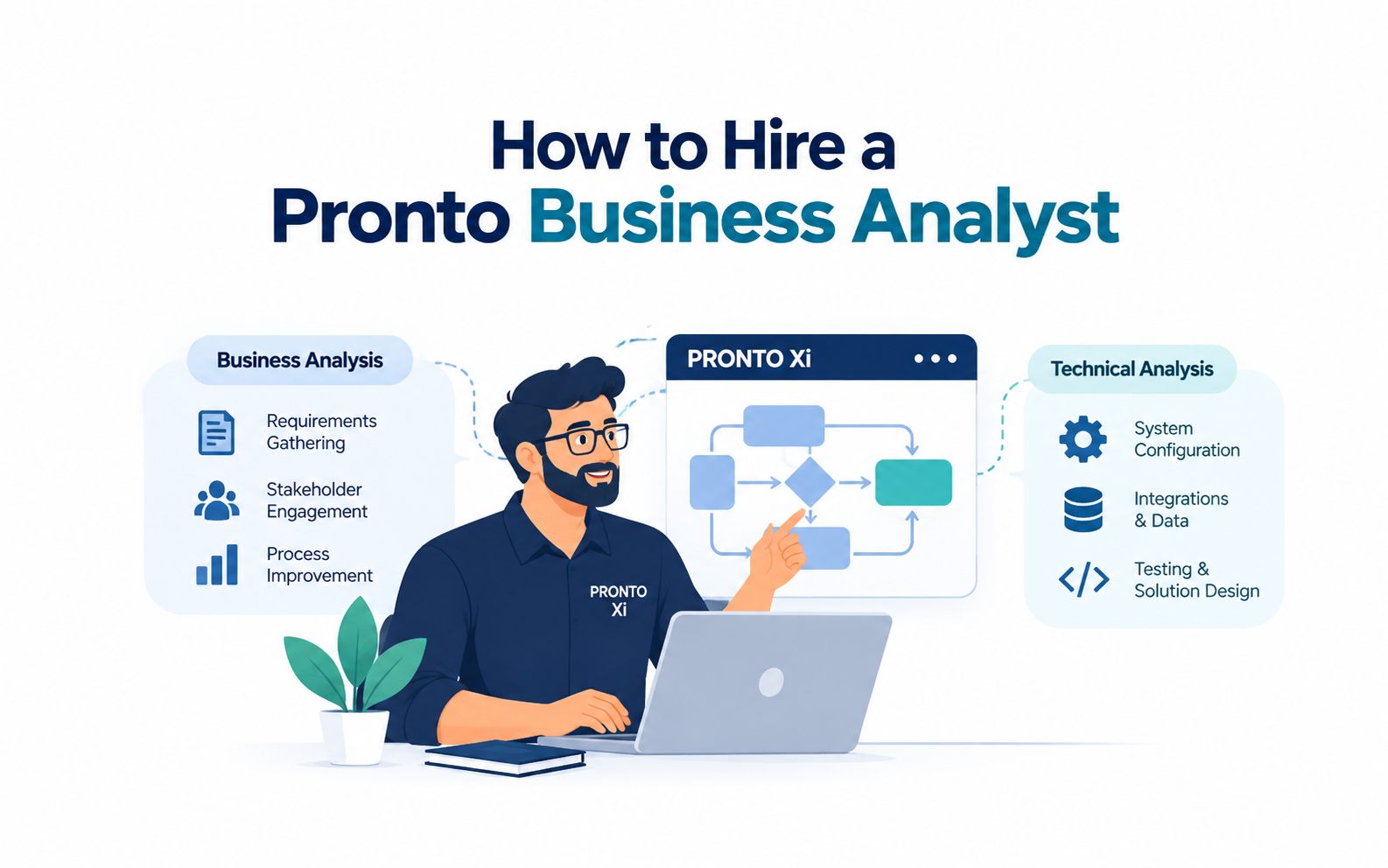
How to Hire a Pronto Business Analyst
A practical guide to hiring a Pronto Business Analyst, including when you need a technical rather than business-focused BA, what to assess and which interview questions to ask.
Hiring a strong Pronto Business Analyst is not simply about finding someone who can gather requirements and document processes.
The more important question is:
Do you need a business-focused BA who understands processes and stakeholders, or a technical BA who can also work across integrations, data, system dependencies and developer conversations?
That distinction matters because the two profiles may look similar on a CV but can perform very differently in a Pronto Xi environment.
For Australian organisations, hiring the wrong type of BA can lead to misunderstood requirements, rework for developers, unnecessary customisation, failed UAT, integration issues, project delays and higher consulting costs.
Technical BA vs Non-Technical BA: What Is the Difference?
A simple way to think about the distinction is:
A non-technical BA asks, “What does the business need?”
A technical BA can also ask, “How will this requirement affect data, integrations, customisations and downstream systems?”
Both roles are valuable. The right choice depends on where the position sits between business and technology.
A business-focused or non-technical BA typically:
- Runs stakeholder workshops
- Maps current and future-state processes
- Gathers and documents requirements
- Defines business rules
- Identifies process inefficiencies
- Supports change management
- Coordinates UAT
- Helps prioritise business needs
This profile is usually strongest when the role is centred on users, process improvement and business change.
A technical BA typically:
- Understands business requirements and technical constraints
- Works closely with developers and integration teams
- Understands data flows and system dependencies
- Supports API, EDI and interface requirements
- Assists with data mapping and migration
- Can investigate system and data issues
- Helps define technical specifications
- Bridges business users, functional consultants and developers
A technical BA is not necessarily a developer, but they should be comfortable operating at the boundary between business and technology.
When Do You Need a Technical Pronto BA?
A technical BA is usually the better fit when the role involves:
- Pronto integrations with e-commerce platforms
- EDI
- WMS or warehouse integrations
- APIs or web services
- Custom 4GL development
- SQL-based investigation
- Data migration
- Cognos or Power BI reporting
- Upgrade-related remediation
- Cross-system workflows
- Complex data or interface dependencies
For example, if a sales-order process needs to be changed and that process affects Pronto, e-commerce, warehousing and reporting, a technical BA is more likely to identify the downstream impact before development begins.
When Is a Business-Focused BA Enough?
A business-focused BA may be the right choice if the main requirement is:
- Process mapping
- User workshops
- Requirements gathering
- Business-case development
- Change management
- UAT coordination
- Policy and process improvement
- Stakeholder alignment
In these situations, deep technical fluency may be less important than strong facilitation, communication and process analysis.
One of the Most Common Pronto BA Hiring Mistakes
One of the most common mismatches in Pronto recruitment is hiring a strong general BA for a role that actually needs someone to sit between business users, functional consultants and 4GL developers.
We also see candidates described as “technical BAs” when their technical exposure is limited to documenting requirements for IT.
That is not the same as being able to understand:
- data structures
- integration dependencies
- system constraints
- customisation impacts
- technical trade-offs
This is why the title alone is not enough.
SAAPRO’s 5-Point Pronto BA Assessment
When assessing a Pronto Business Analyst, focus on five areas.
1. Pronto Functional Knowledge
The candidate should understand the Pronto modules relevant to the role.
Common areas include:
- Financials
- Accounts Payable
- Accounts Receivable
- Inventory
- Purchasing
- Sales
- Warehouse Management
- Manufacturing
- Payroll
- CRM
- Reporting
You do not need someone who knows every module. You need someone with depth in the areas your business relies on.
2. Business-Process Analysis
A strong BA should be able to:
- Understand current-state processes
- Identify root causes
- Map future-state processes
- Clarify business rules
- Separate symptoms from underlying problems
- Define measurable outcomes
In ERP environments, poor process understanding often leads to unnecessary system changes.
3. Technical Fluency
For a technical BA, assess comfort with:
- APIs
- EDI
- SQL
- Data flows
- Data mapping
- Integrations
- File-based interfaces
- Reporting structures
- System dependencies
- Custom development impacts
You are not necessarily looking for someone who can code. You are looking for someone who can work intelligently with technical teams.
4. Requirements Quality
Good BAs do more than take notes.
Requirements should be:
- Clear
- Testable
- Prioritised
- Traceable
- Technically realistic
- Connected to business outcomes
Ask candidates to show or explain requirements they personally produced.
5. Stakeholder Management
A Pronto BA may need to work across:
- Finance
- Warehousing
- Supply chain
- Operations
- Payroll
- Sales
- IT
- Executives
- External vendors
Strong candidates should be able to handle conflicting priorities and challenge unclear or unrealistic requests constructively.
Business Analyst vs Functional Consultant
These roles overlap, but they are not the same.
A Business Analyst focuses on understanding requirements, documenting processes and coordinating change.
A Functional Consultant usually has deeper product knowledge and may configure Pronto, design solutions and recommend specific system changes.
A Technical BA sits closer to the technical team, especially where integrations, data and custom development are involved.
If the person needs to configure Pronto directly, a Functional Consultant may be more appropriate.
If the person needs to bridge business users and developers, a technical BA may be the better fit.
Start With the Problem, Not the Job Title
Avoid a vague brief such as:
“We need a Pronto BA with five years’ experience.”
Instead, define:
- Which business processes need improvement?
- Which Pronto modules are involved?
- Is the role business-focused or technical?
- Will the BA work directly with developers?
- Are integrations involved?
- Is there an upgrade underway?
- Is data migration required?
- Will the BA write technical specifications?
- Will they own UAT?
- What should they deliver in the first six months?
The clearer the problem, the easier it is to identify the right profile.
Interview Questions for a Pronto Business Analyst
Use evidence-based questions rather than generic ones.
Tell me about a Pronto project where you gathered requirements from multiple departments.
Look for stakeholder complexity and process understanding.
How do you distinguish between a business problem and a system problem?
Strong BAs should not assume every issue needs a technical fix.
Tell me about an integration or data project you supported.
For technical BAs, ask what they personally did.
How technical are you when working with developers?
Look for comfort with data, interfaces and system constraints.
Tell me about a requirement that changed significantly during discovery.
This reveals analytical discipline.
How do you make requirements testable?
Look for acceptance criteria and traceability to UAT.
Tell me about a stakeholder who wanted a solution you did not think was appropriate.
This reveals judgement and communication skills.
Assess Evidence, Not Titles
“Business Analyst” can mean very different things across organisations.
For each candidate, verify:
- Pronto modules used
- Business processes analysed
- Projects delivered
- Integration exposure
- Data migration experience
- SQL or technical fluency
- Requirements documentation
- UAT responsibility
- Stakeholder seniority
- Experience working with developers
- Functional configuration exposure
- Upgrade or implementation experience
The goal is to understand what the candidate has actually done.
Permanent Hire or Contractor?
A permanent BA may be better when:
- There is an ongoing improvement pipeline
- You want to retain business and system knowledge internally
- The role supports continuous improvement
- The BA works across multiple departments
- Pronto capability is strategically important
A contractor or staff-augmentation BA may be better when:
- You have a defined upgrade
- You need project capacity
- You are implementing a new module
- You need technical BA capability for a limited period
- You have an integration or migration project
- You need urgent backfill
Common Pronto BA Hiring Mistakes
Hiring a general BA for a technical role
Strong stakeholder skills do not automatically translate into technical capability.
Hiring a technical BA who cannot manage stakeholders
Technical fluency is not enough if the person cannot clarify and challenge business requirements.
Confusing BA and Functional Consultant responsibilities
If the role requires configuration and deep product expertise, recruit for that explicitly.
Combining too many roles
Trying to hire one person who is a BA, Functional Consultant, Project Manager, Developer and Support Analyst can unnecessarily shrink the candidate pool.
Focusing too much on documentation
The best BAs improve decision quality, not just document quality.
Pronto Business Analyst Hiring Checklist
Before going to market, define:
- Pronto Xi version
- Modules involved
- Key business processes
- Current pain points
- Technical vs non-technical BA requirement
- Integration requirements
- Data requirements
- Reporting needs
- UAT responsibilities
- Functional configuration expectations
- Team structure
- Reporting line
- Stakeholder groups
- Location and flexibility
- Permanent or contract requirement
- Salary or contract rate
- Expected outcomes in the first six months
Need Help Hiring a Pronto Business Analyst?
Not sure whether you need a business-focused BA, technical BA, Functional Consultant or Project Manager?
SAAPRO specialises in Pronto Xi recruitment, contracting and staff augmentation across Australia.
We can help define the requirement before you go to market, identify the right level of technical capability and access experienced Pronto professionals who may not be actively applying through job boards.
Talk to SAAPRO about your Pronto Business Analyst requirement.
Frequently Asked Questions
A Pronto Business Analyst helps translate business needs into process and system improvements within a Pronto Xi environment.
A non-technical BA focuses mainly on business processes, requirements and stakeholders. A technical BA also understands data, integrations, system dependencies and technical constraints.
Usually no. However, a technical BA should understand enough about systems, data and integration to work effectively with developers and technical teams.
A BA focuses on requirements and process analysis. A Functional Consultant usually has deeper product knowledge and may configure Pronto directly.
If the BA needs to become productive quickly in a complex Pronto environment, prior Pronto experience is valuable. In some cases, strong ERP BA experience may transfer successfully.
Permanent hiring suits ongoing improvement and knowledge retention. Contractors can be effective for upgrades, implementations, integrations and defined projects.
Key Takeaways
- ✓The right Pronto BA depends on where the role sits between business and technology.
- ✓If the role involves integrations, data, developers or system dependencies, you probably need a technical BA rather than a traditional BA.
- ✓The best Pronto BA is not simply the person who produces the best documentation.
- ✓It is the person who can understand the business problem, challenge assumptions, translate requirements clearly and work effectively with both business and technical teams.