Pronto Xi Cash Flow Forecasting: How to Improve Cash Visibility and Working Capital Decisions
A practical guide to Pronto Xi cash flow forecasting, covering documented General Ledger capability, receipt and commitment timing, forecast accuracy, working capital and ROI.
Pronto Xi General Ledger includes cash-flow forecasting capability that can generate flexible projections using ERP data and business-specific assumptions. Pronto also documents the ability to include information not already held in the underlying database, such as planned capital expenditure.
But producing a forecast is not the same as producing a reliable view of future liquidity.
The real CFO question is:
Are the timing assumptions behind receipts, payments and commitments accurate enough to support decisions?
For CIOs, the corresponding question is:
Can Finance obtain that forward view from governed ERP data without continually rebuilding it in spreadsheets?
The objective is:
Reliable data → Credible assumptions → Earlier visibility → Better decisions → Better cash outcomes
Pronto Xi capability versus independent guidance
This article separates product functionality from finance guidance.
Documented Pronto Xi capability
Pronto's published Financials material describes:
- cash-flow forecasting in General Ledger;
- flexible cash-flow projections;
- business-specific assumptions;
- inclusion of external information such as future capital expenditure;
- projected cash-flow reporting;
- Accounts Receivable ageing and KPIs;
- Accounts Payable current and forward commitments;
- purchase-order commitment visibility;
- working-capital and bank-balance information;
- Business Intelligence reporting; and
- use of cash-flow information with Excel.
Independent guidance
The recommendations in this article on forecast accuracy, working capital, forecast horizons, scenario analysis, ROI and forecast-versus-actual discipline are independent finance and ERP guidance.
They are not official Pronto Software methodologies or guaranteed outcomes.
What does Pronto Xi cash-flow forecasting do?
Documented Pronto Xi capability
Pronto documents cash-flow forecasting within General Ledger.
Its Financials material states that businesses can create flexible projections based on assumptions relevant to the organisation.
Information not already held in the underlying database can also be incorporated. Pronto specifically uses upcoming capital expenditure as an example.
The documented Cash Flow Image includes information relating to:
- customers;
- suppliers;
- invoices;
- sales;
- supplier invoices;
- purchase orders;
- payroll; and
- starting cash position.
Pronto also lists projected cash flow among its General Ledger reporting capabilities.
Independent interpretation
The practical shift is from:
How much cash do we have today?
to:
Based on known transactions and assumptions, where is cash likely to be heading?
That forward view is where management value begins.
Is your cash-flow problem really a forecasting problem?
Before changing Pronto Xi or adding another forecasting product, identify what is actually failing.
| Symptom | Issue to investigate |
|---|---|
| Forecast is consistently too optimistic | Customer receipt assumptions |
| Supplier payments surprise Finance | AP or commitment visibility |
| Capex appears late | Off-system assumptions |
| Inventory purchases cause cash shocks | Purchasing or inventory planning |
| Forecast requires extensive spreadsheet rebuilding | Reporting or data process |
| Forecast is rarely compared with actual | Forecast governance |
| Different people produce different cash numbers | Ownership or source-of-truth issue |
| Forecast changes materially every week | Data quality or unstable assumptions |
The underlying problem may be:
Data → Process → Assumptions → Reporting → Capability
Do not assume new software is automatically the answer.
Which Pronto Xi data matters most for cash forecasting?
A useful cash forecast depends on more than bank balances.
Accounts Receivable
Documented Pronto Xi capability
Pronto Xi Accounts Receivable provides information including:
- aged balances;
- invoice status;
- customer balances;
- receipt history; and
- Accounts Receivable Days.
Independent guidance
An outstanding invoice tells Finance what is owed.
The forecast needs to estimate when it will be paid.
For example:
Invoice due: Friday
Customer normally pays: 20 days late
Using the due date without considering actual payment behaviour may overstate short-term cash.
Pronto's public documentation confirms AR ageing and cash-flow forecasting capability, but it does not establish that standard Pronto Xi automatically predicts every customer's future payment date using machine learning.
Accounts Payable and purchase commitments
Documented Pronto Xi capability
Pronto Xi Accounts Payable supports current and forward commitment tracking.
Pronto's Payment Commitment by Supplier reporting includes future payments and can account for purchase orders and shipments that have not yet been invoiced.
General Ledger also includes commitment accounting, which can track outstanding purchase-order values against GL accounts.
Independent guidance
This matters because the business may already have made an economic commitment before an invoice reaches Accounts Payable.
The stronger question is:
What have we already committed ourselves to spend?
A forecast based only on posted supplier invoices can miss material future cash requirements.
How do bank balances, working capital and cash forecasts differ?
Pronto's Financials material includes CFO-oriented views of:
- bank balances;
- Accounts Receivable Days;
- Accounts Payable Days; and
- working capital.
These measures answer different questions.
Bank balance
Where are we now?
Receivables
What cash do customers owe us?
Payables and commitments
What cash are we likely to have to pay?
Working capital
Where is operating cash tied up?
Cash-flow forecast
How could those movements affect future liquidity?
The CFO needs the relationship between them, not another isolated report.
Cash-flow statement, budget and cash forecast: what is the difference?
Pronto documents both budgeting and projected cash-flow capability.
They should not be confused.
| Tool | Primary question |
|---|---|
| Cash-flow statement | Where did cash move? |
| Budget | What financial performance do we expect? |
| Cash-flow forecast | When is cash likely to enter and leave the business? |
For example:
A budget may record:
$1 million sales in March
The cash forecast asks:
When will customers actually pay for those sales?
Accounting timing and cash timing are not always the same.
What should feed a useful cash-flow forecast?
The exact design depends on the organisation, but a practical model may include:
Cash inflows
- expected customer receipts;
- cash sales;
- financing inflows;
- other material receipts.
Cash outflows
- supplier payments;
- purchase commitments;
- payroll;
- taxes;
- recurring operating expenses;
- capital expenditure;
- financing payments;
- other material obligations.
Pronto's documented Cash Flow Image includes several of these transaction types and allows business-specific assumptions to supplement ERP data.
The customer's actual Pronto Xi configuration should still be verified before assuming what is automatically included.
Why can a Pronto Xi cash forecast still be wrong?
Because ERP data and economic reality are not always identical.
Typical causes may include:
- customers paying later than expected;
- supplier payments occurring earlier than forecast;
- missing purchase commitments;
- unrecorded capital expenditure;
- unexpected tax or payroll movements;
- incorrect opening cash;
- transactions posted late;
- financing movements outside the forecast.
The core principle is:
A forecast is only as useful as the transactions and assumptions behind it.
That applies to any forecasting system, not just Pronto Xi.
The most important discipline: forecast versus actual
A forecast should not end when the report is published.
The operating loop should be:
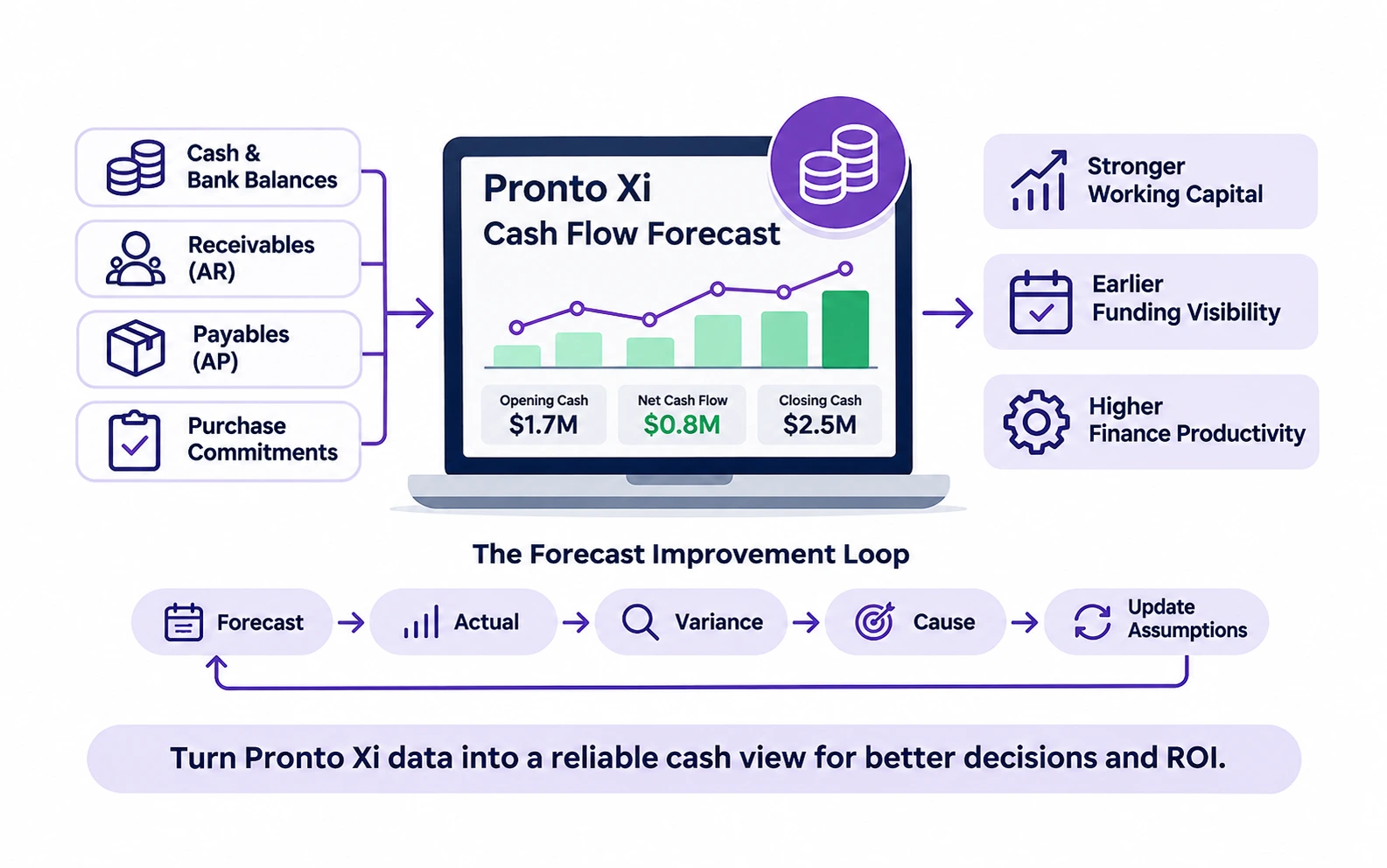
Forecast → Actual → Variance → Cause → Assumption change → Next forecast
For example:
Forecast closing cash: $2.4 million
Actual closing cash: $1.7 million
Variance: $700,000
The useful question is:
Why were we $700,000 wrong?
Possible causes might include:
- customer receipts arriving late;
- supplier payments occurring earlier;
- higher inventory purchasing;
- unexpected capex;
- payroll or tax differences;
- omitted transactions.
Then improve the assumption or process responsible.
Independent forecasting principle: A forecast that is never compared with actual cash movements is a periodically recreated estimate, not a closed-loop forecasting process.
How should forecast accuracy be measured?
Useful measures may include:
- forecast closing cash versus actual;
- absolute cash variance;
- forecast receipts versus actual receipts;
- forecast supplier payments versus actual payments;
- material omissions;
- manual adjustment value;
- forecast error by period;
- forecast bias.
A particularly important distinction is:
Forecast error
Forecasts miss in both directions.
Forecast bias
Forecasts repeatedly miss in the same direction.
For example, if customer receipts are consistently forecast too early, Finance has a systematic assumption problem rather than random forecasting noise.
Should Finance still use Excel?
Documented Pronto Xi capability
Pronto explicitly documents using its Cash Flow Image with external applications such as Excel.
Independent guidance
Excel is not inherently the problem.
It may be useful for:
- sensitivity modelling;
- scenarios;
- board presentation;
- temporary assumptions;
- events not represented in ERP data.
The risk appears when Excel becomes a parallel finance system with:
- manually copied ERP values;
- undocumented formulas;
- multiple versions;
- unclear ownership;
- dependence on one employee.
A stronger model is:
Pronto Xi data → Controlled assumptions → Forecast → Actual → Variance
rather than:
Pronto Xi export → Spreadsheet rebuild → Unexplained adjustments
Where does cash-flow forecasting ROI come from?
The forecast itself is not the ROI.
Value comes from decisions made earlier because management has better visibility.
1. Working capital
Better visibility can support decisions around:
- customer collections;
- supplier-payment timing;
- inventory purchasing;
- purchase commitments;
- discretionary expenditure.
The question is:
Can we release or protect cash without damaging operations?
2. Funding visibility
Earlier warning of a liquidity gap can give management more time to:
- manage bank facilities;
- arrange funding;
- defer discretionary spending;
- adjust investment timing;
- change operating decisions.
The question is:
Can we see a funding problem early enough to retain choices?
3. Finance productivity
A better-integrated process may reduce:
- repeated ERP exports;
- reconciliation;
- rekeying;
- spreadsheet maintenance;
- version management.
The strongest ROI question is:
What decision will management make earlier or better because this forecast exists?
If that cannot be answered, the forecast risks becoming reporting rather than management information.
When is Pronto Xi enough?
Not every organisation needs another forecasting application.
Pronto Xi may be sufficient when:
- the main cash movements already exist in Pronto Xi;
- AR and AP data are reliable;
- purchase commitments are visible;
- management assumptions are relatively straightforward;
- Finance can produce the required forecast efficiently;
- forecast-versus-actual analysis is manageable.
Additional forecasting capability may be worth assessing when:
- scenario modelling is highly complex;
- many entities or financing structures must be modelled together;
- treasury requirements extend significantly beyond operational ERP forecasting;
- large amounts of forecast information originate outside the ERP;
- sophisticated sensitivity modelling is required.
Fix ERP data first when:
- receivables are unreliable;
- supplier commitments are incomplete;
- key transactions are posted late;
- purchase-order data is poor;
- Finance cannot reconcile ERP information confidently.
A more sophisticated forecasting tool cannot compensate for unreliable underlying data.
What forecast horizon should CFOs use?
There is no universal horizon appropriate for every Pronto Xi customer.
| Horizon | Typical question |
|---|---|
| Near term | Can we meet immediate obligations? |
| Rolling 13-week style view | Where could liquidity pressure emerge this quarter? |
| Medium term | How will working-capital and investment decisions affect funding? |
| Longer term | Do strategic plans create future financing requirements? |
The appropriate horizon depends on factors such as:
- cash volatility;
- seasonality;
- working-capital cycle;
- financing arrangements;
- supplier terms;
- capital expenditure.
A 13-week forecast is a general finance practice, not a documented Pronto requirement.
How does inventory affect cash flow?
Inventory can absorb significant operating cash.
A business can be:
Profitable + growing + cash constrained
if receivables and inventory consume cash faster than operating inflows replenish it.
For inventory-intensive Pronto Xi users, Finance should understand:
What are we buying?
When will we pay for it?
How long will it sit in inventory?
When will the resulting sale turn back into cash?
Cash forecasting and working-capital management therefore should not operate independently.
A practical Pronto Xi cash-flow review
Before buying another application or rebuilding another spreadsheet, review the process in this order:
Cash → Receivables → Payables → Commitments → External assumptions → Forecast → Actual → Variance → Improve
1. Confirm opening cash
Verify the bank and cash accounts forming the starting position.
2. Validate customer receipts
Determine whether invoice due dates realistically represent expected collection dates.
3. Validate supplier payments and commitments
Review invoices, purchase orders and expected payment timing.
4. Include major external cash movements
Capture material items such as planned capital expenditure where needed.
5. Document assumptions
Avoid adjustments understood only by the person building the forecast.
6. Produce the forecast
Use a horizon appropriate to management decisions.
7. Compare forecast with actual
Identify the largest differences.
8. Explain and correct recurring variance
Improve the data, assumptions or process that caused the error.
This is independent finance guidance, not an official Pronto Software methodology.
Executive self-assessment: is your cash forecast good enough?
A closer review may be worthwhile if several of these statements are true:
- Finance rebuilds the forecast manually each week.
- Different executives have different expected cash numbers.
- Supplier commitments are difficult to identify.
- Customer receipts regularly arrive later than forecast.
- Capital expenditure unexpectedly affects liquidity.
- Inventory purchasing creates cash surprises.
- Finance struggles to reconcile the forecast to Pronto Xi.
- Forecast versus actual is rarely measured.
- The process depends heavily on one spreadsheet owner.
- Today's cash position is clear but future liquidity is not.
Several “yes” answers do not automatically mean you need new software.
First determine whether the problem is:
Configuration → Data → Finance process → Reporting → Assumptions → Capability
Is your Pronto Xi cash forecast still heavily dependent on spreadsheets?
Before adding another forecasting product, determine whether the problem lies in:
Pronto Xi configuration → Data quality → Finance process → Reporting → Assumptions → Capability
If the issue is capability, SAAPRO can help determine whether you need a:
- Pronto Xi Business Analyst
- Functional Consultant
- Senior Application Analyst
- BI/reporting specialist
- technical/integration specialist
- ERP Manager
SAAPRO specialises in the Australian Pronto Xi talent market and can help identify the capability required before you engage or recruit a specialist. Discuss Your Pronto Xi Requirement or Compare Pronto Xi Roles
Disclosure: SAAPRO is an independent Pronto Xi recruitment specialist and is not Pronto Software or an ecommerce implementation vendor.
Frequently Asked Questions
Yes. Pronto Xi General Ledger includes cash-flow forecasting capability for producing flexible cash-flow projections using business-specific assumptions.
Yes. Pronto specifically documents upcoming capital expenditure as an example of information outside the underlying database that can be incorporated into a cash-flow projection.
Yes. Pronto Xi Accounts Payable supports current and forward commitment tracking, while Payment Commitment reporting can include purchase orders and shipments not yet invoiced.
Yes. Pronto documents commitment accounting for tracking outstanding purchase-order values against General Ledger accounts.
Yes. Pronto documents use of its Cash Flow Image with external applications such as Excel.
The public documentation reviewed for this article does not establish automated behavioural prediction of individual customer payment dates.
The public Pronto material reviewed for this article does not provide sufficient evidence to claim that standard Pronto Xi automatically generates AI cash-flow forecasts.
No. It is a general finance practice used by some organisations, not a documented Pronto methodology.
Measure whether better forecasting improves decisions across working capital, funding visibility and finance productivity, and whether forecast accuracy improves over time.
Key Takeaways
- ✓Pronto Xi provides cash-flow forecasting in General Ledger, with financial information that supports a forward view of liquidity across Cash → Receivables → Payables → Purchase commitments → Payroll and other cash movements → Management assumptions.
- ✓The forecast itself is not the value. The real operating loop is Reliable data → Credible assumptions → Forecast → Actual → Variance → Better next forecast.
- ✓Business value should appear in working capital, funding visibility and finance productivity.
- ✓For CFOs, the goal is to see liquidity pressure early enough to make better decisions. For CIOs, it is to give Finance reliable, governed data rather than forcing it to reconstruct the financial picture outside the ERP.
- ✓Ask three questions consistently: What future cash movements does Pronto Xi already know about? Which material assumptions still sit outside the ERP? How accurately did the last forecast predict what actually happened?