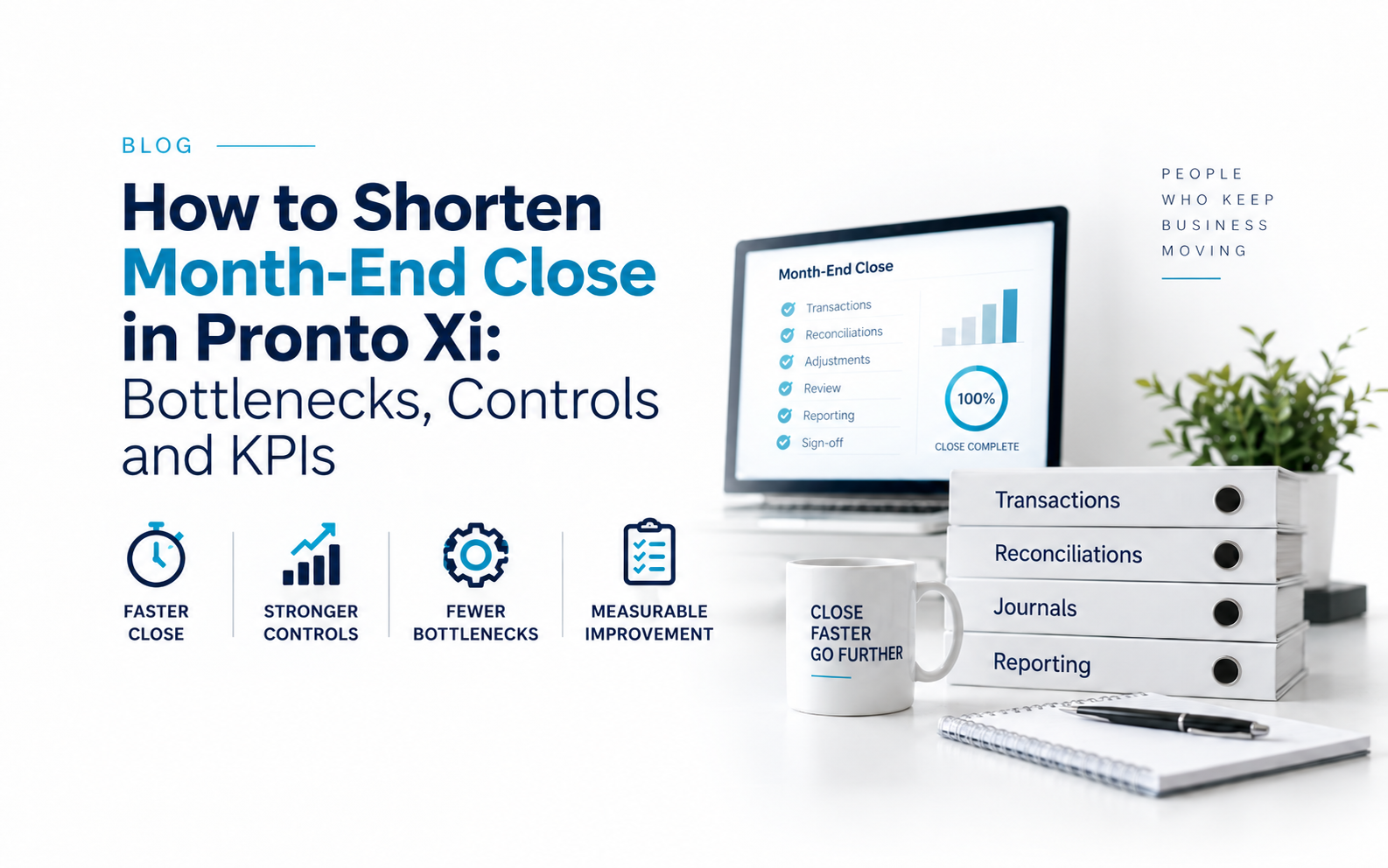
How to Shorten Month-End Close in Pronto Xi: Bottlenecks, Controls and KPIs
A practical guide to shortening month-end close in Pronto Xi by finding the real bottlenecks on the critical path, moving routine reconciliations earlier, managing exceptions instead of chasing every task, and tracking the close KPIs that actually indicate control and speed.
Why does month-end close take so long in a Pronto Xi environment?
A slow month-end close is usually not caused by one slow finance task. It is caused by dependencies accumulating across transactions, reconciliations, approvals, interfaces, journals and reporting.
Pronto Xi provides functionality that can support a controlled financial close, including integrated financial modules, transaction-based bank reconciliation, period-end processing, financial reporting and automated alerts. Pronto's Financials documentation describes General Ledger, Accounts Receivable, Accounts Payable and Fixed Assets as integrated financial applications, while General Ledger supports period-end processing and independent rollovers of the major ledgers.
But software does not create a fast close by itself.
The objective should be:
Produce controlled, decision-ready financial information sooner with less waiting, fewer exceptions and less unnecessary manual effort.
That means treating month-end as an end-to-end operating process, not simply a finance-department deadline.
Pronto Xi month-end close at a glance
A typical close can be viewed as six connected stages:
| Stage | Typical activity | Main question |
|---|---|---|
| 1. Pre-close | Resolve exceptions, chase approvals, prepare accruals | What can be completed before month-end? |
| 2. Cut-off | Finalise sales, purchases, inventory, payroll and operational activity | Are cut-off rules clear? |
| 3. Subledgers | Reconcile AR, AP, Inventory, Fixed Assets, bank and other balances | Which subledger is blocking the GL? |
| 4. Adjustments | Accruals, provisions, allocations, intercompany and journals | Which adjustments are avoidably manual? |
| 5. GL review | Trial balance, reconciliations, variance analysis and corrections | Are errors being found too late? |
| 6. Reporting | Management accounts, commentary and executive sign-off | Does reporting add days after accounting close? |
Pronto Xi General Ledger supports 12 or 13 user-defined periods, date-based transactions and Period End Processing, while the main AR, AP, Inventory and GL ledgers can be rolled independently.
The bigger opportunity is not simply running those functions faster.
It is identifying where elapsed time accumulates before the close can move forward.
1. Where does your close actually lose time?
Before automating or redesigning anything, diagnose the problem.
A useful starting point is to match symptoms with likely causes.
| Symptom | Likely underlying issue |
|---|---|
| AP consistently closes late | Invoice receipt, PO matching, approvals or goods receipt |
| Inventory delays finance | Warehouse cut-off, stock processing or valuation |
| Large number of late journals | Weak upstream configuration or process design |
| Reconciliations reveal old issues | Controls are happening too late |
| Intercompany takes days | Ownership or entity-process design |
| Reports take days after GL close | Reporting architecture or spreadsheet dependency |
| Finance spends close chasing people | Weak task ownership and workflow visibility |
| Interface errors appear at month-end | Exception monitoring is insufficient |
| Close relies on one person | Knowledge and process concentration risk |
The key discipline is to measure the actual delay rather than rely on perceptions.
Ask:
-
What are we waiting for?
-
Who owns it?
-
When was it supposed to finish?
-
When did it actually finish?
-
What could not start until it finished?
-
Why was it late?
Within three monthly cycles, repeated patterns usually become visible.
2. Find the critical path
Not every month-end task matters equally.
Some activities happen in parallel. Others determine the earliest possible close date.
Consider:
Inventory transactions complete
↓
Inventory valuation confirmed
↓
Inventory-to-GL reconciliation
↓
GL review
↓
Management P&L
If the inventory process is four hours late, every downstream activity may also move four hours.
Meanwhile, shortening a non-critical report by two hours might have no impact at all on the final close date.
That is why the objective should be:
Optimise the critical path, not every task equally.
For each close activity, document:
-
predecessor;
-
successor;
-
planned finish;
-
actual finish;
-
elapsed delay;
-
effort required; and
-
business owner.
This separates activities that merely consume effort from those that genuinely delay the close.
3. Measure elapsed time separately from effort
This distinction is often overlooked.
A task may require only 20 minutes of work but introduce a 12-hour delay because it waits overnight for approval.
Conversely, a three-hour reconciliation may consume significant finance effort without delaying anything because other critical tasks are still running.
Track both:
Effort: How many staff hours are consumed?
Elapsed time: How long does the activity delay the overall process?
That changes improvement priorities.
The best opportunity is often not the task requiring the most work.
It is the task creating the longest downstream wait.
4. Move routine work before month-end
The fastest month-end task is the one that has already been completed.
This is the foundation of a continuous close approach.
Instead of allowing problems to accumulate until Day 1, resolve them throughout the month.
Potential candidates include:
-
bank reconciliation;
-
invoice exceptions;
-
unmatched receipts;
-
unallocated customer payments;
-
interface errors;
-
asset additions;
-
invalid master data;
-
unusual account movements; and
-
aged reconciling items.
Pronto Xi capability
Pronto Xi supports transaction-based bank reconciliation using imported bank lines, automated matching and categorisation.
Process decision
The value comes from how frequently the organisation reconciles.
If bank exceptions are reviewed every few days instead of on Day 1, finance begins the close with fewer unresolved items.
The same principle applies elsewhere:
Find exceptions while there is still time to fix them.
5. Reduce upstream Accounts Payable delays
Late supplier invoices are a common close problem.
The accounting response is often to create more accruals.
But the more important question is:
Why are the invoices late or unprocessed?
Common causes include:
-
invoice sent to the wrong person;
-
PO missing;
-
goods receipt incomplete;
-
pricing discrepancy;
-
approval delayed;
-
supplier details incorrect; or
-
business owner unavailable.
Pronto Xi Accounts Payable is integrated with Purchasing and General Ledger, and Pronto's Financials material describes supplier transactions, approval controls and related processing within the integrated environment.
That does not make late invoices disappear.
The process improvement comes from categorising late invoices by root cause.
For example:
| Root cause | Monthly count | Average delay | Owner |
|---|---|---|---|
| Missing receipt | 31 | 1.4 days | Operations |
| Approval outstanding | 22 | 0.8 days | Budget owners |
| PO discrepancy | 14 | 1.1 days | Procurement |
| Supplier issue | 6 | 0.5 days | AP |
This turns a recurring close problem into an operational improvement opportunity.
6. Reconcile continuously, not retrospectively
A reconciliation that repeatedly produces the same exception is not just a month-end task.
It is evidence of a process problem.
Key reconciliations may include:
-
AR to control accounts;
-
AP to control accounts;
-
inventory valuation to GL;
-
fixed assets to GL;
-
payroll to GL;
-
bank accounts;
-
intercompany balances; and
-
interface source-to-destination totals.
Pronto Xi Fixed Assets provides reconciliation capability supporting investigation and verification of asset transactions, while Pronto Financials also provides bank-reconciliation functionality.
The management goal is:
Do not wait until month-end to discover that two balances stopped agreeing weeks earlier.
A strong close process progressively reduces:
-
aged reconciling items;
-
unexplained differences;
-
repeated corrections; and
-
time spent investigating historical issues.
7. Challenge recurring manual journals
Manual journals are not inherently bad.
Professional judgement will always be required in areas such as provisions, impairment or complex accruals.
The problem is repetitive manual activity with stable rules.
Analyse journals by:
-
reason;
-
preparer;
-
frequency;
-
amount;
-
reversal;
-
source process;
-
account; and
-
recurrence.
Then ask:
Why does this journal still need to exist manually?
Some may represent:
-
recurring accruals;
-
allocations;
-
missing configuration;
-
integration limitations;
-
master-data problems; or
-
processes that should occur upstream.
Do not aim for zero manual journals.
Aim for:
fewer unnecessary journals + better evidence + stronger controls over those that remain.
And do not automate a process simply because it is slow.
Automating a bad close process only makes the bad process run faster.
8. Manage the close by exception
Traditional close management often relies on finance repeatedly asking:
“Have you finished yet?”
A mature process moves towards:
“Which items are outside tolerance and require intervention?”
Pronto Xi capability
Pronto Xi Tasks & Alerts allows organisations to define triggers, notifications and scheduled status checks. Pronto positions the capability as a way to surface exceptions and reduce delays, errors and rework.
Process decision
Finance should decide which events genuinely require intervention.
Examples may include:
-
balance variance above tolerance;
-
unreconciled item older than X days;
-
invoice received after cut-off;
-
failed interface;
-
approval past due;
-
unexpected account movement;
-
inventory variance above threshold.
The objective is to move from checking everything to investigating exceptions.
This can reduce both close effort and management noise.
9. Protect financial control while shortening the close
The objective is not simply the shortest possible close.
A faster process is not an improvement if it weakens:
-
segregation of duties;
-
approval;
-
reconciliation;
-
audit trail;
-
cut-off;
-
evidence retention; or
-
management review.
For every acceleration initiative, ask:
Does this reduce elapsed time without reducing financial control?
For example:
Automating recurring journals may help.
Automatically approving material journals probably does not.
Reconciling throughout the month can strengthen the close.
Removing reconciliation to hit a deadline weakens it.
A better objective is:
The shortest close that still produces controlled, decision-ready financial information.
10. Separate accounting close from management reporting
Many organisations say:
“Our close takes seven days.”
But the General Ledger may actually be closed on Day 3.
The remaining four days may be spent:
-
exporting data;
-
rebuilding spreadsheets;
-
preparing management packs;
-
adjusting presentation;
-
collecting commentary; or
-
reconciling different reporting versions.
That is not the same problem.
Pronto Xi Financials provides reporting across the financial environment, and Pronto's current education resources continue to include IBM Cognos reporting functionality.
Track two metrics separately:
Time to financial close
and
Time to decision-ready management reporting
This makes it possible to determine whether the constraint lies in:
-
accounting;
-
data;
-
reporting architecture; or
-
management commentary.
11. Measure the close using the right KPIs
“Which day did we finish?” is not enough.
A useful close dashboard should include:
| KPI | Why it matters |
|---|---|
| Days to accounting close | Overall cycle time |
| Critical-path delay | Shows what actually moved the close date |
| Elapsed time by stage | Identifies waiting |
| Effort hours by stage | Identifies workload |
| % close tasks on time | Measures process discipline |
| Late dependencies | Identifies upstream causes |
| Post-close journals | Indicates close quality |
| Manual journal count | Shows manual intervention |
| Aged reconciliations | Measures control quality |
| Interface exceptions | Measures systems reliability |
| Reopened periods | Indicates close instability |
| Time to management pack | Measures reporting performance |
Do not optimise one KPI in isolation.
For example:
Day 5 close → Day 4 close
looks positive.
But if post-close adjustments double, it may represent a worse outcome.
12. Prioritise improvements quantitatively
A useful prioritisation model is:
Priority = Frequency × Delay × Financial/Control Impact
For example:
| Bottleneck | Frequency | Delay | Control / financial impact | Priority |
|---|---|---|---|---|
| Inventory reconciliation late | High | High | High | Critical |
| AP approval backlog | High | Medium | Medium | High |
| Manual board-pack formatting | High | Low | Low | Medium |
| Rare FX exception | Low | Medium | Medium | Lower |
This prevents improvement programs from becoming long lists of visible but low-value frustrations.
Fix the recurring constraints that delay the critical path first.
13. What does a good Pronto Xi month-end close look like?
A mature close process typically has:
-
a defined close calendar;
-
explicit task ownership;
-
clear cut-off rules;
-
reconciliations performed throughout the month;
-
limited aged exceptions;
-
controlled manual journals;
-
automated or exception-based monitoring;
-
fewer late upstream dependencies;
-
reconciled subledgers and GL;
-
documented business sign-off; and
-
management information delivered soon after financial close.
The objective is predictability.
A CFO should be able to answer:
What will close today, what is late, why is it late, and what risk does it create?
without assembling information from multiple spreadsheets and conversations.
14. Illustrative Pronto Xi month-end close calendar
Every organisation is different, but an illustrative structure might look like this:
| Timing | Example activity |
|---|---|
| D-5 to D-2 | Resolve bank and interface exceptions, chase approvals, review open receipts, identify unusual accounts |
| D-1 | Prepare recurring accruals, validate cut-off readiness, resolve remaining exceptions |
| Day 0 | Transaction cut-off and operational completion |
| Day 1 | AP, AR, payroll and inventory reconciliation |
| Day 2 | Fixed assets, intercompany, accruals and adjustments |
| Day 3 | GL reconciliation, variance analysis and corrections |
| Day 4 | Management reporting, commentary and sign-off |
This is not a universal target.
A complex multi-entity organisation may require a different timetable.
The value is in defining dependencies and ownership so the organisation can progressively reduce unnecessary elapsed time.
15. A practical 90-day close-improvement program
You do not necessarily need a major ERP project to improve month-end.
Use the next three closes.
Month 1 — Diagnose
Capture:
-
every task;
-
planned and actual completion time;
-
owner;
-
predecessor;
-
successor;
-
elapsed delay;
-
effort;
-
exceptions;
-
journals; and
-
reconciliation problems.
Identify the critical path.
Month 2 — Remove obvious delay
Focus on the largest repeated constraints:
-
move reconciliations earlier;
-
enforce cut-offs;
-
improve AP approval;
-
resolve recurring interface failures;
-
clarify ownership;
-
eliminate unnecessary reports;
-
challenge repeated manual journals.
Month 3 — Standardise and control
Introduce:
-
repeatable close checklists;
-
tolerance-based exception management;
-
reconciliations throughout the month;
-
close dashboards;
-
root-cause categories;
-
documented process ownership.
Then compare:
Before → After
for:
-
close duration;
-
critical-path delay;
-
effort;
-
late tasks;
-
exceptions;
-
post-close adjustments; and
-
management-report delivery.
The objective is not a one-off faster close.
It is a repeatable improvement system.
Month-end close bottleneck checklist
Use this as a quick diagnostic.
-
Supplier invoices regularly arrive or receive approval after cut-off
-
Bank reconciliation is largely performed after month-end
-
Inventory is not reconciled until finance asks
-
Recurring journals are manually rebuilt
-
Intercompany differences repeatedly delay close
-
Interface errors are discovered during close
-
Finance spends substantial time chasing task owners
-
Reports require significant spreadsheet manipulation
-
Close depends heavily on one or two individuals
-
Nobody records why close activities finish late
-
Reconciliation exceptions remain unresolved for multiple periods
-
Management reporting takes substantially longer than accounting close
If several boxes are checked, asking finance to “work faster” is unlikely to solve the problem.
Final takeaway
The fastest way to improve Pronto Xi month-end close is usually not to start with the period-end function.
Start by asking:
Where does the close actually wait?
Map:
Transaction → Cut-off → Reconciliation → Adjustment → GL → Reporting → Sign-off
Then identify the few dependencies that determine the critical path.
Move routine work earlier.
Reconcile continuously.
Manage by exception.
Challenge unnecessary manual journals.
Separate accounting close from management reporting.
And measure both elapsed time and effort.
Pronto Xi provides integrated financial processing, period-end functionality, bank reconciliation, reporting and alert capabilities that can support those disciplines. But the larger improvement comes from the operating model around the ERP.
A good close is not simply fast. It produces controlled, decision-ready numbers quickly and predictably.
Where SAAPRO fits
If improving month-end close exposes a gap in Pronto Xi finance, Cognos, systems or business-analysis capability, SAAPRO can help identify specialists with relevant Pronto experience.
Frequently Asked Questions
Pronto Xi provides Period End Processing that can automatically perform tasks associated with closing a period, while AR, AP, Inventory and General Ledger can be rolled independently. Automation can support the process, but upstream transactions, reconciliations, approvals and accounting judgement still require appropriate process design.
Pronto Xi supports transaction-based bank reconciliation using imported bank lines, automated matching and categorisation. Performing these reconciliations regularly during the month can reduce the number of unresolved items that reach the formal close.
No. Journals involving professional judgement should remain appropriately reviewed and controlled. Repetitive journals with stable rules should be investigated to determine whether configuration, automation or improved upstream processing could remove unnecessary manual work.
There is no single KPI. Days to close should be assessed alongside critical-path delay, post-close adjustments, reconciliation quality, manual effort and time to management reporting. Speed without accuracy and control is not an improvement.
There is no universal number of days. The appropriate target depends on entity complexity, operations, regulatory requirements and reporting needs. A better objective is continuous reduction in elapsed time, exceptions and manual effort without weakening control.
ERP integration does not automatically create efficient processes. Late approvals, poor cut-off discipline, unresolved interface exceptions, manual reconciliations, weak ownership and spreadsheet-based reporting can still extend the close even when transactions are processed through an integrated ERP.
Key Takeaways
- ✓Month-end delays come from dependencies piling up across the close, not one slow task, find the critical path before fixing anything.
- ✓Move reconciliations and exception-handling earlier in the month instead of leaving them for Day 1.
- ✓Manage the close by exception and challenge recurring manual journals rather than checking everything by hand.
- ✓Track KPIs like critical-path delay and post-close adjustments alongside close speed, a faster close that weakens control isn't a real improvement.