Pronto Xi MRP & Production Scheduling: How to Align Materials, Capacity and Delivery
A guide to how Pronto Xi MRP, CRP and Manufacturing Scheduler align materials, capacity and production sequence.
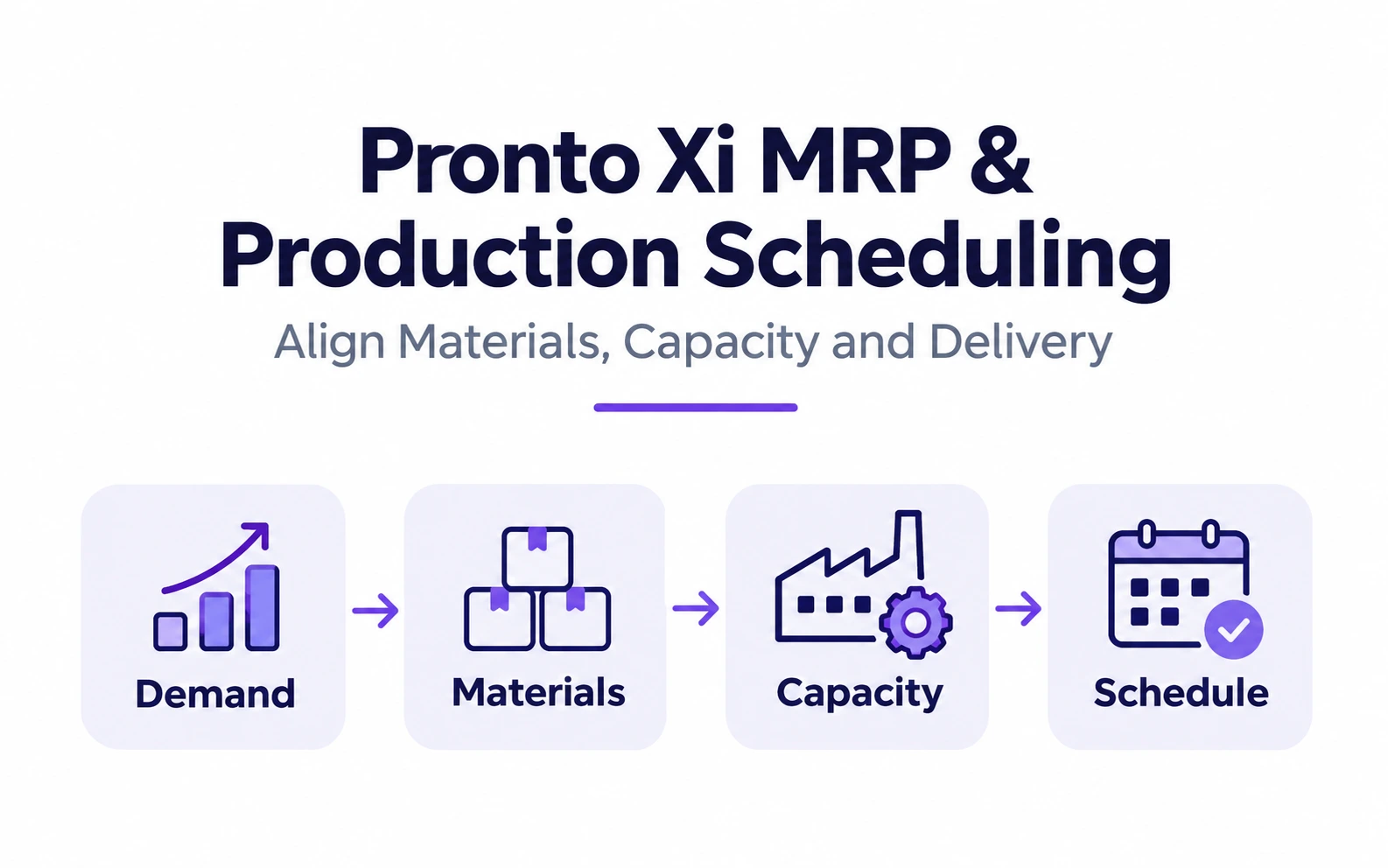
Pronto Xi Manufacturing Planning provides Master Production Scheduling (MPS), Material Requirements Planning (MRP) and Capacity Requirements Planning (CRP), while Manufacturing Scheduler helps sequence production activity against work-centre capacity. Together, these capabilities can support the progression from demand to materials, capacity and executable production scheduling.
The executive question is not simply:
Are we running MRP?
It is:
Can we reliably translate demand into the materials, capacity and production sequence required to meet the business plan?
For CFOs, the potential business impact includes inventory, work in progress (WIP), emergency purchasing, premium freight and production disruption.
For CIOs, the question is whether manufacturing planning operates from reliable ERP data or depends heavily on spreadsheets and disconnected workarounds.
For manufacturing leaders, the objective is a plan that can actually be executed.
Pronto Xi functionality versus independent manufacturing guidance
This article deliberately separates two types of information.
Documented Pronto Xi capability
Statements labelled Documented Pronto Xi capability describe functions published by Pronto Software, including:
- Master Production Scheduling (MPS);
- Material Requirements Planning (MRP);
- Capacity Requirements Planning (CRP);
- Manufacturing Scheduler;
- Bills of Materials (BOMs);
- work centres;
- resource-availability calendars;
- planned work orders;
- finite and infinite scheduling; and
- Manufacturing Scheduler “what-if” scenarios.
Independent guidance
Statements labelled Independent guidance are manufacturing and ERP principles used to help CFOs, CIOs and operations leaders evaluate:
- ROI;
- master-data quality;
- planning stability;
- bottlenecks;
- governance;
- ownership;
- implementation priorities; and
- performance measurement.
These are not official Pronto Software methodologies or guaranteed Pronto Xi outcomes.
Which Pronto Xi manufacturing capability addresses which problem?
Documented Pronto Xi capability
Pronto Xi Manufacturing Planning includes MPS, MRP and CRP, while Manufacturing Scheduler uses CRP information to help manage production sequencing and capacity.
Independent guidance
A practical way to decide where to investigate first is:
| Business problem | Capability to assess |
|---|---|
| Finished-goods production plan is unclear | MPS |
| Material shortages or excess raw materials recur | MRP |
| Work centres are overloaded | CRP |
| Jobs are continually resequenced manually | Manufacturing Scheduler |
| Actual production differs significantly from the plan | Shopfloor Manufacturing / production feedback |
| Several problems occur together | Integrated manufacturing-planning review |
The key is to start with the business problem rather than the module name.
What is Pronto Xi Material Requirements Planning?
Documented Pronto Xi capability
Pronto Xi Material Requirements Planning organises recommended replenishment orders so demand can be satisfied when items become due.
Pronto documents that MRP can:
- create planned work-order requirements for components and sub-assemblies;
- produce suggested purchases for known demand;
- plan completion dates for work orders using lead time; and
- produce released planned orders and exception reports.
Pronto also states that planned work orders result from time-phasing demand. Net item requirements are exploded through all levels of the Bill of Materials (BOM), with lead time, on-hand quantities and on-order quantities affecting the timing and quantity of purchasing and manufacturing requirements.
Conceptually:
Demand → BOM requirements → Existing supply → Net requirements → Planned purchasing or manufacturing
Independent guidance
MRP should not be judged merely by whether the calculation completes.
The useful business question is:
Does the resulting material plan help the organisation make better purchasing and production decisions?
Why does BOM accuracy matter to MRP?
Documented Pronto Xi capability
Pronto's MRP process explodes requirements through the levels of the BOM to determine gross material requirements.
Independent guidance
That means the quality of the BOM directly influences the usefulness of the result.
If a finished product actually requires:
4 × Component A
but the BOM records:
3 × Component A
the calculation may operate correctly against the configured data while the material requirement is still wrong.
The same principle applies to:
- obsolete components;
- incorrect quantities;
- inaccurate lead times;
- incorrect units of measure;
- outdated product structures; and
- production assumptions that no longer reflect reality.
Independent planning principle: MRP depends heavily on master-data quality. Poor input data can produce poor recommendations even when the calculation itself is functioning correctly.
What is Pronto Xi Master Production Scheduling?
Documented Pronto Xi capability
Pronto Xi Manufacturing Planning includes Master Production Scheduling (MPS) alongside MRP and DRP. Pronto also states that MRP, DRP and MPS can run sequentially within the planning process.
Independent guidance
A useful conceptual distinction is:
MPS: What finished products are we planning to produce and when?
MRP: What purchasing and manufacturing requirements arise from that plan?
This distinction helps executives avoid treating all production-planning questions as an MRP issue.
What is Pronto Xi Capacity Requirements Planning?
Documented Pronto Xi capability
Capacity Requirements Planning (CRP) creates a detailed plan by department or work centre based on constraints defined by the resource-availability calendar.
Pronto documents both finite scheduling and infinite scheduling within CRP for open work orders and planned requirements generated from MRP.
Independent guidance
Material availability and production capacity are different constraints.
For example:
MRP may indicate that all required components will be available on Monday.
But three work orders may each require eight hours on the same machine, while only eight hours of capacity are available.
The material plan alone does not establish that all three jobs can be completed Monday.
Independent planning principle: Material feasibility and capacity feasibility should be assessed separately before treating a production plan as executable.
What does Pronto Xi Manufacturing Scheduler do?
Documented Pronto Xi capability
Pronto describes Manufacturing Scheduler as an electronic whiteboard scheduler used with CRP.
Its published capabilities include:
- resource-availability calendars;
- work-centre and work-order information;
- drag-and-drop movement of operations;
- automatic operation sequencing;
- locking operations or work centres;
- Gantt views;
- user-defined optimisation parameters; and
- alternative “what-if” scenarios before information is submitted back to Pronto Xi.
Pronto also describes Manufacturing Scheduler as helping users manage workload against factory-capacity constraints.
Independent guidance
The business value is not the graphical schedule itself.
The more useful question is:
Does the schedule reflect materials, work-centre capacity and operational priorities closely enough that production teams can rely on it?
How do MRP, CRP and production scheduling fit together?
Documented Pronto Xi capability
Pronto documents MRP as producing planned requirements, CRP as creating detailed work-centre capacity plans, and Manufacturing Scheduler as using CRP information to sequence production activity.
Independent guidance
A useful management model is:
Demand → Production plan → Materials → Capacity → Sequence → Execution → Feedback
In this model:
MPS helps establish production intent.
MRP calculates material and replenishment requirements.
CRP assesses workload against available capacity.
Manufacturing Scheduler helps convert that capacity information into a production sequence.
Production feedback shows what actually occurred.
This is an independent explanatory framework, not an official Pronto Software process model.
Why should CFOs care about MRP and production scheduling?
Independent guidance
Manufacturing planning can influence three broad financial areas.
1. Working capital
Potential areas include:
- raw-material inventory;
- WIP;
- slow-moving material; and
- inventory purchased earlier than economically required.
The objective is not minimum inventory.
It is:
Enough material to support production without carrying unnecessary inventory.
2. Disruption cost
Poor material or capacity planning can contribute to:
- emergency purchasing;
- premium freight;
- overtime;
- production stoppages; and
- repeated replanning.
3. Throughput and productive capacity
Relevant outcomes can include:
- bottleneck utilisation;
- manufacturing lead time;
- schedule adherence; and
- on-time delivery.
The CFO-level question is therefore:
How much working capital, disruption cost and productive capacity are affected by the quality of the manufacturing plan?
Does better MRP automatically reduce inventory?
Documented Pronto Xi capability
Pronto documents MRP as calculating recommended purchasing and manufacturing requirements based on demand, BOMs, lead times, on-hand inventory and on-order quantities.
Independent guidance
No planning calculation automatically guarantees lower inventory.
Suppose a supplier reliably delivers in four weeks but the planning data records an eight-week lead time.
The ERP may recommend ordering earlier based on the information supplied to it.
The calculation may therefore be operating correctly while the business decision remains economically inefficient.
The CFO should ask:
Which purchasing, production or inventory decision will change because the planning information is better?
What manufacturing data needs to be reliable?
Documented Pronto Xi capability
Pronto's documented planning processes use information including:
- BOMs;
- demand;
- lead times;
- on-hand quantities;
- on-order quantities;
- work centres;
- work orders; and
- resource-availability calendars.
Independent guidance
A broader manufacturing-data review should consider whether the following accurately reflect reality:
| Planning input | Why it matters |
|---|---|
| BOMs | Drive component requirements |
| Lead times | Influence action timing |
| Inventory records | Determine available material |
| Open purchase orders | Affect future supply |
| Open work orders | Affect future production |
| Work centres | Define where operations occur |
| Routings | Influence production sequence |
| Resource calendars | Affect available capacity |
| Production times | Influence workload |
| UOMs | Affect quantities |
Poor data should be corrected before attributing every planning problem to the software.
Why does production planning become unstable?
Independent guidance
Repeated rescheduling can indicate planning instability rather than a defect in the scheduler.
Potential causes include:
- changing demand;
- inaccurate supplier lead times;
- incorrect BOMs;
- late suppliers;
- unrealistic capacity assumptions;
- machine downtime;
- urgent customer changes;
- incomplete production feedback; or
- frequent manual overrides.
Instead of measuring only:
How often did the schedule change?
also ask:
What repeatedly caused it to change?
If the same underlying assumption repeatedly forces replanning, correcting that assumption may create more value than improving the scheduling interface.
Why bottleneck capacity matters
Documented Pronto Xi capability
Pronto Manufacturing Scheduler uses work-centre and CRP information to manage production workload against factory-capacity constraints.
Independent guidance
A factory's true production constraint may be concentrated in:
- one specialist machine;
- one work centre;
- one skilled labour group;
- one subcontract process; or
- one quality-control stage.
Overall factory utilisation can therefore hide the constraint that actually determines throughput.
The relevant management question is:
Which resource limits our ability to execute the production plan?
Can planners test alternative production schedules?
Documented Pronto Xi capability
Yes. Pronto documents that Manufacturing Scheduler can create alternative schedules and save them as “what-if” scenarios before the information is submitted back to Pronto Xi.
Independent guidance
This can support scenario-based planning questions such as:
- What happens if a critical work centre becomes unavailable?
- What happens if a priority order is brought forward?
- What happens if a component arrives late?
- What happens if additional capacity becomes available?
The specific outcome will depend on the organisation's Pronto Xi setup, production data and operating constraints.
How should manufacturing-planning ROI be measured?
Independent ROI framework
Pronto Software documents the planning capabilities. The framework below is an independent way for CFOs and CIOs to evaluate whether those capabilities are creating measurable business value.
Working capital
Monitor:
- raw-material inventory;
- WIP;
- slow-moving materials; and
- inventory held earlier than required.
Disruption cost
Monitor:
- material shortages;
- emergency purchases;
- premium freight;
- overtime;
- production stoppages; and
- reactive schedule changes.
Throughput and capacity
Monitor:
- schedule adherence;
- recurring bottlenecks;
- manufacturing lead time;
- critical work-centre utilisation; and
- on-time delivery.
Do not use arbitrary generic improvement targets.
Establish the organisation's own baseline and measure actual change.
One documented Pronto Xi MRP customer example
Documented customer outcome
Pronto Software publishes a case study for Australian manufacturer Crusader Caravans.
Pronto says the company had previously relied on spreadsheets and manual processes and experienced stock shortages, overstocking and production stoppages.
According to Pronto, Pronto Xi MRP automated inventory calculations using existing inventory, customer orders and supplier lead times.
Pronto reports that Crusader Caravans reduced inventory from $6 million to around $5 million and recorded a 30–40% reduction in production bottlenecks.
These are results for one named customer.
They are not universal Pronto Xi benchmarks and should not be assumed for another manufacturer.
Independent takeaway
The useful methodology is:
Establish the starting problem, change the planning process and then measure the financial and operational result.
When should MRP be the first priority?
Independent guidance
Investigate MRP first where the dominant problems are:
- recurring component shortages;
- excess raw-material inventory;
- emergency purchasing;
- spreadsheet-based requirements calculations; or
- poor visibility of future material requirements.
The diagnostic question is:
Do we reliably know what materials are required, in what quantities and by what date?
If the answer is no, more sophisticated production sequencing may not address the underlying material-planning problem.
When should production scheduling be the priority?
Independent guidance
Scheduling deserves more attention where:
- materials are generally available;
- work-centre conflicts recur;
- bottlenecks are difficult to manage;
- jobs are constantly resequenced;
- priorities frequently conflict; or
- actual capacity is poorly represented in the production plan.
The diagnostic question becomes:
Can we realistically sequence production against the capacity we actually have?
When do manufacturers need both MRP and scheduling?
Independent guidance
Many manufacturers need both because materials and capacity constrain production independently.
Scenario 1: material available, capacity unavailable
MRP indicates:
Materials available Monday
Capacity information indicates:
Critical work centre unavailable until Wednesday
The order cannot be treated as executable Monday simply because the material exists.
Scenario 2: capacity available, material unavailable
The schedule has:
Capacity available Tuesday
but a critical component is not expected until:
Friday
Tuesday's capacity cannot be used for that job.
The useful planning principle is:
An executable production plan needs material availability, capacity availability and a workable production sequence.
What should CFOs and CIOs assess before investing further?
Independent guidance
Before changing Pronto Xi configuration or adding planning capability, establish the economic and operational baseline.
Ask:
- How much raw-material inventory and WIP do we currently hold?
- How often does production stop because materials are unavailable?
- How much emergency purchasing and premium freight do we incur?
- Which work centres repeatedly constrain production?
- How frequently does the schedule change, and why?
- Are BOMs, lead times and capacity assumptions trusted?
- How much planning occurs outside Pronto Xi?
- How accurately does production follow the schedule?
- How reliably can the business commit to delivery dates?
- Which measurable outcome should improve if planning improves?
These questions should precede investment decisions.
Independent implementation guidance
The following is not an official Pronto Software implementation methodology.
A practical improvement sequence is:
Baseline → Master data → Demand → MPS → MRP → Capacity → Schedule → Execute → Measure → Improve
Start by measuring the current inventory and production problems.
Validate the critical planning data.
Confirm what demand should drive production.
Test MRP against realistic manufacturing scenarios.
Validate work-centre and capacity assumptions.
Then assess scheduling and execution.
Finally, measure whether working capital, disruption and throughput actually improve.
Need Pronto Xi manufacturing capability?
MRP and production-scheduling improvement can span Manufacturing Planning, MPS, MRP, CRP, Manufacturing Scheduler, Shopfloor Manufacturing, Inventory, Purchasing, BOMs, master data and reporting.
If an assessment identifies gaps in Pronto Xi manufacturing, functional, technical, business-analysis or ERP-management capability, SAAPRO can help assess specialist availability in the Australian Pronto Xi market. Discuss Your Pronto Xi Requirement or Compare Pronto Xi Roles
Disclosure: SAAPRO is an independent Pronto Xi recruitment specialist and is not Pronto Software or an ecommerce implementation vendor.
Frequently Asked Questions
Pronto Xi Material Requirements Planning (MRP) organises recommended replenishment requirements to satisfy demand when items become due. Pronto documents planned work-order requirements, suggested purchases, BOM explosion, lead-time planning and adjustment for on-hand and on-order quantities.
Pronto Xi includes both Master Production Scheduling (MPS) and Material Requirements Planning (MRP). As a planning distinction, MPS establishes production intent for important manufactured items, while MRP determines the purchasing and manufacturing requirements generated by demand.
Pronto Xi MRP calculates material and manufacturing requirements, while Capacity Requirements Planning (CRP) creates detailed plans by department or work centre using resource-availability constraints.
Yes. Material availability and production capacity are separate constraints. This is a general manufacturing-planning principle; Pronto provides MRP for material requirements and CRP for capacity planning.
Pronto Xi Manufacturing Scheduler uses CRP information, work-centre data, work orders and resource calendars to support production scheduling. Published functionality includes drag-and-drop scheduling, Gantt views, operation sequencing, locking and alternative “what-if” schedules.
No guaranteed inventory reduction follows simply from running MRP. Pronto documents the planning capability; actual inventory outcomes depend on the organisation’s data, parameters, purchasing decisions and operating processes.
Yes. Pronto states that its planning engine supports sourcing and production visibility across multiple factories and alternate-factory planning.
Frequent rescheduling can result from changing demand, late supply, inaccurate parameters, capacity loss or changing priorities. This is independent diagnostic guidance rather than a Pronto-specific product claim.
Use organisation-specific data across working capital, disruption cost and throughput/capacity. This ROI framework is independent guidance, not an official Pronto Software methodology or benchmark.
Key Takeaways
- ✓Pronto Xi provides manufacturing-planning capabilities including MPS, MRP, CRP and Manufacturing Scheduler.
- ✓MRP calculates material and manufacturing requirements using demand, BOMs, lead times and existing supply.
- ✓CRP creates capacity plans by department or work centre.
- ✓Manufacturing Scheduler uses CRP and production information to help sequence work against capacity.
- ✓The executive objective is broader than successfully running those applications.
- ✓A useful management model is: Demand → Production plan → Materials → Capacity → Sequence → Execution → Financial outcome
- ✓A production plan should be assessed for material availability, capacity availability and executability.
- ✓ERP ROI then comes from measurable business outcomes such as better use of working capital, fewer material-driven disruptions, improved control of bottlenecks and more reliable production performance.
- ✓For CFOs, that means assessing the economics.
- ✓For CIOs, it means maintaining reliable data and integrated planning.
- ✓For manufacturing leaders, it means answering three practical questions: Do we have the materials? Do we have the capacity? Can we actually make it when required?