Pronto Xi Inventory Forecasting & DRP: How to Improve Availability Without Unnecessary Inventory
A guide to how Pronto Xi Advanced Forecasting and DRP can improve availability without tying up unnecessary inventory capital.
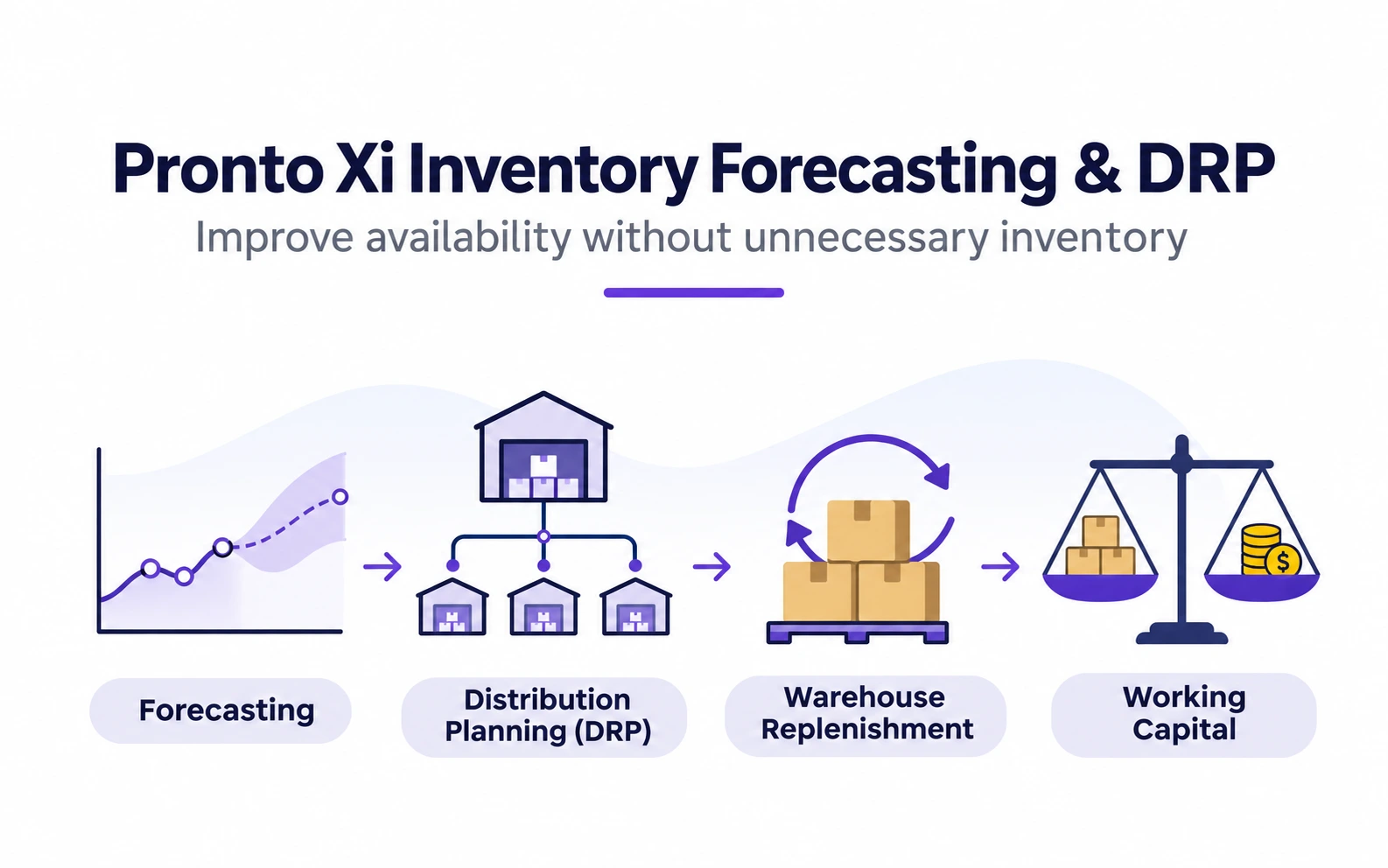
Pronto Xi Advanced Forecasting helps estimate future demand. Distribution Requirements Planning (DRP) helps determine where and when inventory should be replenished across a distribution network. Used together, they can help businesses make better inventory decisions, but neither automatically reduces stock or improves working capital.
The value comes when better information changes actual purchasing, transfer and inventory-policy decisions without creating unacceptable service risk.
The executive objective is therefore not simply:
Forecast demand more accurately.
It is:
Use better demand and replenishment information to improve availability while avoiding inventory the business does not economically need.
For CFOs, that means working-capital discipline.
For supply-chain leaders, it means fewer avoidable shortages, emergency purchases and reactive transfers.
For CIOs, it means moving planning away from disconnected spreadsheets and towards a more integrated, governed ERP process.
Which Pronto Xi planning capability should you assess?
Start with the business problem rather than the module name.
| Business problem | Capability to assess |
|---|---|
| Demand is difficult to predict | Advanced Forecasting |
| Forecasts depend heavily on spreadsheets or individual judgement | Advanced Forecasting |
| Demand is understood but inventory is poorly positioned across sites | DRP |
| Warehouses frequently transfer stock reactively | DRP |
| Replenishment needs to be planned across branches, central warehouses or suppliers | DRP |
| Manufacturing needs component and sub-assembly requirements calculated from demand | MRP |
| Both demand forecasting and multi-site replenishment are weak | Advanced Forecasting + DRP |
This distinction matters because forecasting, distribution planning and manufacturing requirements planning solve different problems.
What is Pronto Xi Advanced Forecasting?
Pronto Xi Advanced Forecasting uses demand information and statistical forecasting methods to estimate future product requirements.
Pronto documentation states that Advanced Forecasting can consider factors such as entered sales orders, goods shipped and inventory transfers, and can identify demand patterns including steady demand, seasonal demand and seasonal trends. It supports multiple calculation methods, including triple exponential smoothing and moving averaging.
Pronto also documents:
- daily, weekly, fortnightly, monthly and custom forecast periods;
- smoothing of unusual historical events;
- adjustments for anticipated future events;
- linking new items with no history to similar items with history;
- graphical comparison of calculated and manual forecasts; and
- use of published forecasts by other Pronto Xi planning and reordering processes.
The key question Advanced Forecasting addresses is:
What demand should we reasonably expect?
What is Pronto Xi Distribution Requirements Planning?
Distribution Requirements Planning (DRP) plans how goods should flow across a multi-location supply network over time.
Pronto describes DRP as supporting the flow of goods across satellite, branch and central warehouse locations and helping plan replenishment between warehouses, suppliers and production sources. DRP can also generate purchase orders and warehouse transfer orders.
The key DRP question is:
Given demand and available supply, where should inventory come from, where should it go and when is it required?
That is a different problem from forecasting demand.
What is the difference between Advanced Forecasting, DRP and MRP?
This distinction is important because the terms are related but not interchangeable.
| Capability | Primary question | Main planning focus |
|---|---|---|
| Advanced Forecasting | What demand is likely? | Future demand |
| DRP | Where and when should inventory be replenished? | Distribution network |
| MRP | What materials and components are required, and when? | Manufacturing requirements |
Pronto's Manufacturing Planning documentation states that Material Requirements Planning (MRP) calculates replenishment requirements for manufactured items and components, using demand, bills of materials (BOM), lead times, on-hand quantities and on-order quantities to determine purchasing and manufacturing requirements.
Pronto also states that MRP, DRP and Master Production Scheduling (MPS) can run sequentially within its planning environment.
A simple way to think about it
Advanced Forecasting:
“We expect to sell 1,000 units.”
DRP:
“Where should those 1,000 units be positioned across our network, and when?”
MRP:
“What components and production orders are required to make the manufactured product?”
A business may legitimately use more than one of these capabilities.
How do Advanced Forecasting and DRP work together?
Conceptually:
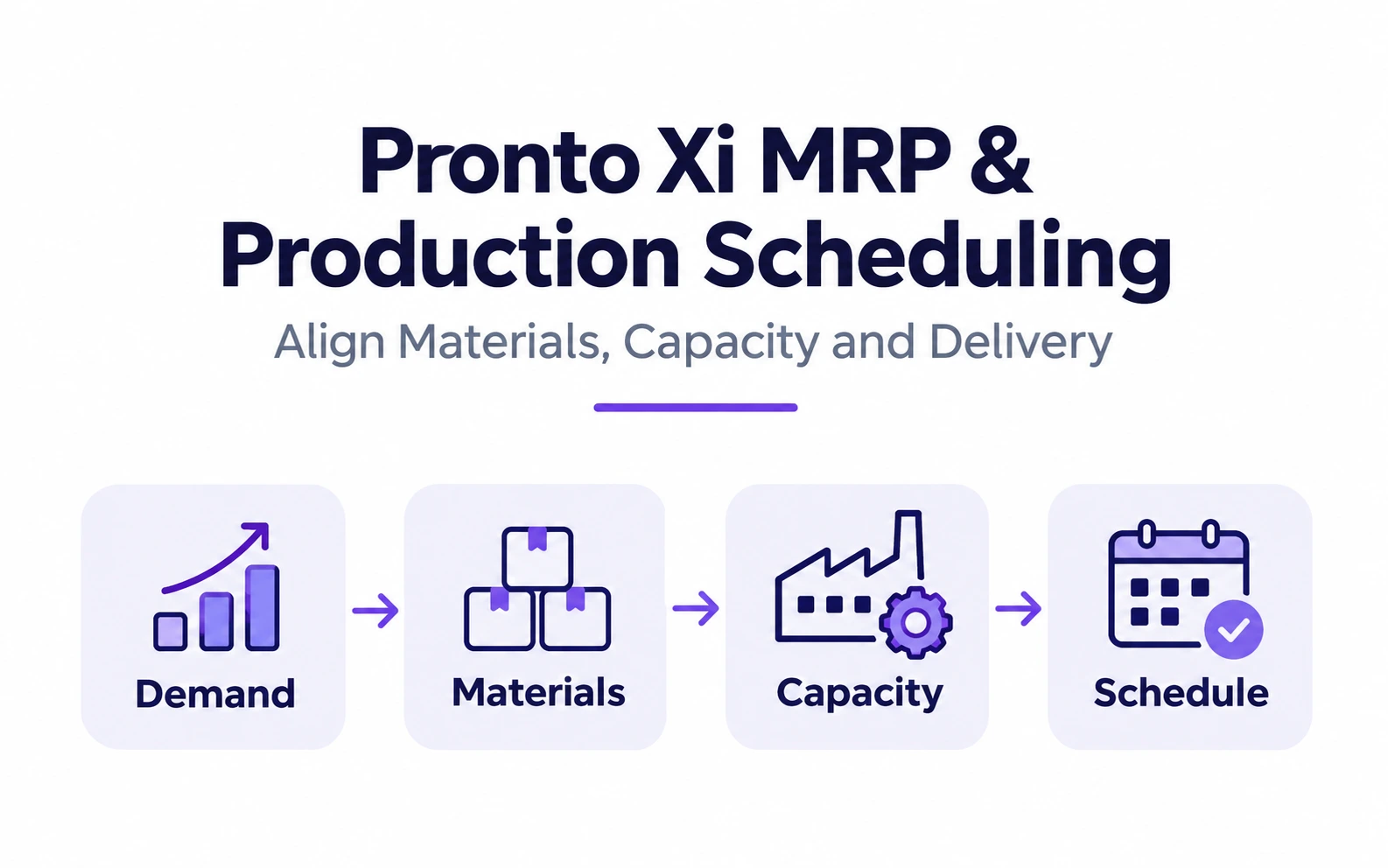
Historical demand → Forecast → Inventory position → Replenishment requirement → Purchase or transfer → Execution
Advanced Forecasting improves the demand signal.
DRP turns demand and supply information into time-phased distribution requirements.
Pronto describes its Supply Chain suite as integrating forecasting, distribution planning and warehouse operations, with Advanced Forecasting feeding planning and reordering processes.
For a multi-site distributor, for example, demand may be increasing nationally while individual locations have very different stock positions.
Simply purchasing more inventory may not be the best answer.
The business may instead need to determine:
- which warehouse actually requires stock;
- whether another site has excess inventory;
- when stock will be required;
- whether replenishment should come from a central warehouse or supplier;
- and when the purchase or transfer decision needs to occur.
That is where better forecasting and DRP can work together.
Why does inventory forecasting matter to CFOs?
Inventory is both an operating requirement and a use of capital.
Too little inventory can contribute to:
- stockouts;
- delayed sales;
- production disruption;
- emergency purchasing;
- expedited freight; and
- customer-service problems.
Too much inventory can contribute to:
- unnecessary working capital;
- storage and handling costs;
- slow-moving stock;
- obsolescence exposure; and
- unnecessary transfers.
The CFO's objective should therefore not be:
Minimise inventory.
It should be:
Hold the inventory economically required to support the business's service and operating objectives.
Pronto positions Advanced Forecasting around improving demand planning and supporting leaner inventory processes, while DRP is designed to improve replenishment across multi-site networks.
Does better forecasting automatically reduce inventory?
No. Better forecasting improves the information available for inventory decisions. It does not automatically change those decisions.
The potential value chain is:
Better demand signal → Better replenishment decision → Less unnecessary buffer stock or emergency purchasing → Improved inventory position or availability → Better working-capital outcome
But consider a business that improves forecast accuracy while leaving:
- safety-stock settings;
- minimum/maximum quantities;
- purchasing policies;
- supplier assumptions; and
- planner behaviour
unchanged.
The financial impact may be limited.
The stronger CFO question is:
Which inventory or purchasing decision will change because our forecast is better?
If the answer is unclear, forecasting risks becoming a reporting exercise rather than an inventory-improvement program.
Why forecast bias matters as much as forecast accuracy
Forecast accuracy measures how closely forecasts track actual demand.
Forecast bias asks whether forecasts are systematically too high or too low.
That matters financially.
A persistent upward bias may encourage excess purchasing and inventory.
A persistent downward bias may contribute to shortages and reactive replenishment.
A business can therefore improve an overall accuracy measure while still carrying a commercially important bias in particular product groups.
A useful review should examine:
forecast accuracy + forecast bias + business outcome
and segment results by factors such as:
- high-value products;
- high-volume products;
- seasonal products;
- new products;
- intermittent-demand products; and
- important warehouses or customer groups.
Pronto Advanced Forecasting itself recognises different demand patterns and uses multiple forecasting methods rather than treating every item identically.
How should forecasting performance be measured?
Forecast accuracy alone is not enough.
A stronger executive scorecard connects forecast performance with operational and financial outcomes.
| Measure | Executive question |
|---|---|
| Forecast accuracy | Are forecasts becoming closer to actual demand? |
| Forecast bias | Are we consistently over- or under-forecasting? |
| Stockouts | Are important shortages reducing? |
| Inventory value | Is working capital moving in the intended direction? |
| Inventory turns | Is stock being used more effectively? |
| Emergency purchasing | Are reactive orders decreasing? |
| Expedited freight | Are avoidable urgent logistics costs reducing? |
| Unplanned transfers | Are locations becoming less dependent on emergency redistribution? |
| Slow-moving inventory | Is excess-stock exposure improving? |
| Planner overrides | Do planners trust recommendations or repeatedly replace them? |
The organisation should establish its own targets rather than rely on generic benchmarks.
How does DRP help multi-warehouse businesses?
Multi-location businesses can experience an important contradiction:
Too much inventory overall and stockouts at individual locations at the same time.
For example:
| Location | Inventory position | Demand |
|---|---|---|
| Sydney | High | Moderate |
| Melbourne | Low | High |
| Brisbane | Moderate | Low |
Purchasing additional inventory for Melbourne may solve the immediate problem while increasing total stock unnecessarily.
A better question is:
Can existing or incoming inventory be positioned more effectively across the network?
Pronto DRP is specifically designed for complex distribution networks and time-phased replenishment across warehouses and supply sources.
What does time-phased replenishment mean?
Inventory requirements are not only about how much.
They are also about when.
If a warehouse eventually needs 500 units but only needs 100 next week, committing to all 500 immediately may tie up working capital earlier than necessary.
At a conceptual level:
Requirement date − replenishment lead time = required action date
The actual calculation can involve inventory, open supply, sourcing rules and network parameters.
The CFO significance is simple:
Better timing can affect when the business commits cash to inventory, not merely how much inventory it eventually buys.
How is DRP different from ordinary inventory replenishment?
Pronto Xi Distribution already provides ordering and replenishment capabilities. Pronto describes purchase-order automation using information such as inventory levels, sales commitments and sales history.
DRP addresses a broader network problem.
Rather than considering only whether an individual item needs replenishment at one location, DRP can model the movement of inventory across connected warehouses, distribution centres and supply sources over time.
DRP therefore becomes more relevant as the supply network becomes more complex.
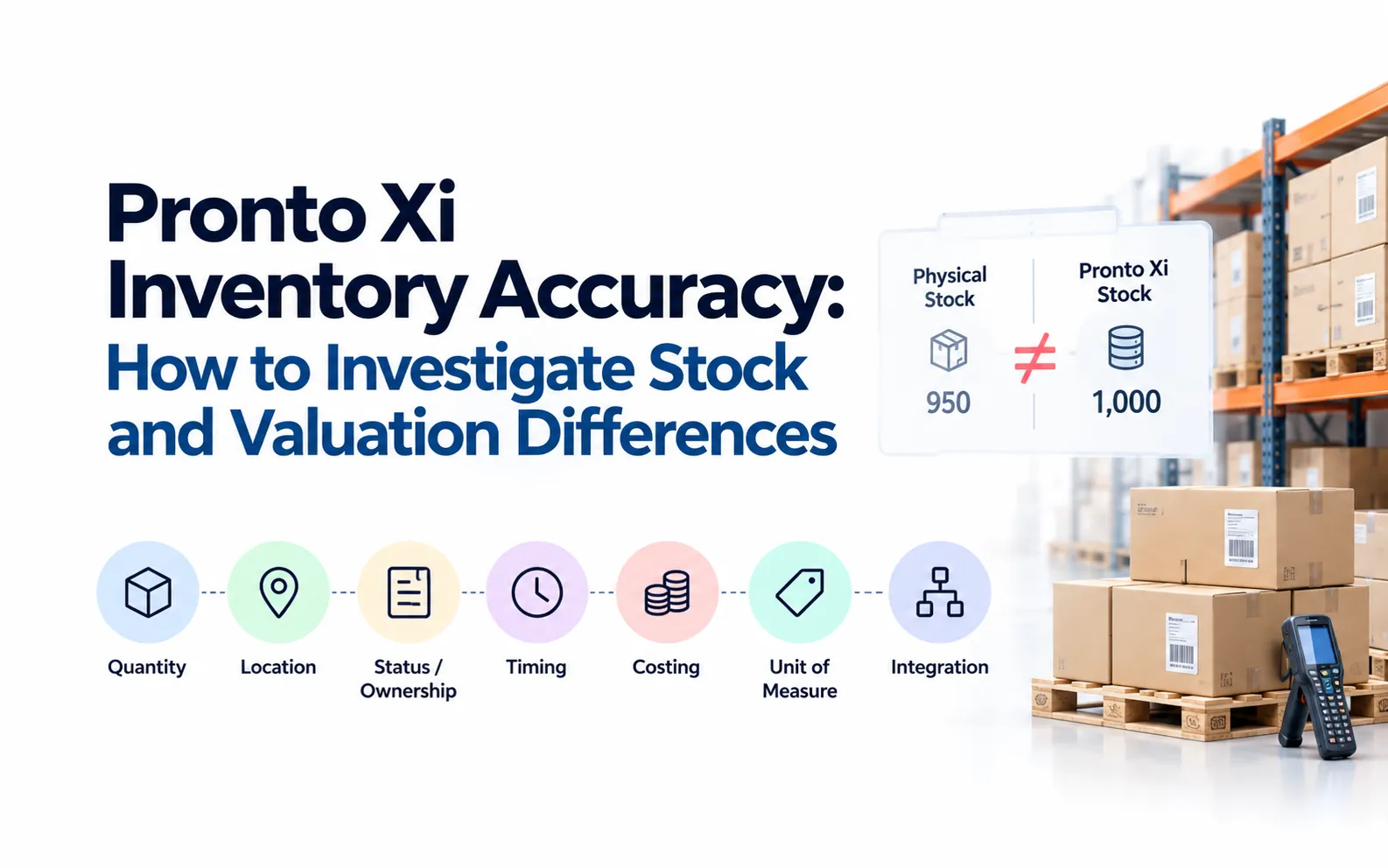
What data needs to be trustworthy?
Sophisticated planning cannot compensate for unreliable source information.
Before relying heavily on forecasting or DRP, review the quality of:
| Planning input | Why it matters |
|---|---|
| Sales and usage history | Influences future demand calculations |
| Abnormal historical periods | Can distort forecasting patterns |
| Product lifecycle | Replacement or discontinued products can distort history |
| Warehouse inventory | DRP depends on reliable inventory positions |
| Supplier lead times | Wrong lead times move replenishment decisions |
| Transfer lead times | Affect multi-site timing |
| Inventory policies | Drive intended inventory positions |
| Unit of measure | Conversion errors can multiply requirements |
| Open purchases and transfers | Affect future availability |
| Sourcing rules | Influence where replenishment originates |
Pronto Advanced Forecasting supports smoothing unusual historical events and accounting for anticipated future events.
But technology cannot determine the commercial reason behind every unusual period.
Business judgement remains necessary.
Can Pronto Xi forecast a new product with no history?
Pronto states that Advanced Forecasting can link a new item with no history to a similar item that has historical data.
That creates a starting point rather than certainty.
New-product forecasts may also need business input covering:
- product launch timing;
- comparable products;
- known customer commitments;
- planned promotions;
- substitution from existing products; and
- early actual demand.
Once real demand becomes available, assumptions should be revisited.
Should planners automatically accept every recommendation?
No. The objective should be to automate routine planning while focusing human judgement on material exceptions.
A practical operating model is:
Automate routine recommendations → Surface exceptions → Review material decisions → Record overrides → Measure outcomes
Exceptions may deserve attention where there is:
- a large forecast movement;
- an unusual purchase recommendation;
- high-value inventory exposure;
- significant supplier disruption;
- product launch or discontinuation;
- an unexpected transfer requirement; or
- major divergence between forecast and actual demand.
The purpose is not to remove planners.
It is to concentrate their attention where judgement creates the most value.
When is Advanced Forecasting most useful?
Advanced Forecasting deserves closer assessment where:
- demand history contains useful predictive information;
- the business manages many items;
- seasonality or trends are difficult to manage manually;
- forecasting depends heavily on spreadsheets;
- forecast preparation consumes significant planner time;
- forecast outputs need to feed Pronto Xi planning processes; or
- planning quality varies significantly between individuals.
The important benefit is not simply a statistical forecast.
It is a more repeatable and integrated planning process.
When is DRP most useful?
DRP becomes particularly relevant when inventory flows across:
- multiple warehouses;
- branch networks;
- central distribution centres;
- suppliers;
- factories; or
- combinations of central and local purchasing.
Pronto positions DRP for complex networks and documents sourcing and replenishment across multiple locations.
A simple single-site operation may not need the same planning capability.
The complexity of the supply network should drive the decision.
What should CFOs ask before investing further?
Before changing planning tools or processes, establish the current economic problem.
Ask:
- How much inventory are we carrying today, and why?
- Where do stockouts occur despite that inventory?
- How much emergency purchasing and expedited freight do we incur?
- How much slow-moving or obsolete inventory do we carry?
- How much planner effort goes into spreadsheets and manual calculations?
- Which locations frequently transfer stock reactively?
- Are supplier and transfer lead times trustworthy?
- What is current forecast accuracy and bias?
- Which purchasing or inventory decisions would change with better information?
- Who is accountable for forecast and replenishment performance?
Without a baseline, measuring ROI later becomes difficult.
How should the ROI case be built?
Avoid unsupported statements such as:
“Forecasting will reduce inventory by 20%.”
There is no universal result.
Instead, measure the organisation's own baseline.
Working capital
Can average inventory be reduced without unacceptable service deterioration?
Availability
Can important stockouts or fulfilment delays be reduced?
Procurement and freight
Can emergency purchasing or expedited freight be reduced?
Inventory redistribution
Can unnecessary reactive transfers between locations be reduced?
Planning labour
How much time is currently spent preparing spreadsheets, calculating requirements, reconciling data and correcting planning errors?
Slow-moving inventory
Can excess or declining inventory be identified earlier?
Then compare the realised benefit with the actual costs of:
licensing + configuration + implementation + data remediation + training + internal effort + ongoing governance
A practical implementation approach
Treat forecasting and DRP improvement as a business-planning program rather than simply enabling software.
A practical sequence is:
Baseline → Data → Segmentation → Forecasting → Replenishment → Pilot → Measure → Tune → Scale
1. Establish the baseline
Measure inventory, stockouts, forecast performance, transfers, urgent purchasing and planning effort.
2. Correct critical planning data
Prioritise lead times, UOMs, product status, inventory settings and transaction history.
3. Segment the inventory
High-value, seasonal, intermittent-demand and business-critical items may require different treatment.
4. Validate forecasting
Compare forecast results with actual history and known commercial information.
5. Validate DRP parameters
Confirm warehouse networks, sourcing rules, lead times and replenishment assumptions.
6. Pilot
Start with a manageable product group, warehouse or network segment.
7. Measure outcomes
Compare service, inventory, forecast and planning results with the baseline.
8. Investigate overrides and exceptions
Repeated manual intervention may indicate poor parameters, poor data or lack of trust.
9. Scale proven practices
Extend the approach after the operating model is understood.
This is independent ERP planning guidance, not an official Pronto Software implementation methodology.
Who should own forecasting and DRP?
The ERP team should not own the commercial assumptions alone.
| Area | Typical responsibility |
|---|---|
| Demand assumptions | Sales / Supply Chain |
| Forecast process | Supply Chain / Planning |
| Forecast overrides | Named business owner |
| Inventory policy | Supply Chain + Finance |
| Working-capital objectives | CFO / Finance |
| Supplier lead times | Procurement |
| Network and sourcing rules | Supply Chain |
| Pronto Xi configuration | ERP team |
| Master-data quality | Process/data owners |
| Performance measurement | Finance / Supply Chain |
| Platform/integration support | IT / ERP |
The important principle is:
IT can own the platform. The business must own the planning assumptions and economic outcomes.
Pronto Xi forecasting and DRP checklist
Before relying heavily on automated forecasting or replenishment, confirm:
- Demand history is sufficiently reliable.
- Forecast accuracy and forecast bias are measured.
- Abnormal historical events are understood.
- New and replacement products have an agreed approach.
- Supplier and transfer lead times reflect reality.
- Inventory policies and targets are intentionally set.
- Warehouse and sourcing rules are current.
- UOM and product-master data are accurate.
- Open purchases and transfers are reliable.
- Material planner overrides are reviewed.
- DRP recommendations have been tested against real scenarios.
- Working-capital and service outcomes are measured together.
- Finance and Supply Chain agree on the objectives.
- Named owners exist for forecasting and replenishment performance.
If these foundations are weak, fixing them may create more value than simply generating more sophisticated forecasts.
Need Pronto Xi capability for forecasting or inventory improvement?
Forecasting and replenishment improvement can span Inventory, Purchasing, Advanced Forecasting, DRP, WMS, master data, reporting and business-process design.
If an improvement program identifies gaps in Pronto Xi functional, analytical or ERP-management capability, SAAPRO can help assess specialist availability in the Australian Pronto Xi market. Discuss Your Pronto Xi Requirement or Compare Pronto Xi Roles
Disclosure: SAAPRO is an independent Pronto Xi recruitment specialist and is not Pronto Software or an ecommerce implementation vendor.
Frequently Asked Questions
Pronto Xi Advanced Forecasting uses demand information and statistical forecasting methods to estimate future requirements. Pronto documents support for multiple demand patterns, smoothing, graphical analysis, exception handling and multiple forecast periods.
Distribution Requirements Planning (DRP) plans the flow and replenishment of inventory across warehouses and other supply sources over time. It can support purchase orders and warehouse transfer orders within a multi-location network.
Advanced Forecasting estimates future demand; DRP helps determine where and when inventory should be replenished to meet requirements.
DRP focuses primarily on distributing and replenishing inventory across a supply network. Material Requirements Planning (MRP) focuses on the materials and components required for manufacturing and uses BOM, demand, lead-time and inventory information to determine requirements.
Yes. Pronto documents demand classifications including seasonal demand and seasonal trends and uses forecasting methods including triple exponential smoothing.
Yes. Pronto states that a new item can be linked to a similar item with history to provide a forecasting basis. Business assumptions should still be validated as actual demand emerges.
No. Better forecasting improves decision information. Inventory only changes when purchasing, replenishment, safety-stock or other inventory policies change in response.
DRP deserves closer consideration when inventory must be replenished across multiple warehouses, branches, distribution centres, suppliers or factories and the business needs a time-phased view of the network.
Use the organisation’s actual baseline. Measure changes in inventory, availability, emergency purchasing, expedited freight, transfers, slow-moving inventory and planning effort against the cost of improving the planning process.
Key Takeaways
- ✓The value of Advanced Forecasting is not simply producing a more sophisticated forecast.
- ✓The value of DRP is not simply automating replenishment.
- ✓The real objective is to connect: Demand → Inventory → Location → Timing → Replenishment → Working capital
- ✓Advanced Forecasting improves the demand signal. DRP turns that signal into time-phased replenishment decisions across the distribution network. Neither creates ROI by itself, the value comes when better planning changes inventory, purchasing and transfer decisions without creating unacceptable service risk.
- ✓For CFOs, success means better use of inventory capital while maintaining the service level the business requires.
- ✓For CIOs, it means a more integrated and governed planning process.
- ✓For Supply Chain, it means better answers to three questions: What do we expect to need? Where will we need it? When should we act?
- ✓That is where Pronto Xi forecasting and DRP can begin contributing directly to ERP ROI.