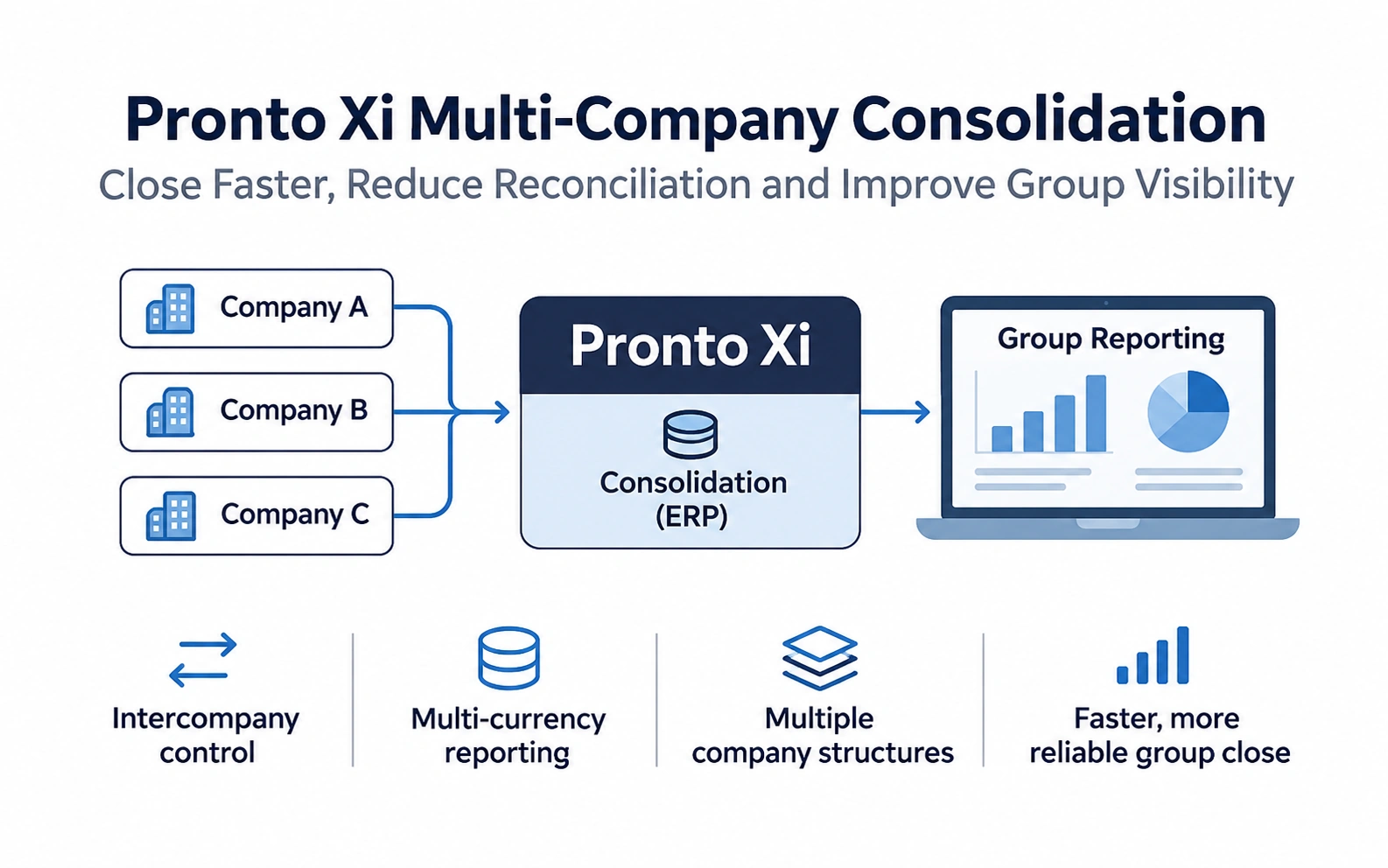
Pronto Xi Multi-Company Consolidation: Close Faster, Reduce Reconciliation and Improve Group Visibility
A practical guide to Pronto Xi multi-company consolidation, covering documented structures, intercompany reconciliation, account mapping, currency policy, group adjustments and how to close faster with less manual work.
Pronto Xi supports multiple company structures, intercompany balancing, multi-currency reporting and financial consolidation. But faster, more reliable group reporting depends just as heavily on entity-close discipline, intercompany reconciliation, account mapping, currency policy and control over group adjustments.
For CFOs and CIOs, the objective should not simply be:
“Consolidate the companies.”
It should be:
Entity close → Intercompany agreement → Currency treatment → Group adjustments → Consolidation → Traceable group reporting
The business value comes when that chain reduces manual reconciliation, spreadsheet dependency and reporting delay without weakening financial control.
What does Pronto Xi support for multi-company consolidation?
Pronto-specific
Pronto Xi General Ledger documents four ways to structure a multi-company environment:
- multiple companies in one dataset;
- separate company datasets consolidated to a holding company;
- separate subsidiary ledgers sharing a common General Ledger; and
- foreign-currency consolidation.
Pronto also documents automatic intercompany balancing entries for certain single-dataset or common-GL structures, and states that entity data can roll into consolidated structures based on defined rules and configurations.
Its current Financials material states that GL Consolidation can accommodate:
- different local currencies;
- different financial periods;
- different financial years;
- regular and irregular periods; and
- non-uniform charts of accounts.
These are documented product capabilities.
They do not mean every Pronto Xi environment is automatically ready for an efficient group close.
The organisation still needs to govern:
Structure → Accounts → Intercompany → Currency → Adjustments → Reporting
Statutory consolidation vs management consolidation
General ERP and finance guidance
These two requirements should not automatically be treated as identical.
Statutory consolidation
The objective is formal group financial reporting under the organisation’s applicable accounting and regulatory requirements.
It may require controlled treatment of:
- entity balances;
- intercompany transactions;
- currency translation;
- group adjustments;
- eliminations;
- audit evidence.
Management consolidation
The objective may be faster internal visibility across:
- revenue;
- margin;
- cash;
- working capital;
- business units;
- regions;
- operational performance.
Management reporting may use different hierarchies, timing and analytical views from statutory reporting.
The important design question is:
Are we trying to solve statutory consolidation, management reporting, or both?
Using one process without distinguishing those requirements can create unnecessary complexity.
Why does group consolidation still take too long?
The consolidation engine is often not the main bottleneck.
General ERP guidance
Common causes include:
- one entity closing late;
- unmatched intercompany balances;
- inconsistent local account mappings;
- different transaction cut-offs;
- late group journals;
- currency-rate differences;
- recurring spreadsheet adjustments;
- unclear ownership of exceptions.
A useful principle is:
The group close can move only as fast as its slowest unresolved dependency.
This is why multi-company consolidation should be managed as an end-to-end close process rather than a final reporting activity.
Why can intercompany balances disagree even when both entities believe they are correct?
This is where many real consolidation delays occur.
Pronto-specific
Pronto Xi can automatically raise balancing entries in certain multi-company structures.
But technical balancing is different from economic agreement.
General ERP and finance guidance
Entity A and Entity B can disagree because of:
- different posting dates;
- different accounting periods;
- one side recording the transaction before the other;
- currency or exchange-rate differences;
- credit notes recorded on only one side;
- disputed charges;
- goods or services recorded at different points in the process.
For example:
Entity A records an intercompany charge on 30 June.
Entity B records it on 1 July.
Both entries may be valid locally, but the group has a period-end mismatch.
The control objective should therefore be:
Counterparty agreement before consolidation, not merely technically balanced ledgers.
Useful measures include:
- unmatched intercompany value;
- unmatched item count;
- ageing of differences;
- number of differences carried across periods.
How should intercompany reconciliation be governed?
A stronger operating model includes:
- standard counterparty coding;
- common transaction references;
- agreed cut-off dates;
- defined tolerance rules;
- named owners;
- escalation for unresolved items.
The most useful question for a CFO is:
How much unresolved intercompany value exists when each entity declares itself closed?
If that number remains material, consolidation is starting too early.
How should different charts of accounts be managed?
Pronto-specific
Pronto’s current consolidation documentation states that GL Consolidation can work with non-uniform charts of accounts.
General ERP and finance guidance
Supporting different charts does not remove the need for strong mapping governance.
Every material local account should map consistently to an agreed group reporting structure:
Local GL account → Group account/category → Financial statement/reporting hierarchy
The mapping itself becomes controlled financial master data.
For each mapping, define:
- business owner;
- effective date;
- mapping version;
- approval for changes;
- treatment of newly created local accounts;
- review frequency.
Without this discipline, mapping tables can become another hidden spreadsheet dependency.
A useful control is:
No new local account should enter group reporting without an approved group mapping.
How does Pronto Xi support multi-currency consolidation?
Pronto-specific
Pronto Xi supports foreign-currency transactions and Multiple Reporting Currencies across financial applications, while its GL Consolidation capability is designed to work across entities using different local currencies.
Pronto’s documentation also describes consolidation into a reporting currency.
General ERP and finance guidance
Technology does not determine accounting policy.
Finance still needs agreed rules for:
- functional currency;
- reporting currency;
- exchange-rate source;
- applicable rate dates;
- revaluation;
- translation differences.
The ERP should implement the policy.
It should not invent it.
What about group adjustments and eliminations?
Pronto’s published consolidation diagrams include an Eliminations component in the consolidated structure.
However, the public material reviewed is not sufficiently detailed to claim how every elimination scenario is configured or automated in every Pronto Xi environment.
General finance guidance
Whatever technology is used, material consolidation adjustments should have:
Purpose → Source → Calculation → Approver → Period → Reconciliation
The group should be able to explain and reproduce each material adjustment.
What should trigger a consolidation redesign?
A redesign or structured review is worth considering when several of these conditions exist:
| Trigger | What it may indicate |
|---|---|
| Group close is consistently late | Entity-close or dependency problem |
| Intercompany differences recur monthly | Process/control weakness |
| Consolidation depends on offline spreadsheets | Architecture or governance gap |
| Local accounts require repeated manual remapping | Mapping-governance problem |
| Group journals continue increasing | Upstream process/configuration issue |
| Acquired entities take too long to integrate | Consolidation model does not scale |
| Finance cannot trace group numbers back quickly | Reporting/control weakness |
| One person understands the consolidation workbook | Key-person risk |
| Management reporting takes days after entity close | Reporting architecture problem |
The strongest trigger is not inconvenience.
It is recurring effort or risk that increases as the group grows.
What does a strong multi-company close look like?
A practical group-close model is:
| Stage | Control question |
|---|---|
| 1. Entity close | Has each company completed its own reconciliations? |
| 2. Intercompany | Do counterparties agree? |
| 3. Mapping | Are local accounts correctly mapped to group reporting? |
| 4. Currency | Have agreed translation rules been applied? |
| 5. Adjustments | Are group journals controlled and approved? |
| 6. Eliminations | Are internal balances/activity treated appropriately? |
| 7. Consolidation | Does the group result reconcile to contributing entities? |
| 8. Reporting | Can management numbers be traced to source? |
This is general finance/ERP guidance rather than Pronto-specific functionality.
The key discipline is:
Do not allow the consolidation layer to hide unresolved entity-level problems.
What should CFOs measure?
Use a baseline before changing the process.
| KPI | Why it matters |
|---|---|
| Days to entity close | Identifies slow entities |
| Days to group close | Measures overall elapsed time |
| Entity submissions on time | Close discipline |
| Unmatched intercompany value | Financial exposure |
| Aged intercompany differences | Recurring control weakness |
| Manual consolidation journals | Manual dependency |
| Manual mapping adjustments | Chart/mapping weakness |
| Post-close journals | Close quality |
| Spreadsheet transfers | Process dependency |
| Entity-close-to-group-report time | Reporting efficiency |
| Unexplained group variances | Reporting/control quality |
Speed alone is not enough.
A faster close with more post-close corrections is not an improvement.
Where does the ROI come from?
Better consolidation creates value when it changes work, decision timing or risk.
1. Less manual effort
Measure current hours spent on:
- exporting;
- mapping;
- importing;
- reconciling;
- rebuilding group reports.
2. Less intercompany investigation
Track how much Finance time is consumed by recurring differences.
3. Fewer manual adjustments
Repeated group journals may indicate upstream processes that can be standardised.
4. Faster group visibility
Earlier reliable group information can improve:
- cash management;
- capital allocation;
- management review;
- board reporting.
5. Lower key-person dependency
Replacing opaque consolidation workbooks with governed processes reduces operational risk.
6. Better scalability
A sound consolidation model should allow another entity to be added without increasing manual effort proportionately.
A practical ROI model
General ERP guidance
A defensible annual benefit model can start with:
Hours eliminated + avoidable external support + avoided recurring rework + avoided future finance capacity
Then show separately:
- faster management reporting;
- lower key-person risk;
- stronger auditability;
- improved decision timing.
Do not assign arbitrary dollar values to those softer benefits unless the organisation can defend the calculation.
Every material benefit should have:
Baseline → Target → Owner → Measurement frequency
That turns consolidation improvement into an operating commitment rather than a technology promise.
A practical consolidation diagnostic
Before changing technology, review the process in this order:
Structure → Entity close → Intercompany → Mapping → Currency → Adjustments → Consolidation → Reporting → Ownership
Structure
Does the Pronto Xi architecture reflect the legal and operational model?
Entity close
Are entities genuinely ready before consolidation starts?
Intercompany
Do counterparties agree?
Mapping
Can every material local account roll consistently into group reporting?
Currency
Are rates and policies governed?
Adjustments
Which entries exist only at group level, and why?
Consolidation
Can the result be reconciled back to entity submissions?
Reporting
Are statutory and management requirements clearly distinguished?
Ownership
Who owns every unresolved exception?
This avoids a common mistake:
Trying to fix the consolidation report when the real problem occurred earlier in the process.
Need Pronto Xi Financials or reporting expertise to work through this diagnostic? Talk to SAAPRO.
Pronto-specific vs general guidance
| Topic | Pronto-specific | General finance/ERP guidance |
|---|---|---|
| Multi-company structure | Four documented structural approaches | Choose based on legal and operational needs |
| Intercompany | Automatic balancing in certain structures | Reconcile counterparties before group close |
| Multi-currency | MRC and foreign-currency consolidation supported | Finance defines translation policy |
| Different charts | Non-uniform charts supported in consolidation | Govern local-to-group mappings |
| Consolidation | Different periods, years and currencies supported | Control adjustments and reconciliations |
| Reporting | Consolidated data can support Cognos reporting | Separate statutory and management requirements |
| Eliminations | Published architecture depicts eliminations | Confirm exact configuration and controls |
Conclusion
Pronto Xi provides documented capability for multi-company structures, intercompany balancing, multi-currency reporting and financial consolidation.
But reliable consolidation still depends on Finance controlling:
Entity close → Intercompany → Mapping → Currency → Adjustments → Consolidation → Reporting
The goal is not merely to automate consolidation.
It is to create a repeatable group-close process where material numbers can be:
explained → reconciled → traced → reproduced
with less manual effort and less dependency on spreadsheets.
That is where multi-company ERP functionality becomes measurable finance ROI.
If consolidation problems expose a Pronto Xi finance, reporting, business-analysis or ERP-management capability gap, SAAPRO specialises in Pronto Xi recruitment and specialist resourcing. Contact SAAPRO to discuss your requirement.
Before making changes in your Pronto Xi environment
Important: Pronto Xi multi-company and consolidation functionality can vary by software version, licensed modules, configuration and the way each organisation has structured its entities and financial processes.
Before changing your consolidation process, confirm:
- the multi-company and consolidation functionality available in your current Pronto Xi release;
- how intercompany balancing and eliminations are configured in your environment;
- whether Multiple Reporting Currencies and related functionality are licensed and implemented;
- how local charts of accounts map into group reporting;
- the accounting policies governing currency translation, consolidation adjustments and eliminations.
Where functionality or treatment is material to statutory reporting, verify it with your Pronto Xi specialist and appropriate finance or accounting adviser before implementation.
Frequently Asked Questions
Yes. Pronto Xi documents several multi-company structures, including multiple companies in one dataset, separate datasets consolidated into a holding company, shared-General-Ledger structures and foreign-currency consolidation. The right approach depends on the organisation’s legal structure, operating model and reporting needs.
Pronto’s current Financials documentation states that GL Consolidation can handle non-uniform charts of accounts, as well as different financial periods and years. Finance still needs controlled mappings between local accounts and the group reporting structure so those differences do not become recurring manual reconciliation work.
Differences can arise from timing, periods, currencies, unrecorded transactions, credit notes or different treatment by each entity. Pronto Xi can generate balancing entries in certain multi-company structures, but Finance should still confirm that counterparties agree economically before group consolidation begins.
Yes. Pronto Xi documents Multiple Reporting Currencies and consolidation across entities using different local currencies. Finance must still define functional currencies, exchange-rate sources, translation rules and revaluation policy for the organisation.
Start with days to entity close, days to group close, unmatched intercompany value, aged differences, manual consolidation journals, mapping adjustments, spreadsheet transfers and post-close corrections. These measures reveal whether delay originates in entity accounting, intercompany, mapping, consolidation or reporting.
Review the process when late closes, recurring intercompany mismatches, spreadsheet dependence, manual mapping, growing group journals or poor traceability become persistent. The strongest business case exists where manual effort and control risk increase as the organisation adds entities or reporting complexity.
Key Takeaways
- ✓Pronto Xi documents four multi-company structures, including multiple companies in one dataset, separate datasets consolidated into a holding company, shared-General-Ledger arrangements and foreign-currency consolidation.
- ✓Pronto Xi can automatically raise intercompany balancing entries in certain structures, but balancing entries do not remove the need to reconcile counterparties.
- ✓Pronto’s GL Consolidation supports entities with different currencies, periods, financial years and non-uniform charts of accounts.
- ✓Statutory consolidation and management consolidation may have different reporting purposes, controls and timing.
- ✓The strongest ROI comes from reducing manual consolidation, intercompany investigation, mapping effort and time from entity close to decision-ready group reporting.