Pronto Xi Warehouse Optimisation: Increase Throughput, Reduce Labour Waste and Improve Stock Control
A practical guide to optimising a Pronto Xi warehouse after WMS go-live, covering constraints, slotting, putaway, replenishment, picking, KPIs and how to measure real unit-cost ROI.
Once Pronto Xi WMS and warehouse scanning are operating reliably, optimisation should focus on the constraint that limits end-to-end throughput, not simply making individual warehouse activities faster.
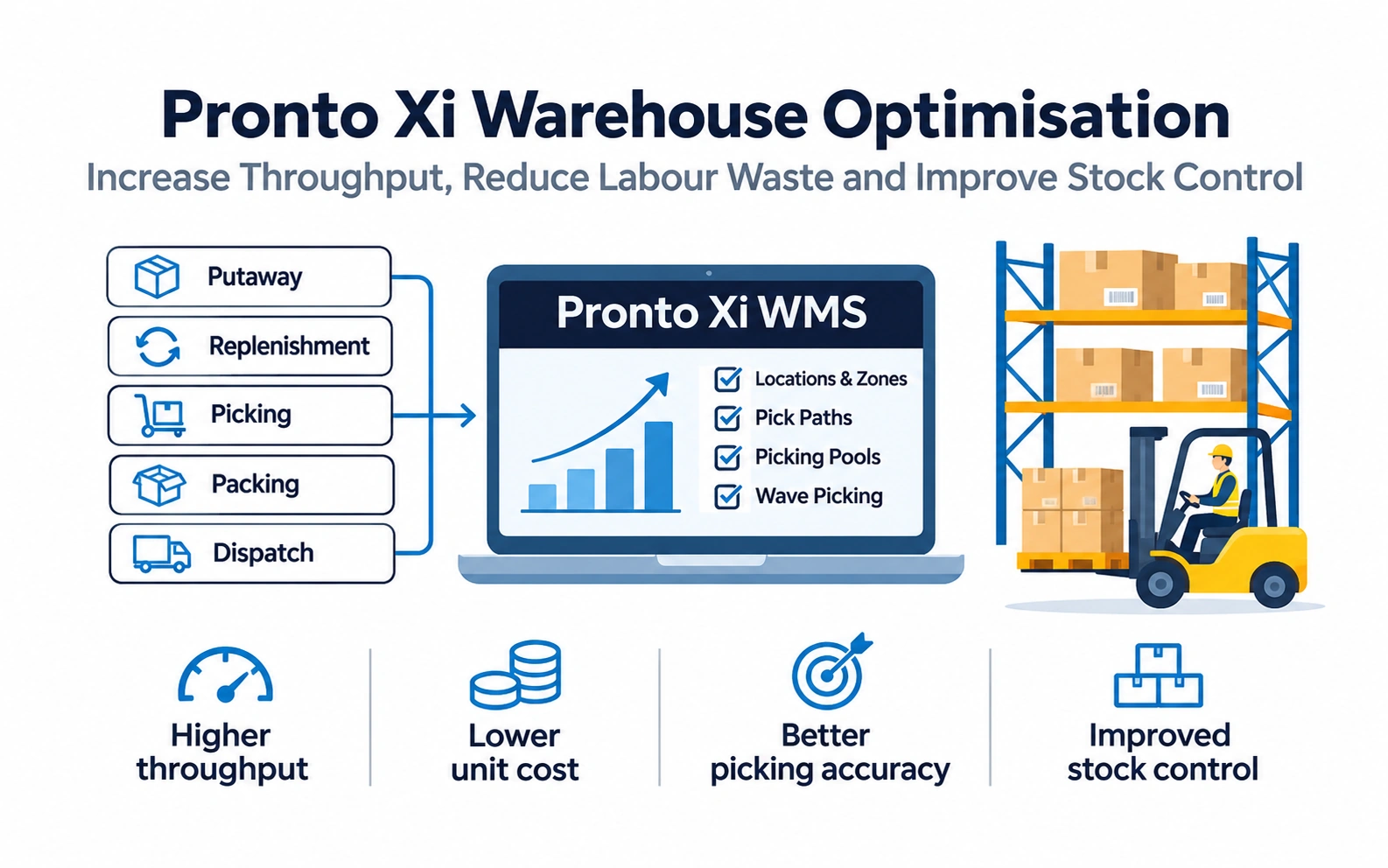
Pronto Xi WMS supports locations and zones, putaway, replenishment, picking paths, picking pools, wave picking and warehouse execution. Radio Frequency can extend handheld workflows across receiving, putaway, replenishment, picking, packing and dispatch.
But functionality does not automatically produce productivity.
For CFOs and CIOs, the more useful question is:
Where does inventory or warehouse work wait, move unnecessarily, get handled twice or become an exception?
A practical optimisation sequence is:
Control → Constraint → Cause → Change → Measure → Scale
How is warehouse optimisation different from WMS implementation?
Implementation asks:
Does the process work correctly?
Optimisation asks:
Can the controlled process deliver more throughput, lower unit cost or better service?
A warehouse can successfully scan receipts, transfers, picks and dispatches yet still perform inefficiently because:
- stock is poorly slotted;
- pick faces empty during peak periods;
- operators travel unnecessarily;
- inbound stock waits too long for putaway;
- picking outpaces packing;
- too many orders become exceptions.
That makes this article a natural sequel to WMS readiness.
Readiness establishes control.
Optimisation extracts value from it.
Start with the constraint, not the department
General warehouse guidance
The most important optimisation principle is:
Improving a non-bottleneck activity does not necessarily improve warehouse throughput.
For example, if picking capacity increases by 15% but packing is already the constraint, the warehouse may simply create a larger queue of picked orders waiting to be packed.
Likewise:
- faster receiving may create a putaway backlog;
- faster picking may overload packing;
- aggressive order release may create congestion;
- more replenishment may interrupt pickers.
Before changing configuration or labour, identify:
Where does work consistently wait?
Common constraints include:
- receiving;
- putaway;
- replenishment;
- picking;
- packing;
- dispatch;
- exception resolution.
Optimise there first.
What Pronto Xi WMS capabilities support optimisation?
Pronto-specific
Current Pronto Xi WMS documentation describes:
- multiple bin locations per item;
- storage zones;
- flexible three-dimensional warehouse layouts;
- configurable location types;
- unit, carton and pallet storage;
- picking-location selection;
- optimised picking paths;
- putaway;
- intelligent replenishment and top-up routines;
- cross-dock processing.
Pronto Xi Radio Frequency can support warehouse processes including receiving, putaway, replenishment, picking, packing, dispatch, stocktaking and transfers through handheld or vehicle-mounted terminals.
These capabilities create options.
The ROI depends on how well they are configured around the actual warehouse.
1. Is inventory slotted according to current demand?
Slotting is one of the highest-value warehouse optimisation opportunities.
Pronto-specific
Pronto Xi WMS supports configurable storage zones, location types, pick locations, replenishment settings and picking paths.
General warehouse guidance
Slotting determines where items should live based on how they are actually handled.
Consider:
- pick frequency;
- order-line frequency;
- item size and weight;
- unit, carton or pallet handling;
- replenishment frequency;
- ergonomics;
- frequently co-picked products;
- proximity to packing and dispatch.
A sensible general pattern is:
- fast movers in efficient pick positions;
- bulky items located for safe handling;
- slow movers outside premium pick space;
- items frequently ordered together considered in proximity planning.
Do not assume historical locations remain appropriate.
Product velocity and customer mix change.
A warehouse should periodically ask:
Are our most frequent movements occurring through our shortest practical paths?
2. Does the picking model fit the order profile?
Not every order should be handled the same way.
General warehouse guidance
First understand the order profile.
Examples include:
- many small orders;
- fewer large B2B orders;
- single-item orders;
- each-picking;
- carton picking;
- pallet movements;
- mixed B2B and B2C;
- urgent service-parts orders.
A picking strategy that works well for pallet distribution may perform poorly for thousands of small each-pick orders.
This matters when evaluating:
- discrete picking;
- batch picking;
- wave picking;
- pool priorities;
- pick-path design.
Pronto-specific
Pronto Xi WMS supports picking pools, prioritised order processing, consolidated picking and wave-picking concepts. It can also guide operators through configured pick paths.
The optimisation question is not:
“Does Pronto Xi support wave picking?”
It is:
“Does wave or consolidated picking reduce total work for our order profile?”
3. Is putaway delaying usable inventory?
Pronto-specific
Pronto Xi WMS includes putaway processes and configurable warehouse locations. Radio Frequency can support putaway activity through handheld workflows.
General warehouse guidance
Measure:
Receipt → stock available in the appropriate usable location
not merely:
Receipt → transaction entered
Useful questions include:
- How long does stock wait after receipt?
- Is putaway labour aligned with inbound peaks?
- Is stock handled multiple times?
- Are receiving lanes becoming storage areas?
- Are putaway decisions creating unnecessary future replenishment?
A fast receipt process has little value if inventory then waits hours to become usable.
4. Is replenishment protecting picking, or disrupting it?
Pronto-specific
Pronto Xi WMS supports several replenishment approaches, including automatic, manual, multiple, forced and pre-pick replenishment. It also supports replenishment triggers and assignment of work to warehouse resources.
General warehouse guidance
Replenishment should keep pick faces productive without creating excessive movement.
Watch for:
- frequent emergency top-ups;
- pickers waiting for replenishment;
- operators leaving pick zones to retrieve bulk stock;
- excessive replenishment trips;
- overfilled forward-pick locations.
A particularly useful KPI is:
Picking interruptions caused by stock that exists in the warehouse but is not available at the required pick location.
That identifies a replenishment problem rather than a true inventory shortage.
5. Are pick paths still efficient?
Pronto-specific
Pronto Xi WMS supports optimised picking paths, and Radio Frequency can guide users using intelligent pick-path information.
General warehouse guidance
Travel is necessary, but unnecessary travel is labour waste.
Analyse:
- distance or time between picks;
- repeated visits to the same zone;
- congestion;
- touches per order;
- time walking versus handling.
Do not optimise pick speed in isolation.
The better question is:
How much operator time creates movement without creating order progress?
6. Is order release creating congestion?
Pronto-specific
Pronto Xi WMS and Radio Frequency support picking pools and prioritisation of warehouse work.
General warehouse guidance
Releasing more work does not automatically improve throughput.
Order release should consider:
- labour capacity;
- carrier cut-offs;
- dispatch capacity;
- customer priority;
- zone congestion;
- order type.
Too much released work can increase:
- queue size;
- congestion;
- searching;
- partially completed orders.
A good warehouse controls work in process, not just completed picks.
7. When should wave picking be used?
Pronto-specific
Pronto Xi WMS supports consolidated picking and wave-picking processes, where multiple orders can be grouped and picked together before being separated downstream.
General warehouse guidance
Wave picking may be useful when:
- many orders contain overlapping SKUs;
- travel is a major component of labour;
- order volumes justify consolidation;
- downstream sorting can absorb the workload.
But a wave can simply move the bottleneck.
Always measure:
Release → Pick → Sort → Pack → Dispatch
If picking improves while sorting or packing deteriorates, end-to-end throughput has not improved.
8. Is packing now the constraint?
Packing should be measured as part of warehouse flow, not as an afterthought.
Watch for:
- orders waiting after picking;
- rework;
- incorrect packing;
- missing labels;
- carrier-document delays;
- congestion around dispatch.
A mature optimisation program asks:
Where does the order stop moving toward the customer?
That prevents local improvements from creating downstream queues.
What should trigger a warehouse optimisation review?
A structured review is warranted when several of these conditions appear:
| Trigger | Possible issue |
|---|---|
| Overtime rises faster than warehouse volume | Labour inefficiency or capacity constraint |
| Throughput plateaus | Process constraint |
| Pick accuracy falls | Speed/control imbalance |
| Replenishment frequently interrupts picking | Pick-face or replenishment problem |
| Receiving backlog increases | Inbound/putaway constraint |
| Warehouse appears full despite poor space usage | Slotting/layout problem |
| Dispatch cut-offs are regularly missed | End-to-end flow issue |
| Labour cost per order rises | Economic productivity deterioration |
| Exceptions increase | Process or data problem |
| Volume growth requires proportionally more labour | Poor scalability |
The key signal is:
More volume requires disproportionately more cost, labour or effort.
Use a KPI hierarchy
Not every warehouse metric deserves executive attention.
A useful hierarchy is:
Outcome KPIs
These show whether the warehouse is delivering business results.
- orders shipped on time;
- order accuracy;
- total throughput;
- cost per order or relevant throughput unit.
Flow KPIs
These identify where throughput is being constrained.
- receipt-to-availability time;
- pick cycle time;
- replenishment interruptions;
- packing queue time;
- dispatch delay.
Diagnostic KPIs
These help explain the cause.
- travel time;
- touches per order;
- exception rate;
- location utilisation;
- emergency replenishments;
- rework.
Executives should manage primarily by outcomes.
Operations teams use flow and diagnostic measures to explain them.
Measure unit cost, not just labour hours
A warehouse can use more labour and still become more efficient if throughput grows faster.
That is why CFOs should track unit economics.
A simple general measure is:
Warehouse unit cost = controllable warehouse operating cost ÷ relevant throughput
The throughput measure should match the business model.
Possible denominators include:
- orders;
- order lines;
- cartons;
- pallets;
- units.
Do not compare unlike workloads blindly.
A warehouse processing complex mixed orders may naturally have a different cost per order from one shipping full pallets.
The important question is:
Is unit cost improving while accuracy and service remain acceptable?
A practical warehouse optimisation framework
Use:
Control → Constraint → Cause → Change → Measure → Scale
1. Control
Confirm sufficient inventory, location and transaction accuracy.
If records are unreliable, faster execution can amplify errors.
2. Constraint
Find where work or inventory consistently waits.
3. Cause
Determine whether the constraint arises from:
- slotting;
- layout;
- master data;
- configuration;
- replenishment;
- order profile;
- labour allocation;
- process design;
- system performance.
4. Change
Test the smallest practical intervention.
5. Measure
Compare:
- throughput;
- unit cost;
- accuracy;
- service;
- exceptions.
6. Scale
Expand only when the change improves the full process rather than one isolated activity.
Need Pronto Xi WMS or supply chain expertise to apply this framework? Talk to SAAPRO.
How should warehouse ROI be calculated?
Warehouse optimisation benefits should be separated into distinct categories.
Hard savings
Actual expenditure reduced, such as:
- overtime;
- contractors;
- temporary labour.
Avoided cost
For example:
Warehouse volume grows 20% without hiring additional staff.
Capacity released
Hours become available for additional throughput or other productive work.
Capacity is not automatically a cash saving.
Service improvement
Possible outcomes include:
- fewer missed dispatches;
- fewer picking errors;
- faster fulfilment.
Working-capital effects
Inventory reductions or improved stock positioning should be shown separately from recurring profit.
Avoid double counting.
For example, if labour capacity allows you to avoid hiring another warehouse employee, do not also count the same released labour hours as a separate cash saving.
How should optimisation opportunities be prioritised?
Use:
Frequency × Time lost × Financial/service impact × Ease of correction
A highly visible problem is not necessarily a valuable problem.
For example:
| Issue | Priority |
|---|---|
| Occasional longer walking route | Low |
| High-volume pick face empties several times daily | High |
| Repeated inbound backlog | High |
| Rare manual exception | Low |
| Packing errors repeatedly cause freight rework | High |
| Regular dispatch cut-off misses | High |
Prioritise recurring constraints that affect cost, throughput or customer service.
What does a mature Pronto Xi warehouse look like?
A mature warehouse does not necessarily use the most automation.
It has controlled, economical flow.
Typical characteristics include:
- reliable item and location data;
- stock slotted according to current movement;
- inbound goods becoming available quickly;
- replenishment occurring before pickers are interrupted;
- picking methods aligned with order profiles;
- order release aligned with warehouse capacity;
- exceptions visible and owned;
- packing and dispatch able to absorb picking output;
- productivity measured alongside accuracy and service.
The target is:
More profitable throughput from the existing warehouse without creating more errors, inventory uncertainty or customer-service risk.
Pronto-specific vs general guidance
| Area | Pronto-specific capability | General optimisation guidance |
|---|---|---|
| Locations | Zones, location types and storage configuration | Slot inventory according to demand and handling |
| Putaway | WMS and RF-supported putaway | Reduce receipt-to-availability time |
| Replenishment | Multiple replenishment methods | Protect picking from interruptions |
| Picking | Pools and optimised pick paths | Match method to order profile |
| Wave picking | Consolidated/wave picking capability | Measure total pick-sort-pack effect |
| RF | Handheld warehouse execution | Reduce unnecessary handling and travel |
| ROI | Technology enables process change | Measure unit cost and realised benefit |
Conclusion
Pronto Xi WMS provides substantial capability across:
Putaway → Replenishment → Picking → Packing → Dispatch
including warehouse locations and zones, replenishment, picking paths, picking pools, Radio Frequency workflows and consolidated picking.
But warehouse ROI does not come from activating more functionality.
It comes from identifying the constraint that limits economic throughput and improving it without weakening inventory accuracy or service.
For CFOs and CIOs, the target should therefore be:
Higher throughput + lower unit cost + maintained accuracy + maintained service
rather than simply:
faster picking.
That is where Pronto Xi warehouse optimisation becomes measurable operational ROI.
If the review identifies a capability gap in Pronto Xi WMS, Inventory, business analysis, reporting or ERP management, SAAPRO specialises in Pronto Xi recruitment and specialist resourcing. Contact SAAPRO to discuss your requirement.
Before making changes in your Pronto Xi environment
Pronto Xi warehouse functionality can vary by installed release, licensed applications, configuration, integrations and customisations.
Before changing warehouse processes or system configuration, confirm:
- the Pronto Xi release in use;
- WMS and Radio Frequency functionality licensed and configured;
- current item and location rules;
- device and scanning workflows;
- custom integrations or 4GL development affecting warehouse transactions;
- expected inventory and financial consequences of proposed changes.
Validate material changes in a controlled test environment before wider rollout.
Frequently Asked Questions
Start by identifying the warehouse constraint rather than trying to make every activity faster. Measure where orders or inventory wait, then investigate slotting, putaway, replenishment, picking, packing or dispatch. Test one material change at a time and compare throughput, unit cost, accuracy and service against the original baseline.
Yes. Current Pronto Xi WMS documentation describes putaway and multiple replenishment methods, including automatic, manual, forced and pre-pick replenishment. Exact behaviour depends on the customer’s installed release, configuration and warehouse design.
Yes. Pronto Xi WMS supports configured pick paths, while Radio Frequency can guide operators through warehouse picking sequences. The operational benefit depends on whether the configured route reflects current SKU velocity, warehouse layout and order mix.
Yes. Pronto Xi WMS documents consolidated and wave-picking processes. Whether they improve warehouse performance depends on order profile, layout and downstream sorting and packing capacity. A faster pick process is not beneficial if it simply creates a larger queue elsewhere.
There is no single universal KPI, but a strong executive set includes throughput, on-time shipment, order accuracy and cost per relevant throughput unit. Flow and diagnostic measures, such as replenishment interruptions or travel time, should then explain why those outcomes are improving or deteriorating.
No. Faster picking creates capacity. Financial ROI occurs when that capacity reduces expenditure, avoids additional labour or infrastructure, or supports profitable additional volume. Also confirm the improvement has not moved the constraint into packing or dispatch.
Key Takeaways
- ✓Optimise the warehouse constraint, not individual departments in isolation.
- ✓Confirm inventory and location accuracy before increasing processing speed.
- ✓Slot inventory according to actual demand, handling characteristics and replenishment burden.
- ✓Segment picking strategy by order profile rather than assuming one method suits every order.
- ✓Measure throughput, service and unit cost together so faster activity translates into real economic value.