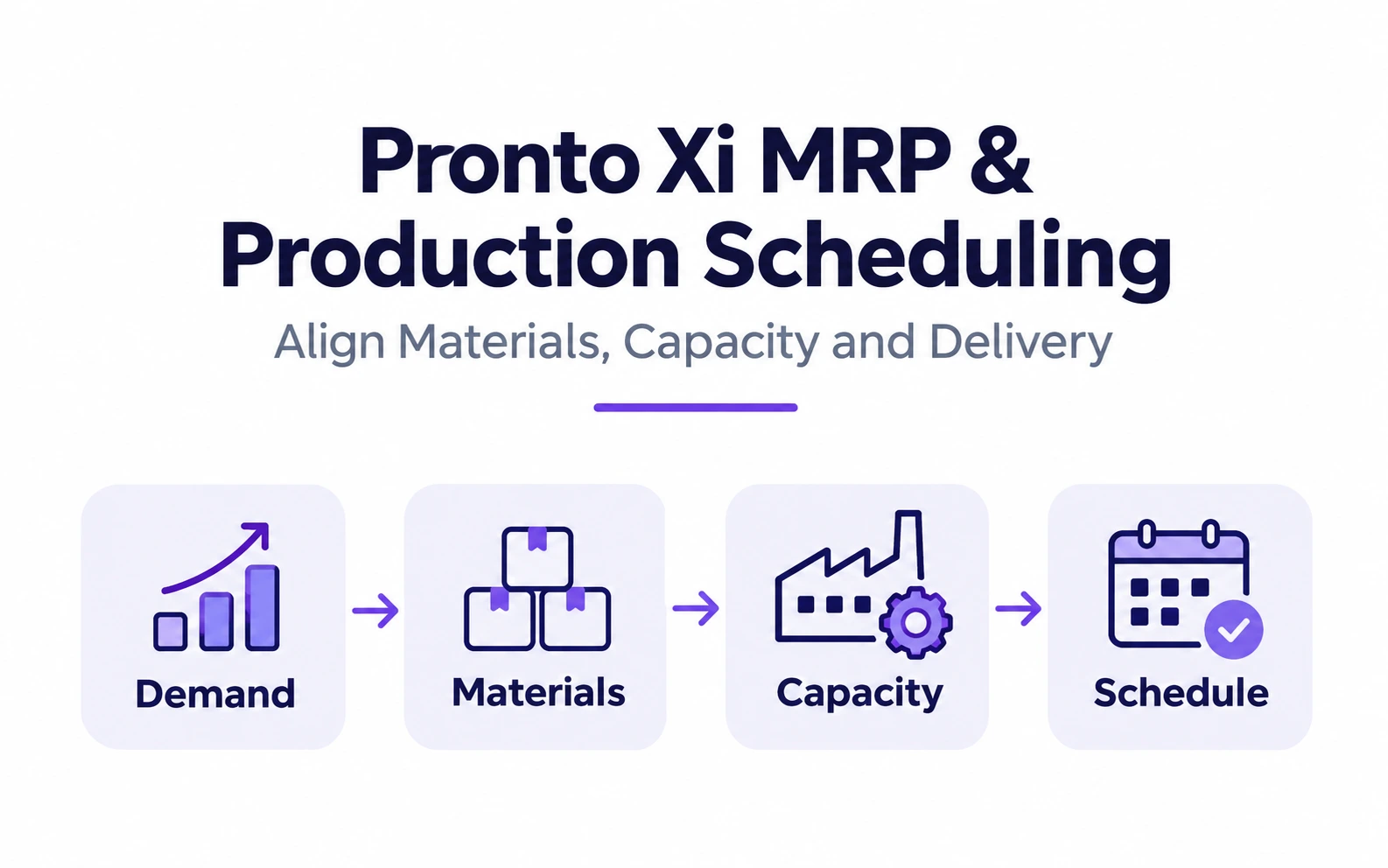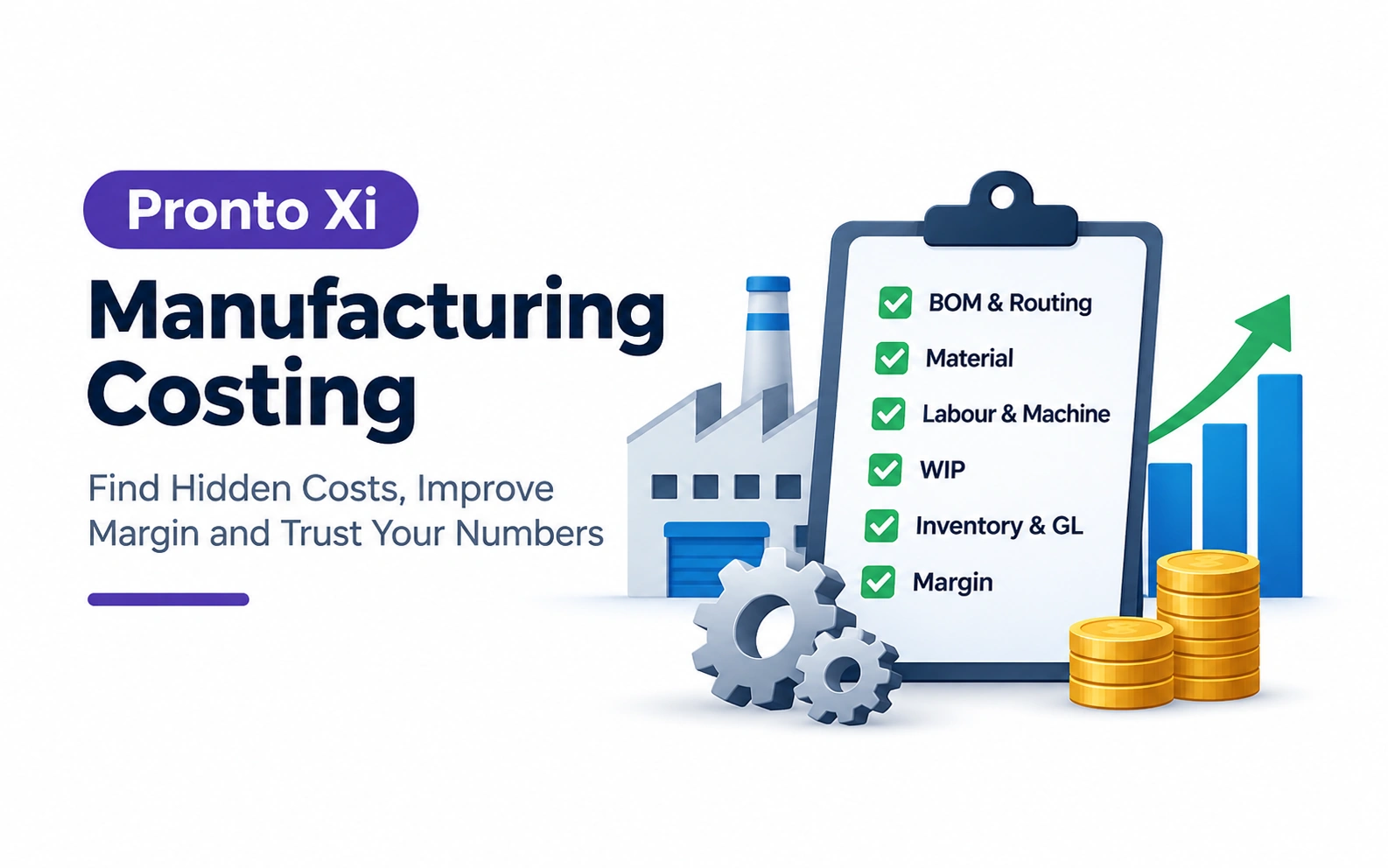
Pronto Xi Manufacturing Costing: Find Hidden Costs, Improve Margin and Trust Your Numbers
A practical guide to Pronto Xi manufacturing costing, explaining standard versus actual cost, WIP, variances, overhead absorption and why production cost, inventory value and margin can differ.
When manufacturing costs in Pronto Xi do not agree with WIP, inventory valuation or reported margin, the first question should not be “which number is wrong?” It should be “which cost are we actually comparing?”
Pronto Xi supports multiple manufacturing and inventory cost concepts. Its published manufacturing documentation states that costs can be generated from standard costs, BOMs and routings, or from actual labour and machine time, work-order cash costs and timesheet records. Inventory can also maintain standard, average, FIFO and actual costs for purposes including posting, valuation and sales-margin reporting.
That means three legitimate numbers can coexist:
| Costing layer | Main question |
|---|---|
| Expected production cost | What should this product cost to manufacture? |
| Inventory valuation cost | At what cost basis is inventory being carried and posted? |
| Realised margin cost | What cost is ultimately being compared with revenue? |
These figures may be related without being identical.
For CFOs and CIOs seeking greater ROI from Pronto Xi, the objective should therefore be broader than producing a more accurate costing report.
The objective is to create a traceable connection between:
BOM → Routing → Material → Labour & Machine Time → Production → Work Order → WIP → Inventory → GL → Margin
When that chain is reliable, costing becomes a tool for operational improvement rather than merely an accounting result.
How does Pronto Xi support manufacturing costing?
Pronto-specific capability
Pronto Xi Shopfloor Manufacturing supports processes including make-to-stock, make-to-order, assemble-to-order, configure-to-order and engineer-to-order, together with work orders, production feedback, materials planning and capacity planning.
For costing, Pronto's current documentation states that Xi can generate costs using:
- standard costs;
- single or multiple BOMs;
- routings;
- actual labour time;
- actual machine time;
- cash costs posted to a work order; and
- timesheet records.
It also allows GL structures to attribute costs and variances to areas such as factories, departments, item groups and work centres.
Pronto Xi Inventory separately maintains cost bases including standard, average, FIFO and actual for posting, inventory valuation and sales-margin reporting.
Those are documented Pronto Xi capabilities.
Exactly which methods, rates, accounts and processes apply in an individual business depends on that organisation's configuration.
Standard cost vs actual manufacturing cost
General manufacturing guidance
A standard cost is an expected cost based on predetermined assumptions.
Those assumptions may include:
- material quantities and prices;
- labour hours and rates;
- machine time;
- overhead;
- expected yield.
An actual production cost reflects what actually happened.
Actual cost can differ because production consumed more material, took longer, generated more scrap, used different labour or machinery, incurred subcontracting costs or operated at a different production volume.
A variance is therefore not automatically an error.
It may be useful operational information.
Pronto-specific point
Pronto Xi can use both predetermined structures such as BOMs, routings and standard costs and actual inputs such as labour, machine time and work-order costs.
The first reconciliation question should therefore be:
Which Pronto Xi cost are we looking at, and what decision is that cost intended to support?
Why can expected production cost, inventory cost and gross margin differ?
These three layers answer different questions.
Expected production cost
This is principally a planning and performance benchmark.
It asks:
What should this product cost if materials, labour, machine activity and overhead behave as expected?
Inventory valuation
This asks:
At what cost basis should the inventory be recorded?
Pronto Xi Inventory supports multiple costing methods, so the cost used for valuation may not be identical to the manufacturing benchmark.
Realised margin
This asks:
What cost is being compared with actual sales revenue?
Again, Pronto Xi documentation states that inventory costs can be used for sales-margin reporting. Which cost basis applies should be confirmed in the customer environment.
This distinction matters because an organisation can waste considerable time trying to force three legitimately different measures to reconcile exactly.
Where do manufacturing-cost variances come from?
General manufacturing guidance
A useful variance taxonomy is:
| Variance | What it may indicate |
|---|---|
| Material price variance | Component purchase economics differ from expectation |
| Material usage variance | More or less material was consumed than planned |
| Labour rate variance | Actual labour cost differs from assumed rate |
| Labour efficiency variance | Production used more or fewer labour hours |
| Machine-time variance | Machine usage differs from routing assumptions |
| Scrap/rework variance | Additional material or processing was required |
| Yield variance | Usable production output differs from expected output |
| Overhead absorption variance | Production volume or cost-driver activity differs from assumptions |
| Subcontract variance | External processing cost differs from plan |
These are useful management categories. They are not a claim that Pronto Xi provides each as a pre-built standard report.
The value comes from classifying a difference before trying to fix it.
1. Is the Bill of Materials still correct?
The BOM establishes the expected product structure.
If it contains incorrect quantities, obsolete components, outdated packaging, missing materials or old versions, the theoretical cost may already be wrong before manufacturing begins.
Pronto-specific capability
Pronto Xi manufacturing manages BOMs alongside production data and work orders, including multi-level manufacturing structures.
General control
Engineering and manufacturing should own the physical accuracy of the BOM.
An ERP can calculate precisely from inaccurate master data.
That does not make the result economically correct.
A useful management question is:
When was this BOM last validated against how the product is actually manufactured?
2. Does the routing reflect the current factory?
A BOM describes what goes into the product.
A routing describes how production is expected to occur.
If the routing has not changed after:
- new machinery;
- automation;
- different work centres;
- labour changes;
- altered production sequence;
- factory relocation,
then standard production cost may represent the economics of an old process.
Pronto-specific capability
Pronto Xi can generate manufacturing costs from routings and can incorporate actual labour and machine-time reports into costing.
This creates an opportunity to compare:
expected routing activity → actual production activity
rather than treating a cost variance as an unexplained finance number.
3. Was the material actually consumed as recorded?
The BOM says what production should consume.
Work-order and inventory transactions should reflect what it did consume.
Pronto Xi Inventory supports manufacturing issues against Factory/WIP or work orders, as well as returns of unused work-order components back into inventory.
If components are physically used but:
- issued late;
- issued against the wrong work order;
- substituted without being recorded;
- returned physically but not returned in the system;
then the cost and inventory record can diverge from factory reality.
This is not primarily a reporting problem.
It is transaction discipline.
4. Are scrap, rework and yield visible?
Scrap and yield deserve separate attention.
Scrap and rework
These increase the amount of input required to produce saleable output.
Yield
Yield asks:
How much usable output did we receive from the inputs consumed?
If a batch is expected to produce 100 good units but produces only 93, cost per usable unit rises even if total labour and material input appear reasonable.
This can be one of the most important explanations for margin erosion in process and repetitive manufacturing.
Pronto has published a customer example where Crusader Caravans reported linking material wastage to individual work orders and identifying approximately $100,000 of previously hidden costs over three months. That is one customer's reported result, not a benchmark for other Pronto Xi manufacturers.
The broader principle is:
If waste and yield are not visible at the production level, they often reappear later as unexplained cost or margin variance.
5. Are labour and machine-time records reliable?
Pronto Xi can use actual labour and machine time in manufacturing costing and can associate work-order time with employee records.
But the calculation is only as reliable as the operational feedback.
Problems can arise when:
- time is recorded against the wrong job;
- employees record time retrospectively;
- machine time is estimated;
- downtime is not classified;
- production completes but time continues accumulating.
What appears to Finance as a labour-cost variance may therefore have its root cause on the shopfloor.
6. Is overhead being absorbed as expected?
This deserves separate analysis from labour and materials.
General manufacturing guidance
Overhead is often allocated using a driver such as:
- labour hours;
- machine hours;
- production volume;
- units produced.
The important question is not simply:
What overhead rate did we use?
It is also:
Did actual production volume absorb overhead at the level assumed by the costing model?
If fixed factory costs remain relatively constant but production volume falls, overhead per unit can rise.
A product can therefore appear less profitable even when:
- material usage is unchanged;
- labour efficiency is unchanged;
- supplier prices are unchanged.
This is an important CFO consideration because operational volume and capacity utilisation can change product economics independently of direct input efficiency.
7. Are material prices and inventory-cost assumptions still relevant?
Pronto Xi Inventory maintains cost bases including standard, average, FIFO and actual, while landed costs can be incorporated through shipment costing.
A manufacturing model may therefore be based on one cost concept while commercial margin is being assessed using another.
Before investigating a variance, confirm:
Are the manufacturing, inventory and margin reports actually using comparable cost bases?
This becomes particularly important where:
- commodity prices move quickly;
- foreign exchange changes;
- freight increases;
- suppliers change;
- landed costs become material.
What is WIP in a Pronto Xi manufacturing environment?
General definition
Work in progress (WIP) represents manufacturing activity that has started but has not yet become completed finished goods.
Its value may include materials and other manufacturing costs accumulated through production.
Pronto-specific capability
Pronto Xi Inventory supports manufacturing issues and returns against Factory/WIP and work orders, while manufacturing costs can be posted into the General Ledger.
The precise accounting treatment, accounts and recognition rules depend on the customer's configuration.
There is no basis for assuming every Pronto Xi manufacturer uses an identical WIP accounting model.
Why does WIP become difficult to reconcile?
General manufacturing guidance
Typical causes include:
- old work orders remaining open;
- material issued before production occurs;
- completed production not recorded promptly;
- incomplete shopfloor feedback;
- unused materials not returned;
- late work-order adjustments;
- labour accumulating after physical completion.
One useful control is WIP ageing.
For example, review WIP in bands such as:
| WIP age | Management question |
|---|---|
| 0–7 days | Is this normal active production? |
| 8–30 days | What is preventing completion? |
| 31–60 days | Is production genuinely still active? |
| 60+ days | Is this real WIP or transaction residue requiring investigation? |
The age ranges should be adapted to the organisation's production cycle.
A manufacturer building complex equipment may legitimately have much longer WIP cycles than a repetitive manufacturer.
The important question is:
Can we explain why every material aged WIP balance remains open?
Why does manufacturing cost not match gross margin?
This is one of the most commercially important questions.
A product can look profitable in the costing model yet produce disappointing realised margin.
Possible causes include:
- actual material usage exceeded the BOM;
- purchase economics changed;
- labour exceeded routing assumptions;
- yield deteriorated;
- scrap increased;
- overhead absorption changed;
- subcontracting costs increased;
- the sales-margin report uses a different cost basis;
- pricing did not move with cost.
The last point is particularly important.
If actual production cost repeatedly exceeds the assumptions used to price the product, the business can improve factory performance and still destroy margin commercially.
Cost analysis therefore needs to close the loop with:
pricing → quoting → product mix → customer margin
not stop at production accounting.
What should trigger a manufacturing-costing review?
A costing review should not occur only once a year.
Useful triggers include:
| Trigger | What it may indicate |
|---|---|
| Gross margin declines without an obvious selling-price change | Cost assumptions may have moved |
| WIP grows faster than production | Work-order or completion issues |
| Inventory adjustments increase | Material transaction or master-data problems |
| Scrap/rework rises | Process or quality deterioration |
| Work orders remain open longer | Production feedback or process constraints |
| Actual labour regularly exceeds routing | Routing or productivity problem |
| Supplier prices change materially | Standard assumptions may be stale |
| New machinery/processes are introduced | Routing and overhead assumptions may be outdated |
| Costing has not changed despite major factory changes | Standards require review |
These are general management triggers rather than Pronto-specific system rules.
A practical Pronto Xi manufacturing-cost diagnostic
When Finance, Operations and Sales disagree about product cost, investigate in this sequence:
| Step | Question | What to examine |
|---|---|---|
| 1. Cost definition | Which cost concepts are being compared? | Standard, average, FIFO, actual, margin basis |
| 2. BOM | Is the product structure current? | Components, quantities, versions |
| 3. Routing | Does the production model reflect reality? | Work centres, sequence, labour, machine assumptions |
| 4. Material | Did usage match expectation? | Work-order/WIP issues and returns |
| 5. Labour/machine | Was actual activity captured accurately? | Production feedback |
| 6. Scrap/rework | Was additional consumption visible? | Work-order activity |
| 7. Yield | Did inputs produce expected saleable output? | Output vs consumption |
| 8. Overhead | Did activity absorb overhead as planned? | Volume and allocation assumptions |
| 9. External cost | Are subcontract/direct costs complete? | Work-order costs |
| 10. WIP | Are incomplete orders genuinely active? | Age and production status |
| 11. Inventory | Which cost basis drives valuation? | Inventory configuration |
| 12. GL | Did manufacturing activity post as expected? | Financial reconciliation |
| 13. Margin | Does the commercial report use the same cost logic? | Reporting and pricing |
Do not begin by rewriting a Cognos report.
First prove the underlying economic chain.
What should CFOs and operations leaders measure?
Need Pronto Xi manufacturing or costing expertise to work through this diagnostic? Talk to SAAPRO.
A practical manufacturing-cost dashboard may include general measures such as:
| KPI | Management purpose |
|---|---|
| Material price variance | Purchasing economics |
| Material usage variance | Production consumption |
| Labour efficiency variance | Productivity |
| Machine-time variance | Asset/process performance |
| Scrap and rework cost | Quality and waste |
| Production yield | Usable output |
| Overhead absorption | Capacity and volume economics |
| WIP value and ageing | Working capital and process flow |
| Work-order cost vs expectation | Production economics |
| Gross margin by product/family | Commercial outcome |
These are general manufacturing-management KPIs. They should not be interpreted as a claim that every measure is supplied as a standard out-of-the-box Pronto Xi report.
Where a KPI matters, determine the appropriate governed source from the organisation's Pronto Xi environment, Cognos model or other reporting layer.
Where does the ROI come from?
Costing accuracy does not create ROI by itself.
ROI appears when better costing changes decisions.
Reduce hidden material loss
Better work-order visibility can expose scrap, excessive usage and rework that previously disappeared into aggregate inventory or margin results.
Improve pricing
If actual production economics are visible, commercial teams can reconsider pricing where cost has materially changed.
Improve product mix
Management can distinguish products that create revenue from those that create sustainable margin.
Improve BOM and routing discipline
Persistent cost variances can identify production structures that no longer reflect reality.
Reduce WIP and working capital
Aged WIP analysis can expose stalled orders and inventory unnecessarily tied up in incomplete production.
Improve operational accountability
The strongest result is moving from:
“Margin missed budget.”
to:
“Material usage increased by X, yield declined by Y, and labour exceeded routing assumptions by Z.”
That converts accounting information into operational action.
Pronto Xi capability does not guarantee costing accuracy
Pronto Xi provides the underlying functionality to manage BOMs, work orders, production feedback, manufacturing costing, multiple inventory costs and GL integration.
But the ERP cannot independently determine whether:
- a BOM matches the physical product;
- a routing reflects the current factory;
- labour is captured correctly;
- scrap is recorded consistently;
- overhead assumptions remain economically useful;
- old work orders should remain open.
That distinction matters.
The system provides the costing mechanism. The organisation provides the production truth.
Who should own manufacturing-cost accuracy?
Manufacturing costing crosses departmental boundaries.
| Area | Typical ownership |
|---|---|
| BOM structure | Engineering / Manufacturing |
| Routing and work centres | Manufacturing / Engineering |
| Material transactions | Production / Inventory |
| Labour and machine feedback | Production |
| Supplier economics | Procurement |
| Overhead methodology | Finance |
| Inventory cost policy | Finance |
| WIP reconciliation | Finance + Operations |
| Variance investigation | Finance + Operations |
| Pronto configuration | ERP / Functional owner |
| Commercial margin response | Finance + Sales / Management |
The exact ownership varies by organisation.
The principle is more important:
The team closest to the operational fact should own input quality; Finance should own financial interpretation and control.
A 30-day manufacturing-cost review
A costing review does not necessarily require a major Pronto Xi project.
Choose a representative sample of commercially important products and work orders.
During the first week, agree exactly which cost concepts are being compared and establish the current BOM, routing and expected economics.
During the second week, validate those assumptions against the current factory, including component quantities, work centres, labour, machine assumptions, overhead and expected yield.
During the third week, trace actual work orders through material issues and returns, labour, machine time, scrap, output and WIP.
During the final week, reconcile:
Work order → Inventory → GL → Sales margin
Classify differences into:
- genuine operational variance;
- outdated master data;
- incomplete transaction;
- accounting/configuration difference;
- reporting-definition difference.
Only then decide whether the solution requires process change, Pronto configuration, master-data improvement or reporting work.
Where SAAPRO fits
Manufacturing-costing problems do not all require the same specialist.
Depending on the root cause, an organisation may need a Pronto Xi Manufacturing Functional Consultant, Business Analyst, experienced Application Analyst, finance-functional specialist, Cognos resource or ERP Manager.
SAAPRO specialises in the Pronto Xi talent market and can help identify the capability required before assuming every costing problem needs custom development or another report. Contact SAAPRO to discuss your requirement.
Disclosure: SAAPRO is an independent Pronto Xi recruitment specialist and is not Pronto Software or an ecommerce implementation vendor.
Frequently Asked Questions
Pronto Xi documentation states that manufacturing costs can be generated from standard costs, BOMs and routings, or from actual labour and machine-time reports, cash costs posted to work orders and timesheet records. The appropriate method depends on the organisation’s configuration and the purpose of the cost being analysed.
Pronto Xi Inventory documentation describes standard, average, FIFO and actual costs that can be maintained for posting, valuation and sales-margin reporting. The costing basis used in a particular report or process should be confirmed in the customer’s configuration.
Actual production may consume different quantities, labour, machine time or external cost than assumed in the BOM, routing and costing model. Scrap, yield, purchase-price changes and overhead absorption can also contribute. A variance should therefore be classified before it is treated as an error.
Common causes include old work orders, material issued before production, incomplete production feedback, unused material not returned and late adjustments. Pronto Xi supports manufacturing issues and returns against Factory/WIP and work orders, but the exact WIP accounting model depends on the customer’s configuration.
The manufacturing model, inventory valuation and sales-margin report may use different cost bases or timing. Start by confirming which cost method drives each figure, then investigate material, labour, yield, overhead and other operational differences. Pronto Xi supports multiple inventory costing methods, so the measures should not automatically be assumed to be identical.
Start with the cost definition, then trace BOM, routing, material consumption, labour and machine activity, scrap, yield, overhead, WIP, inventory valuation and GL posting. Only after the operational chain is understood should management investigate reporting differences.
Key Takeaways
- ✓A Pronto Xi manufacturing-cost problem rarely begins with the GL. It usually begins somewhere in BOM → Routing → Material → Labour & Machine Time → Yield → Production → Work Order → WIP → Inventory → GL → Margin.
- ✓Pronto Xi provides functionality across that chain, including BOM and routing-based costing, actual labour and machine inputs, work-order costs, manufacturing inventory transactions and multiple inventory cost methods.
- ✓Accurate costing depends just as heavily on current master data, accurate production feedback, disciplined inventory transactions, realistic overhead assumptions, timely work-order management and clear financial definitions.
- ✓The goal is not simply to “make the costing report more accurate.” It is to “understand why expected production cost differs from actual factory economics, inventory value and realised margin, and use those differences to improve pricing, purchasing, production, product mix and working capital.”