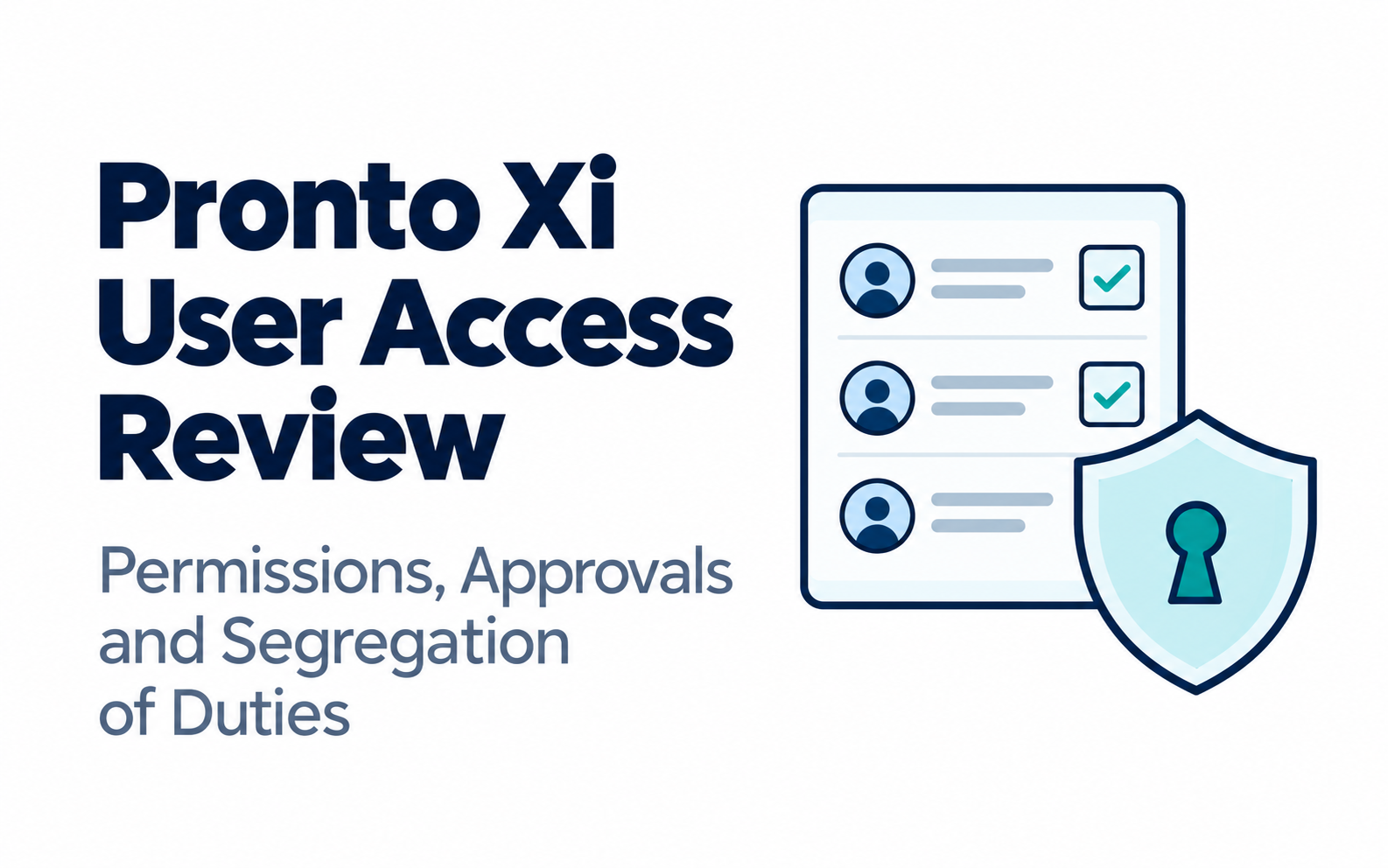
Pronto Xi User Access Review: Permissions, Approvals and Segregation of Duties
A practical framework for reviewing Pronto Xi user access, covering effective permissions, approval authority, segregation of duties, verified remediation and how to measure business value.
Can anyone change sensitive financial data and complete the resulting transaction without independent oversight? If you remove that access, can the person still perform their legitimate work?
These are useful starting questions for CFOs, CIOs and IT leaders reviewing Pronto Xi access.
A Pronto Xi user access review checks whether each person or service has authorised access appropriate to its current duties, and whether combined permissions create unacceptable risk. It covers business actions, company scope and approval authority across relevant roles, accounts and connected systems.
The management task is to identify consequential access, decide what should change and verify the result. Business value comes from stronger controls, more efficient administration and reliable operations. Financial savings require separate evidence.
This article provides a recommended framework, not an official Pronto procedure. A qualified Pronto specialist should validate configuration and testing against your version, modules, customisations and deployment.
What evidence should a Pronto Xi access review produce?
An access review should produce a reconciled account inventory, an assessment of effective business actions, documented conflict decisions, verified access changes and a register of accepted exceptions. Its conclusions should identify the systems and companies covered, the review date, exclusions and unresolved findings.
Management should receive answers to five questions:
| Management question | Required evidence |
|---|---|
| Have we covered the relevant population? | Reconciled accounts, ownership, scope and exclusions |
| Is access appropriate for current duties? | Business-owner decisions on effective permissions and approval authority |
| Where can one person perform incompatible activities? | Conflicts assessed across the relevant end-to-end process |
| Have agreed changes worked? | Implementation records and positive and negative test results |
| What exposure remains? | Open findings and authorised exceptions with owners, controls and deadlines |
An approved username list is an input to this work. The outcome depends on what those accounts can actually do and whether remediation has been verified.
What Pronto Xi documentation establishes
Pronto Software’s Pronto Xi 780 Core Platform overview describes role-based security that can restrict access by company, module and functions within screens. It also describes multiple role assignments, custom roles, data masking and configurable auditing.[1]
These capabilities provide a starting point for assessment. Their availability and operation in your installation need validation; the documentation does not establish that your permissions or approval processes are configured appropriately.
Ask the specialist to explain how overlapping roles, broad permissions, custom functions and alternative update routes affect access in your environment.
Review actual business capability. A role’s name alone does not establish what its holder can do.
1. Define the review boundary and accountable owners
Agree the scope before collecting evidence. Otherwise, a review may appear complete while omitting a payment platform, integration account or company directory.
| Scope item | What to record |
|---|---|
| Business scope | Companies, processes and sensitive information covered |
| Environments | Production and any other environments relevant to the identified risk |
| Systems | Pronto Xi, relevant banking platforms, reporting tools, integrations and administrative access |
| Account population | Employees, contractors, suppliers, privileged users, shared accounts and services |
| Time boundary | Access snapshot date and period covered by supporting activity evidence |
| Exclusions | What is excluded, why, who approved the boundary and what limitation follows |
Changes after the snapshot may affect the conclusion. Record relevant access changes during the review and confirm the final state before closing affected findings.
Assign responsibilities explicitly:
- Business and process owners approve required duties, data access and company scope.
- Finance owners approve financial authority within the organisation’s delegation rules.
- HR, managers and service owners confirm employment, contractor status and non-human account ownership.
- Pronto specialists interpret permissions and validate how configuration implements decisions.
- Authorised administrators implement changes; an independent reviewer verifies sensitive changes where practicable.
- Accountable executives accept residual risk within their authority.
- The ERP or IT service owner coordinates the review and tracks closure.
Administrators should not approve their own elevated access. Where staffing limits separation, document the limitation and assign independent oversight.
2. Reconcile accounts and establish effective access
Reconcile system accounts against current personnel, contractor, supplier and service records. Investigate unexplained accounts and ownership gaps.
Include named users, administrators, emergency accounts, vendor support, integrations, scheduled jobs, shared accounts and relevant reporting or database access.
For each account, record its owner, purpose, status, scope, permissions, approval evidence and any expiry date. Link multiple accounts belonging to the same person.
A service account may run a critical integration without interactive login activity. Confirm dependencies before disabling it. Likewise, low usage alone does not prove that an employee’s access is unnecessary.
The Australian Cyber Security Centre describes least privilege as limiting access to what is needed for duties.[2] Apply that principle to the business task and the person’s current responsibilities.
Translate technical access into business actions
For each person or service, establish whether it can:
- View or export sensitive information.
- Create, amend, approve, post or reverse relevant transactions.
- Change sensitive master data, approval limits or workflow rules.
- Grant access or alter security settings.
- Achieve the same outcome through another account, import, API or privileged route.
Review combined access across roles and systems. Pay particular attention to employees who have changed jobs but retained previous permissions.
The following illustrative record shows how to make the assessment understandable to a business owner. It is not a description of default Pronto behaviour.
| Field | Hypothetical review record |
|---|---|
| Person and purpose | Finance employee maintaining supplier records |
| Accounts | Named ERP account and named banking-platform account |
| Company scope | The same operating company in both systems |
| Effective business actions | Amend supplier bank details; independently release payments |
| Potential conflict | Redirect payment details and release the resulting payment |
| Existing control | A manager reviews payments after release; effectiveness requires assessment |
| Business decision | Retain authorised maintenance duties; remove independent payment release and require another authorised person to verify and release |
| Verification required | Maintenance succeeds; independent release fails; alternate accounts and delegation do not restore the combination |
This record connects technical permissions to a decision. It also makes clear where a control operates outside Pronto Xi.
3. Prioritise findings by consequence and existing controls
Start where inappropriate access could have the greatest business impact. Payment-related changes, financial approvals, sensitive data, privileged administration and external access are useful areas to consider first.
Use the following proposed assessment method to rank findings within your organisation:
| Consideration | Question to answer |
|---|---|
| Business consequence | What funds, sensitive data, reporting or operations could be affected? |
| Reach | Which companies, transactions and approval limits are involved? |
| Independent control | What prevents or detects misuse, and what evidence shows the control works? |
| Urgency | Is the access needed, temporary, unexplained or associated with a departed user? |
| Operational dependency | What legitimate work could be disrupted by changing the access? |
Set remediation deadlines through your own risk and change processes. These considerations do not establish universal severity ratings or Pronto-mandated deadlines.
Where exposure needs urgent containment, use the appropriate incident or emergency-change process. For routine remediation, assess dependencies and operational timing before making changes.
4. Test approval authority and segregation of duties
Permission to open a function, authority to approve a transaction and permission to change approval rules are separate matters.
For relevant approval processes, check company scope, limits, currency, self-approval, temporary delegation, overrides and changes made after approval. Establish who can alter the rules and what evidence records those changes.
A written delegation matrix describes policy. Testing establishes whether the applicable system or procedure enforces it.
Which duty combinations deserve attention?
Segregation of duties aims to prevent one person from completing incompatible activities without effective independent oversight. These combinations are prompts for assessment, rather than declarations that every instance is unacceptable:
| Potential combination | Risk to assess | Control evidence to examine |
|---|---|---|
| Change supplier bank details and release payments | Redirected funds | Bank-detail verification and independent release |
| Request expenditure and approve it | Self-authorised spending | Self-approval restrictions and delegated limits |
| Enter and approve material journals | Unsupported adjustments | Approval authority and independent review |
| Adjust stock and approve the adjustment | Unsupported inventory changes | Adjustment approval and reconciliation |
| Create credits or refunds and authorise settlement | Unsupported customer adjustments | Approval, settlement and reconciliation controls |
| Change security and alter related audit evidence | Concealed access changes | Privileged-access controls and protected evidence |
Assess company scope and the full process. Preparing a payment file in Pronto and releasing funds through a bank portal are different activities. Two usernames controlled by the same person do not create independent approval.
A conflict identifies potential capability; it does not establish that misconduct occurred.
What if full separation is impractical?
Document a specific compensating control and assess whether it addresses the conflict.
An independent check before payment release is preventive. Reviewing bank-detail changes against payments after release is detective. They offer different protection because retrospective review leaves exposure until detection.
For an accepted exception, record:
- The business reason and affected access.
- The risk owner and authorised acceptance decision.
- The control operator, procedure, frequency and evidence.
- The review date and expiry or exit condition.
“Management reviews reports” is too vague. Specify what the reviewer sees, how independence is maintained, what triggers investigation and how the outcome is recorded.
5. Implement changes and prove that they work
Use an approved change process with impact assessment, scheduling, testing and recovery arrangements. Use a representative test environment for transaction scenarios where appropriate, then confirm the relevant production configuration.
Each sensitive change needs two outcomes:
Positive test: required work still succeeds.
Negative test: the prohibited action fails through the relevant routes.
For the hypothetical supplier-maintenance example, the tests would include:
| Test | Expected outcome |
|---|---|
| Employee performs authorised supplier maintenance | Legitimate work succeeds |
| Employee attempts independent payment release | The payment system blocks the action |
| Independent approver checks a payment following a bank-detail change | Required change and verification evidence is available |
| Alternate accounts and temporary delegation are assessed | The prohibited combination is not restored |
| Relevant imports or interfaces are assessed | Sensitive changes through those routes are appropriately controlled |
Define expected outcomes before testing. Retain the scope, date, result and reviewer evidence. If a restriction cannot be enforced, retain the finding or document an authorised exception with explicit interim controls.
Verify privileged access and audit evidence
ACSC guidance recommends restricting administrative privileges and using separate attributable administrative accounts.[3] Assess application, database, hosting and integration privileges where they can affect the process under review.
Establish which events are logged, which routes may fall outside coverage, who can change logging or evidence, how long records are retained and who reviews them. Configurable auditing does not establish that the required events are captured or acted on.
When is the access review complete?
Agree acceptance criteria at the start. The following provides a practical completion checklist:
| Completion criterion | Evidence required |
|---|---|
| Population and boundary are established | Reconciled inventory, review dates and approved exclusions |
| Required access is confirmed | Business-owner decisions on duties, company scope and approval authority |
| Conflicts are assessed | Documented findings, priorities and decisions |
| Approved changes are implemented | Completed change records |
| Outcomes are verified | Relevant positive and negative tests with retained results |
| Exceptions are controlled | Authorised acceptance, named operators, evidence requirements and expiry |
| Remaining work is visible | Open findings with owners, deadlines and escalation |
| Ongoing ownership is assigned | Event-driven triggers and the next scheduled review |
Track approved for removal, removed and verified as separate states. Submitting a change request does not close a finding.
Management may sign off a review cycle with unresolved items, but the sign-off should disclose those items and their treatment. It should not imply that all remediation is complete.
How often should Pronto Xi access be reviewed?
Use scheduled reviews alongside event-driven changes. Set frequency according to risk, organisational policy, contractual requirements and the rate of change.
Departures, transfers, contractor expiry, temporary delegation, incidents and new integrations should trigger the relevant access process without waiting for the next scheduled review.
Prioritise more consequential access when setting the schedule. Record who owns the cycle and who follows up overdue decisions and expired exceptions.
How do you measure business value and ROI?
Establish a baseline before changing the process. Choose comparable periods and account for changes in user numbers, scope and transaction volume.
Keep three outcomes separate:
| Outcome | Suggested measures | Interpretation |
|---|---|---|
| Control improvement | Verified unnecessary access removed; overdue findings; expired exceptions; leaver and mover completion times | Evidence of control performance, without assigning invented financial savings |
| Staff capacity released | Hours spent preparing evidence, reconciling accounts and resolving repeat access issues | Time available for other work; not automatically reduced expenditure |
| Expenditure reduction | Demonstrated reductions in relevant external fees or billable licence costs | Cash benefit only where actual spending or contractual charges change |
Also track access-related disruption after remediation. A faster review loses value if changes repeatedly prevent authorised work.
Define each measure consistently. For example, review coverage should use the reconciled in-scope population as its denominator. Count access removals as verified only after the relevant checks pass.
Include specialist assessment, internal review time, cleanup, testing and ongoing administration in the cost assessment. Compare one-off and recurring costs over the same period as the benefits.
If you calculate financial ROI, use evidenced financial benefits and a consistently defined cost basis. Report estimated capacity value separately from cash savings and avoid counting the same benefit twice. Licence savings depend on the agreement and billable usage model.
An access review can support a business case through stronger controls and reduced effort even when measurable cash savings are limited. It does not, by itself, eliminate fraud or establish compliance with a standard.
Prepare for a useful access-review discussion
Bring your account inventory, role assignments, financial delegation policy, connected-system list and known access concerns. These inputs help define the scope and identify the expertise required.
Look for capability in Pronto permissions, financial processes, connected systems and practical testing. Business owners must remain involved in decisions about required duties and accepted risk.
Read SAAPRO’s guide to Pronto Xi roles or Contact SAAPRO to discuss the specialist capability your organisation needs.
Frequently Asked Questions
Business owners should approve required duties, data and company scope. Finance owners should approve financial authority within delegated limits. Authorised administrators implement changes, while a qualified Pronto specialist validates how configuration delivers the intended access. Sensitive changes should receive independent verification where practicable.
No. Assess the combined business actions available through relevant roles, accounts, company access and delegation. Include connected systems or alternative routes where they can affect the process. A role name or assignment list does not establish effective access.
Identify the specific conflict and assess an independent control that addresses it. Record the risk owner, control procedure, evidence and expiry. Verification before release and review after release offer different protection; the accountable owner needs to understand the remaining exposure.
First establish ownership, business need and dependencies. An account without interactive logins may run an integration or scheduled job. Handle confirmed unnecessary access through the appropriate change or urgent-containment process, preserve required evidence and verify the result.
Ask for the review boundary, reconciled population, business-owner decisions, assessed conflicts, verified changes and exception register. Require a clear account of unresolved findings, owners and deadlines, together with evidence that legitimate work continues after remediation.
Key Takeaways
- ✓An access review should establish what each person or service can actually do, not just which roles are assigned to them.
- ✓Agree the review boundary and accountable owners first, including connected systems, service accounts and privileged access.
- ✓Prioritise findings by business consequence and existing controls, starting with payments, financial approvals, sensitive data and privileged administration.
- ✓Assess segregation of duties across the end-to-end process and company scope. Where full separation is impractical, document a specific compensating control.
- ✓Prove every sensitive change with positive and negative tests, and track approved, removed and verified as separate states.
- ✓Report control improvement, staff capacity released and cash savings separately when measuring ROI.