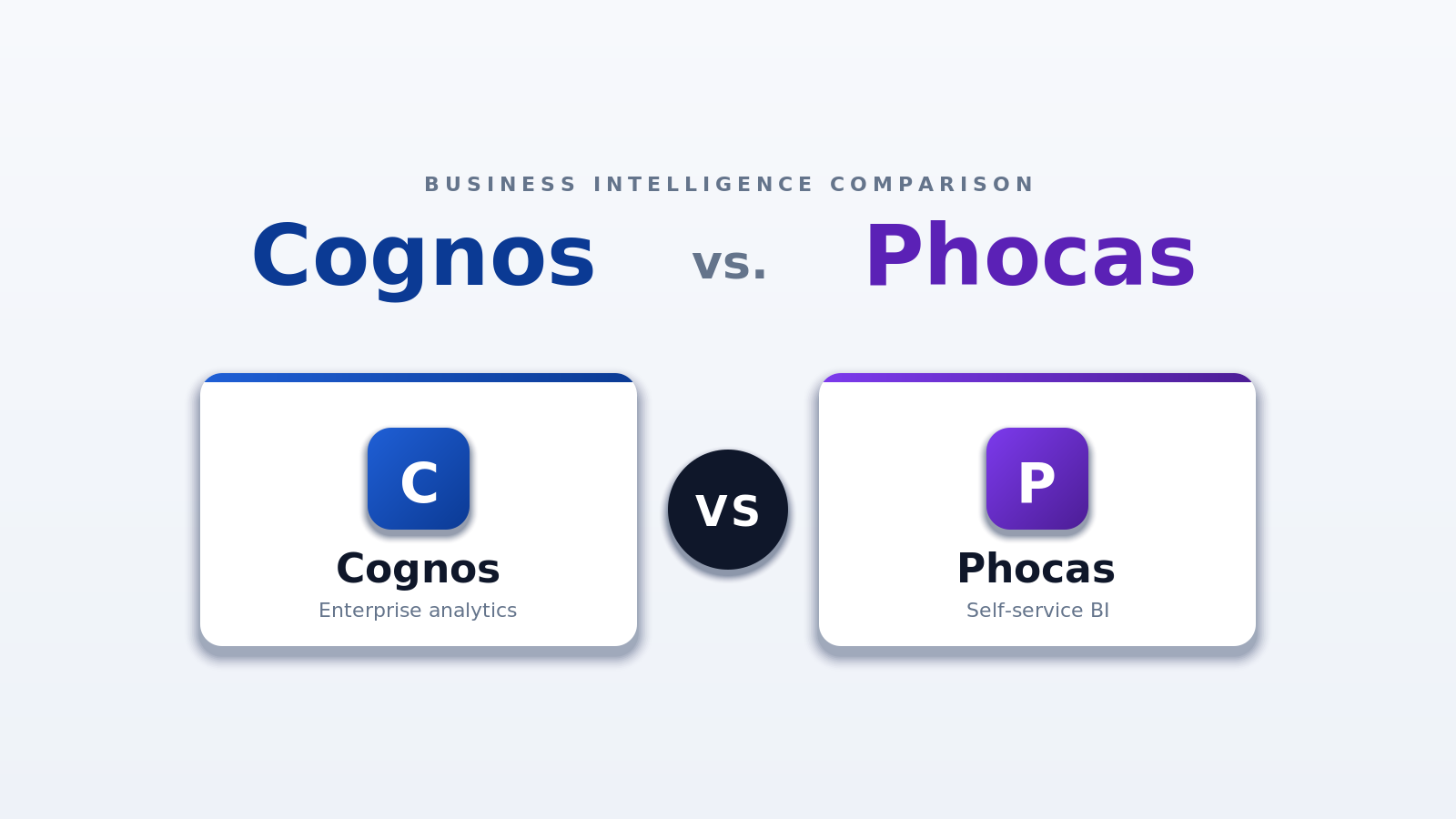
Cognos vs Phocas for Pronto Xi Reporting: Which One Should You Use?
Cognos vs Phocas for Pronto Xi Reporting: Which One Should You Use? The answer is often both. Learn when Cognos is best for governed reporting, when Phocas excels at self-service analytics, and why reporting governance, data quality, and the right talent matter more than the software itself.
The better question is not “Cognos or Phocas?” It is “which reporting problem are we trying to solve?”
For many Pronto Xi businesses, Cognos and Phocas are not direct replacements for each other. Cognos is often best suited to governed, structured and finance-controlled reporting. Phocas is often best suited to fast, self-service operational analytics. Mature Pronto environments commonly need both, but with clear ownership, governance and purpose.
Why this question comes up in Pronto Xi environments
A common question from Pronto Xi customers is:
“If we already have Cognos, why would we need Phocas?”
It is a fair question. Many organisations have spent years building Cognos reports around finance, sales, purchasing, inventory, service and operational reporting. Those reports are trusted, familiar and often deeply embedded into month-end, board reporting and management routines.
But the question can start from the wrong assumption.
The issue is rarely whether one reporting tool is “better” than the other. The real issue is whether the business is using the right tool for the right decision.
A CFO closing month-end, a sales manager reviewing customer margin, a purchasing manager investigating supplier performance, and an operations leader monitoring stock availability all need information — but they do not all need it in the same format, at the same speed, or with the same level of governance.
That is where Cognos and Phocas can play different but complementary roles.
Cognos in a Pronto Xi environment
Cognos is often strongest where the business needs control, consistency and repeatability.
In Pronto Xi environments, Cognos is commonly used for formal reporting where accuracy, formatting, definitions and governance matter. This may include:
-
Financial statements
-
Board and executive reporting
-
Month-end reporting
-
Compliance and audit reporting
-
Scheduled reports
-
Standard management packs
-
Reports that require consistent business rules
-
Reports where finance needs control over definitions and outputs
The strength of Cognos is not simply that it produces reports. Its value is that it can support governed reporting at scale, especially where the business needs consistent numbers, repeatable logic and controlled distribution.
For finance and executive reporting, this matters.
When a business is reviewing revenue, margin, inventory value, debtor position or financial performance, it cannot afford multiple interpretations of the same number. Cognos can provide structure, control and confidence when the reporting environment has been properly designed and maintained.
Where Cognos can become a constraint
Cognos can become less effective when every operational question turns into a report request.
For example:
-
“Can I see sales by customer, product group and region?”
-
“Can I compare this month against the same period last year?”
-
“Can I drill into which customers stopped buying?”
-
“Can I quickly identify slow-moving stock?”
-
“Can I check which suppliers are affecting fulfilment?”
If business users need to go back to IT, finance or a report developer every time they want to ask a follow-up question, decision-making slows down.
That is not necessarily a Cognos problem. It is often an operating model problem.
Cognos is excellent when the question is known, repeatable and governed. It is less ideal when the business needs fast, exploratory analysis by non-technical users.
Phocas in a Pronto Xi environment
Phocas is often strongest where the business needs speed, exploration and self-service analytics.
In a Pronto Xi environment, Phocas can help business users interact with ERP data more directly. Instead of waiting for a new report to be built, users can filter, drill, compare and investigate the data themselves.
This can be especially valuable across:
-
Sales performance
-
Customer buying behaviour
-
Product margin
-
Inventory trends
-
Stock movement
-
Purchasing performance
-
Supplier analysis
-
Branch or territory performance
-
Operational dashboards
-
Exception reporting
The value of Phocas is not simply that it creates dashboards. Its value is that it can change the way managers work with data.
A sales manager can identify margin leakage before month-end. A purchasing manager can see supplier issues earlier. An operations manager can investigate stock anomalies without waiting for a static report. An executive can review performance trends and drill into the drivers behind the number.
That is a different use case from formal financial reporting.
Where Phocas can become a risk
Phocas can create issues if it is rolled out without governance.
Self-service analytics is powerful, but it can also lead to confusion if different teams create different definitions for revenue, margin, stock availability, open orders or customer performance.
The risk is allowing multiple versions of the truth to emerge.
A successful Phocas implementation still needs:
-
Clear data definitions
-
Agreed business rules
-
Ownership of key measures
-
Alignment with finance and operations
-
Strong user training
-
Regular review of dashboards and reports
-
Someone who understands both Pronto data and business process
Without that, the business may move faster — but not necessarily in the right direction.
Cognos vs Phocas: the practical comparison
| Business need | Cognos is usually stronger when… | Phocas is usually stronger when… |
|---|---|---|
| Financial reporting | Reports need tight control, formatting and governance | Users want to explore financial drivers interactively |
| Month-end reporting | Outputs must be repeatable and consistent | Managers want to investigate variances quickly |
| Board reporting | Reports need a polished, approved format | Executives want dashboard-style visibility |
| Sales analysis | The business needs standard sales reports | Sales leaders want to drill into customer, product or margin trends |
| Inventory analysis | Reports are fixed and scheduled | Users need to investigate stock, movement and exceptions |
| Operational reporting | The question is known and repeatable | The question changes from day to day |
| Compliance reporting | Auditability and consistency matter most | Less suited unless governed carefully |
| Ad hoc analysis | Less ideal if every change needs technical input | Strong fit for business-user exploration |
| User experience | Better for controlled reporting environments | Better for non-technical users who need fast answers |
| Governance | Strong when centrally managed | Strong only if definitions and ownership are clear |
The biggest mistake: treating BI as a software decision
The biggest reporting mistake in Pronto Xi environments is assuming this is a software comparison.
It is not.
It is a business decision about how information should flow through the organisation.
Before choosing between Cognos, Phocas, Power BI, Excel or any other reporting tool, the business should ask:
-
Which reports must be governed and controlled?
-
Which users need self-service analytics?
-
Which numbers are business-critical?
-
Which reports are duplicated or no longer trusted?
-
Which decisions are currently too slow?
-
Where are users relying on manual Excel extracts?
-
Who owns the definitions for revenue, margin, stock and customer performance?
-
Who understands the Pronto data model well enough to keep reporting accurate?
These questions matter more than the platform.
A business with poor data definitions will still have reporting problems, regardless of which tool it uses.
A business with clear governance, strong Pronto knowledge and the right reporting operating model can get value from both Cognos and Phocas.
When should a Pronto Xi business use Cognos?
Cognos is often the better choice when the business needs:
-
Formal financial reports
-
Month-end packs
-
Board-level reporting
-
Statutory or compliance reports
-
Highly formatted outputs
-
Scheduled report distribution
-
Centralised control over report logic
-
Consistent reporting definitions
-
Reports that must reconcile to finance-approved numbers
In simple terms, Cognos is a strong fit when the report needs to be trusted, repeatable and governed.
When should a Pronto Xi business use Phocas?
Phocas is often the better choice when the business needs:
-
Faster operational insight
-
Self-service analytics
-
Interactive dashboards
-
Sales and margin analysis
-
Customer and product drill-down
-
Inventory visibility
-
Purchasing and supplier analysis
-
Branch, territory or team performance views
-
Fewer ad hoc report requests going back to IT
-
Better day-to-day decision-making by managers
In simple terms, Phocas is a strong fit when users need to explore, drill and act quickly.
When should a business use both?
Many Pronto Xi businesses should not think in terms of replacement.
They should think in terms of role clarity.
A practical model may look like this:
| Reporting layer | Primary purpose | Best-fit tool |
|---|---|---|
| Governed reporting | Finance, board, compliance, scheduled packs | Cognos |
| Operational analytics | Sales, inventory, purchasing, margin, customer trends | Phocas |
| Data preparation and validation | Extracts, transformations, reconciliations, data quality | SQL / Pronto knowledge / BI administration |
| Exception management | Operational issues requiring action | Phocas, Cognos or workflow tools depending on use case |
| Executive decision support | Approved KPIs plus ability to drill into drivers | Often a combination |
The goal is not to have more tools.
The goal is to have fewer arguments about numbers, faster access to insight, and better decisions across the business.
When should a business not use both?
Using both Cognos and Phocas may not make sense if:
-
Reporting requirements are simple
-
User numbers are small
-
The business lacks internal ownership
-
Data definitions are unclear
-
Existing reports are not trusted
-
There is no appetite to train users
-
The business cannot maintain two platforms properly
-
Finance, IT and operations are not aligned on governance
Adding another BI tool will not fix a reporting environment that lacks ownership.
Before expanding the BI stack, the business should first clarify its reporting strategy, data definitions and support model.
The hidden issue: talent
The hardest part of Pronto Xi reporting is rarely the software.
It is finding people who understand the intersection of:
-
Pronto Xi
-
Finance and operations
-
SQL and data extraction
-
Cognos reporting
-
Phocas analytics
-
Business process
-
Stakeholder management
-
Data governance
-
Automation and workflow improvement
This is where many organisations struggle.
A pure report writer may not understand the operational process behind the data. A pure business user may not understand the structure of Pronto. A pure technical specialist may not know how finance, sales, purchasing and operations interpret the numbers.
The best people can bridge all three worlds: ERP, data and business decision-making.
That is why Pronto reporting roles are becoming broader. Businesses no longer just need someone who can “run reports”. They need people who can improve reporting processes, reduce manual work, automate data flows, support better decisions and help the business get more value from the ERP it already owns.
Final view: Cognos or Phocas?
For most Pronto Xi businesses, the answer is not simply Cognos or Phocas.
The better answer is:
Use Cognos where the business needs governed, controlled and repeatable reporting. Use Phocas where managers need fast, flexible and self-service analytics. Most importantly, make sure someone owns the reporting strategy, data definitions and business outcomes.
The most mature Pronto environments do not measure success by the number of reports produced.
They measure success by whether the right people can access the right information, trust the numbers, understand what is happening and make better decisions faster.
That is the real goal of business intelligence.
Not more reports.
Better decisions.
Need Pronto Xi reporting talent?
SAAPRO connects businesses with Pronto specialists who understand the business behind the ERP screen.
We help identify candidates who can work across Pronto Xi, Cognos, Phocas, SQL, reporting, automation, business process and stakeholder management, the people who can turn ERP data into better business decisions.
Looking for a Pronto Xi reporting, BI or business systems specialist? Contact SAAPRO.
Frequently Asked Questions
Not always. Phocas may reduce the need for some operational and ad hoc reports, but Cognos often remains valuable for governed financial reporting, board packs, compliance reporting and scheduled reporting.
Yes. Cognos remains relevant where the business needs controlled, repeatable and trusted reports, especially for finance, month-end, executive and compliance reporting.
Phocas is often best used for self-service analytics across sales, inventory, purchasing, customer performance, product margin, supplier analysis and operational dashboards.
Yes. Many businesses use Cognos for structured reporting and Phocas for operational analytics. The key is clear governance, agreed data definitions and ownership of reporting logic.
A strong Pronto Xi reporting specialist should understand Pronto data, SQL, reporting tools such as Cognos or Phocas, business processes, data governance, documentation and stakeholder management. Automation and workflow improvement skills are increasingly valuable.
Key Takeaways
- ✓Cognos and Phocas are complementary rather than competing solutions.
- ✓Cognos excels at governed, highly formatted reports such as financial statements, compliance reporting and scheduled reports.
- ✓Phocas enables self-service analytics, allowing business users to explore data without relying on IT.
- ✓Finance teams and operational managers have different reporting needs that are best served by different tools.
- ✓Combining Cognos for structured reporting with Phocas for operational analytics often delivers the greatest business value.
- ✓The focus of modern business intelligence has shifted from producing reports to enabling faster, data-driven decisions.