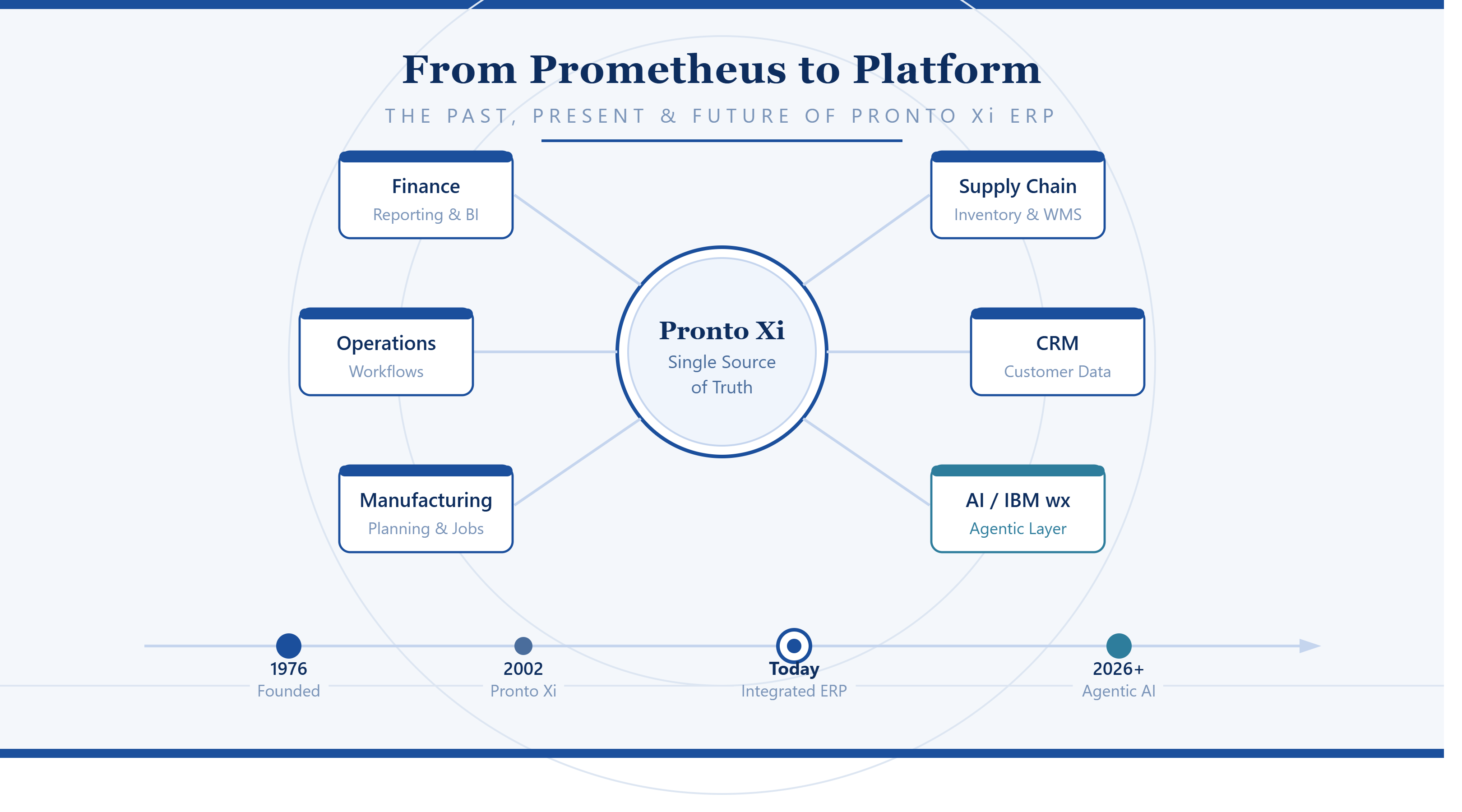
From Prometheus to Platform: The Past, Present, and Future of Pronto Xi ERP
What does it take for a software company to survive and thrive through five decades of technological change?
The Past: Built in Australia, for Australia
The story of Pronto Xi begins not with a venture capital pitch or a Silicon Valley garage, but in Sydney in 1976, under the name Prometheus Software Development. At a time when most businesses still ran their operations on paper, Prometheus was already asking a provocative question: what if all your business data lived in one place?
That question proved durable. The company changed hands in 1999 and was acquired by Sausage Software, before being brought back through a management buyout in 2002, when it re-emerged as Pronto Software. Across each transition, the core product continued to evolve steadily, with major milestones including Phase 5 in 2006, Phase 6 in 2009, and Pronto Xi Dimensions in 2011. Each iteration expanded its footprint across financials, supply chain, manufacturing, retail, and CRM.
What stands out is not the software’s age, but its staying power. More than 1,500 businesses across Australia and beyond have used Pronto Xi for years, with some relying on it for decades. In a market filled with ERP implementations that promised broad transformation but delivered complexity, that level of long-term adoption is significant.
The Present: One System to Run a Business
This is where things become more practical.
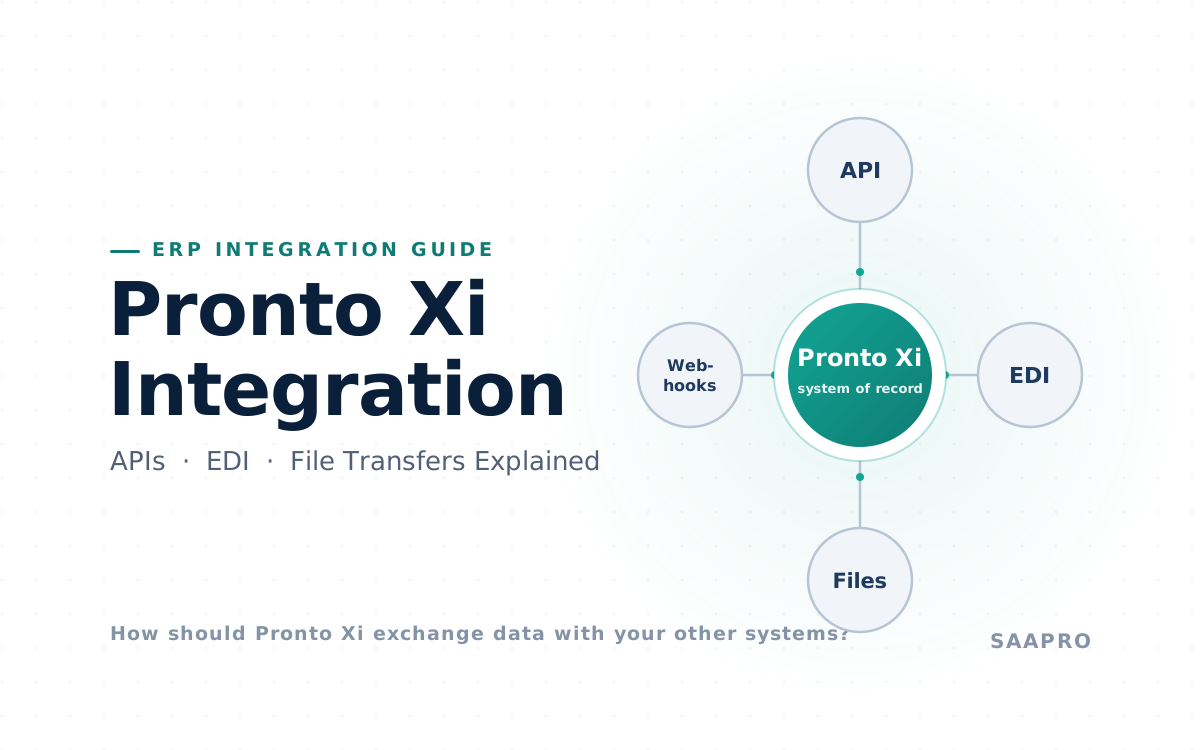
Today, Pronto Xi is a fully integrated, end-to-end ERP platform that connects finance, operations, supply chain, workforce management, and business intelligence into a single system of record. For mid-market Australian businesses, this is not a matter of terminology. It is the difference between disconnected departments and an organisation operating on shared, consistent information.
The operational impact is tangible. When a purchase order moves through to inventory and updates financial records, and those changes are reflected in business intelligence dashboards without manual re-entry, the result is fewer data errors and less duplication of effort. Pronto Xi’s automation reduces manual processing and narrows the gap between operational activity and management visibility.
The platform's built-in business intelligence layer, powered by IBM Cognos Analytics, allows non-technical users to create their own reports and dashboards across the organisation. This represents an important shift in how decisions are made, with less dependence on IT teams for routine reporting.
Pronto Xi is designed to be flexible in deployment, supporting on-premises, hosted, and SaaS models. Organisations can choose the option that aligns with their infrastructure, risk profile, and growth plans. For businesses that have built their processes around the platform over time, this continuity is a key consideration.
Unlike larger ERP platforms that often require extensive consulting to configure, Pronto Xi uses a modular design that allows organisations to implement what they need first and expand over time. The system is designed to scale with the organisation rather than forcing the organisation to adapt to it.
The Future: Agentic AI and the Intelligent Enterprise
The next chapter is already taking shape, and it is ambitious.
Pronto Software has partnered with IBM Australia to embed agentic AI capabilities into Pronto Xi via IBM's watsonx platform. This isn't AI as a bolt-on feature or a chatbot bolted to the side of a legacy system. It's AI woven into the operational core: autonomous decision-making, predictive analytics, and intelligent workflow automation running inside the ERP itself.
The implications are significant. Demand forecasting becomes more adaptive, drawing directly on historical and real-time data. Anomaly detection helps identify issues earlier in the operational cycle, before they escalate. Intelligent scheduling improves the allocation of manufacturing resources as conditions change. A virtual assistant allows users to query business data in natural language, providing answers in real time.
Pronto takes a governance-first approach to this development. Each AI capability is designed with explainability, auditability, and compliance controls built in from the outset. For Australian businesses operating under data sovereignty requirements, this is a core design consideration rather than an afterthought.
The Question Worth Sitting With
Most ERP conversations focus on features, price points, and implementation timelines. But the more interesting question is this: in a world where AI can increasingly automate decisions, what is the role of an ERP system?
Pronto Xi is increasingly positioned not only as a system of record, but as a system of intelligence. It moves beyond recording what has happened to helping organisations anticipate what may come next and respond to issues earlier.
For a product born in 1976, that's a remarkably forward-facing answer.
Match the support to the work
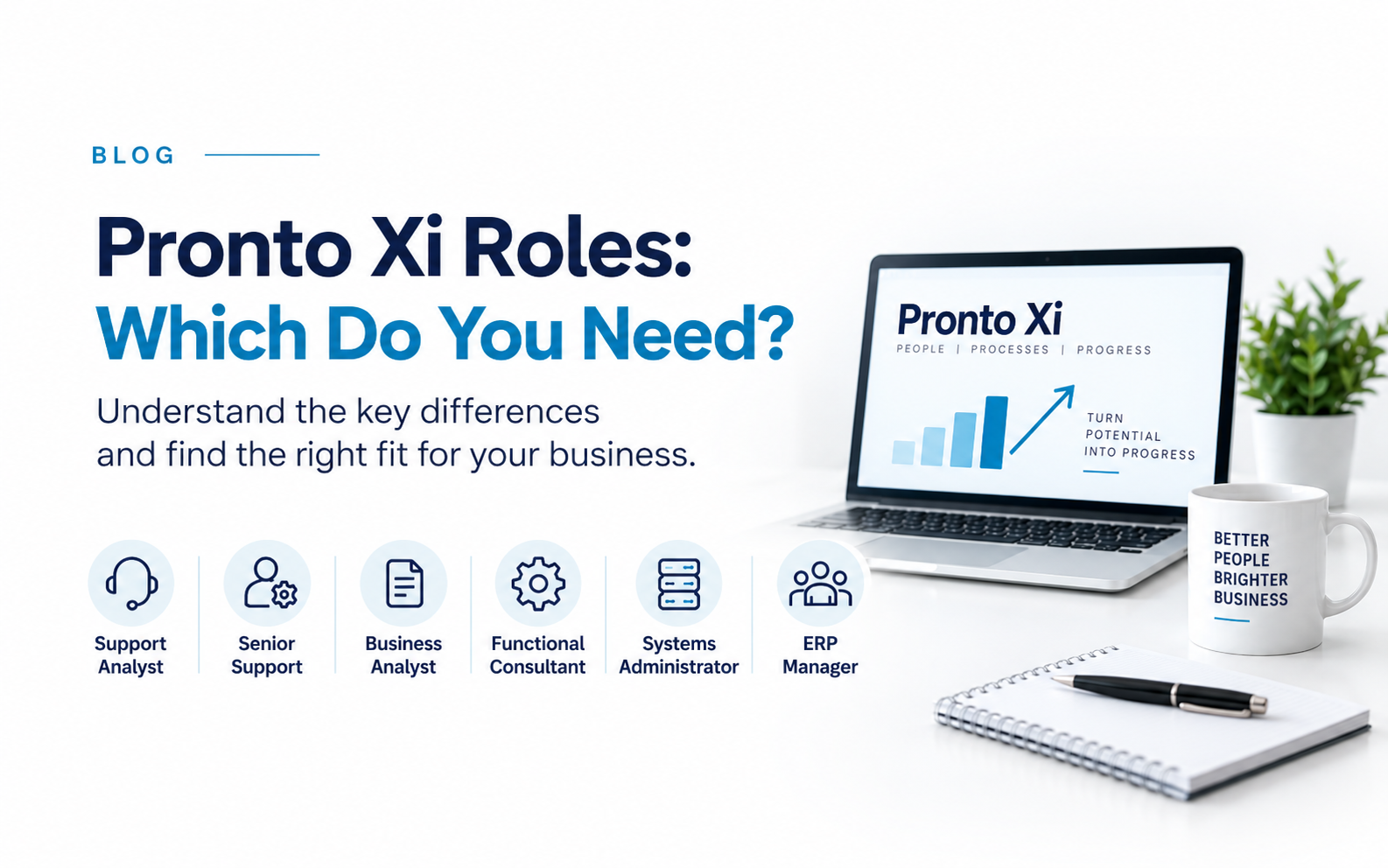
If you want to explore AI around Pronto Xi, look for business-analysis capability that can choose a use case and test the data behind it. If reporting still depends on IT, look for Cognos capability that can move routine reports into self-service. If you are reconsidering deployment, look for Pronto technical capability that understands each hosting model. For how these skills map to roles, see the Pronto Xi roles guide.
Talk to SAAPRO about the Pronto skills needed to get more from the platform today and prepare for what comes next. Bring the processes you want to improve and the AI or reporting ideas you are weighing.
Pronto Xi is developed by Pronto Software, an Australian-owned company headquartered in Melbourne.
Frequently Asked Questions
Pronto Xi is an Australian-developed enterprise resource planning (ERP) system that integrates core business functions such as finance, supply chain, manufacturing, operations, workforce management, and business intelligence into a single platform. It enables organisations to operate on a unified system of record, improving data consistency, reducing manual processes, and supporting more efficient decision-making across departments.
Manufacturing, Retail, Supply chain / logistics, Distribution, Mining, Assets Management
Finance, Operations, Supply chain management, Workforce management, Business intelligence (powered by IBM Cognos Analytics), CRM (customer relationship management), Manufacturing and retail capabilities (as part of its operational suite)
It is not exclusively cloud-based. Pronto Xi supports multiple deployment models:
On-premises, Hosted environments, SaaS (cloud-based option).
So it is a hybrid-deployment ERP system, allowing organisations to choose what suits their infrastructure and strategy.
Key Takeaways
- ✓Pronto Xi originated in Australia in 1976 and has evolved into a long-standing ERP platform
- ✓Used by 1,500+ organisations across multiple industries
- ✓Provides an integrated system covering finance, supply chain, operations, and BI
- ✓Reduces manual processes through automation and improves data consistency
- ✓Supports on-premises, hosted, and SaaS deployment models
- ✓Integrates IBM Cognos Analytics for self-service reporting
- ✓Evolving toward agentic AI through IBM watsonx integration
- ✓Positioned as a system of record and increasingly a system of intelligence